The global crisis of democracy is the logical and inevitable outcome of a system in which individual freedom always loses to the “will of the people.” How can we protect the individual from democracy and restore his genuine freedom? What scenarios for the transformation of democracy are possible under modern conditions?
The crisis of democracy is no longer confined to closed-door academic and political summits; having made its way into the media, it has become evident to every thinking person. Since the mid-2020s, nearly all scholars, experts, and analysts in the fields of politics, economics, human rights, and systems of governance have been speaking openly about this. This applies not only to authoritarian and hybrid regimes, but also to developed countries. Because today, old legal and economic models and systems are breaking down, and institutions that were considered global benchmarks after World War II are becoming increasingly fragile.
The beacons of Western civilization, where freedom is the core value and which for decades have served as a guide for transition and developing countries, no longer point the way to a safe and optimal path toward well-being and prosperity. What, then, is the reason for these processes?
L"Concerns about the health of democracy in the U.S. are not a new phenomenon; our democratic institutions have been tested before. Nevertheless, the current threats to our system of governance are acute. The health and future of U.S. democracy is of deep concern around the world and here at home, including to both Republicans and Democrats."L
According to estimates by the V-Dem Institute at the University of Gothenburg — one of the world’s most authoritative organizations studying democracy — as outlined in a report released in March 2026, the level of democracy worldwide has fallen to levels seen in 1978.
L"The gains of the ‘third wave of democratization’, starting in 1974 in Portugal, are almost eradicated. The level of democracy for the average citizen in Western Europe and North America is at its lowest level in over 50 years, primarily due to ongoing autocratization in the USA."L
FOR THE FIRST TIME IN MORE THAN 50 YEARS, THE UNITED STATES IS LOSING ITS STATUS AS A LIBERAL DEMOCRACY.
According to the V-Dem Institute, as of early 2026, there are 92 autocracies and 87 democracies worldwide. 74% of the world's population (~6 billion) lives in autocracies while only 6% of the world's population (600 million) lives in liberal democracies. More people live in closed autocracies (2.3 billion people, or 28% of the world’s population) than in electoral and liberal democracies (2.2 billion people, or 26% of the world’s population). History has never seen such an intense and rapidly unfolding wave of autocratization. A record 3.4 billion people (41% of the world's population) live in countries on the path to autocracy. These include seven EU member states, as well as the United Kingdom and the United States.
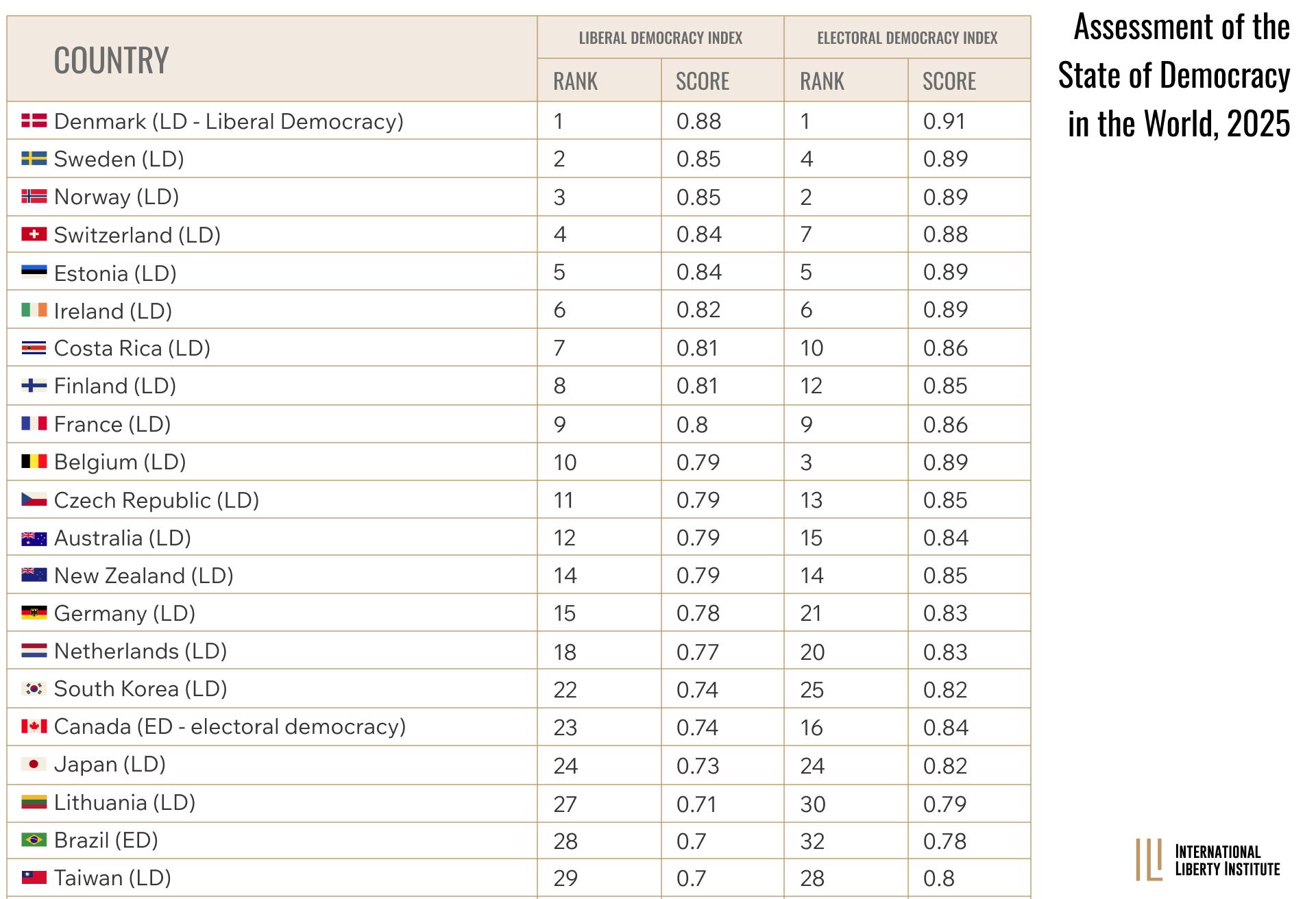
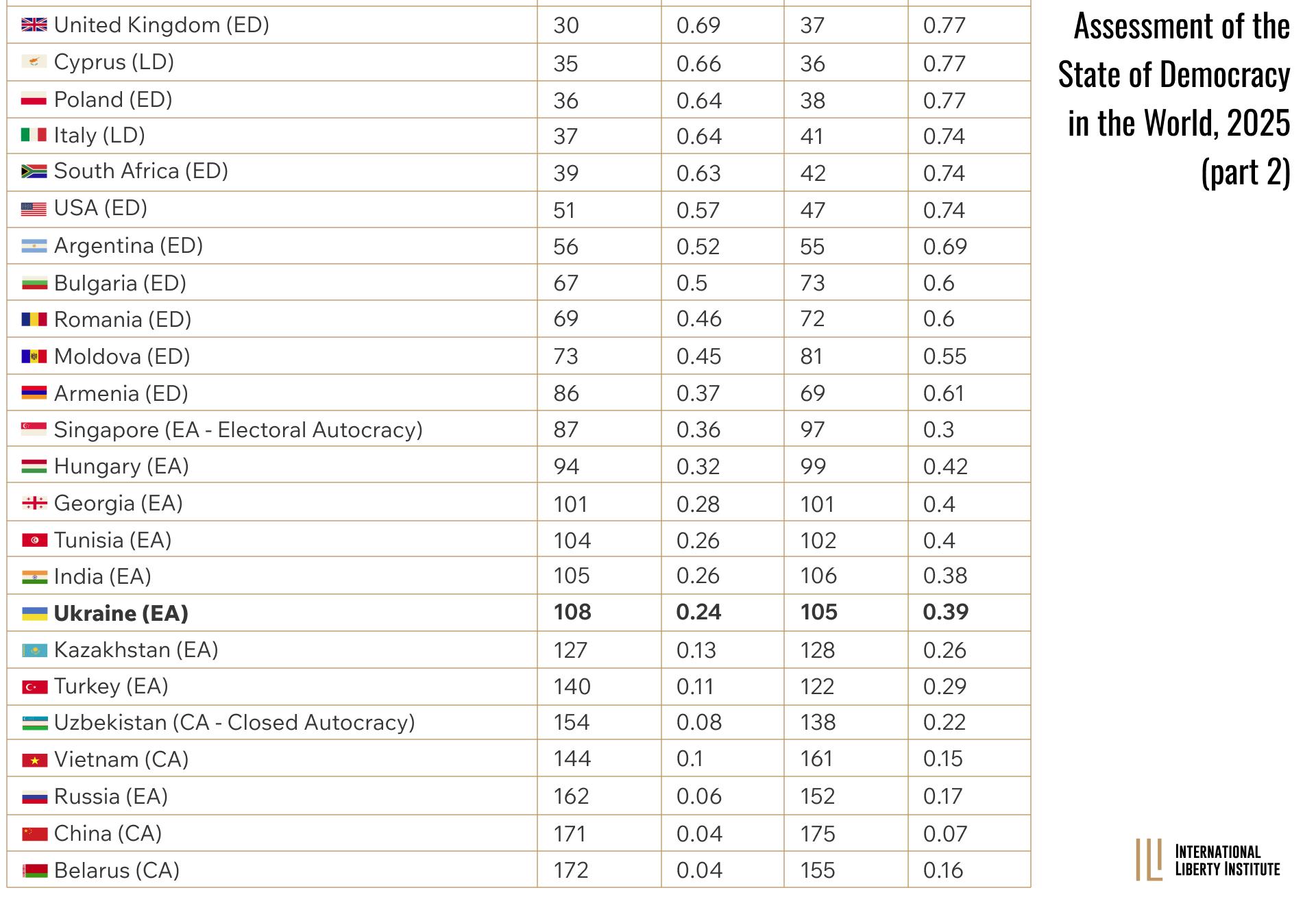
In its report “The Global State of Democracy 2025: Democracy on the Move”, International IDEA assesses the state of democracy based on four groups of factors:
representation;
rights;
the rule of law;
citizen participation.
Each category includes indicators such as fair elections or the independence of the judiciary.
L"Global patterns show that democracy around the world continues to weaken. In 2024, 94 countries—representing 54% of all countries assessed — suffered a decline in at least one factor of democratic performance compared with their performance five years earlier. In contrast, only 55 countries (32%) advanced in at least one factor over that period"L
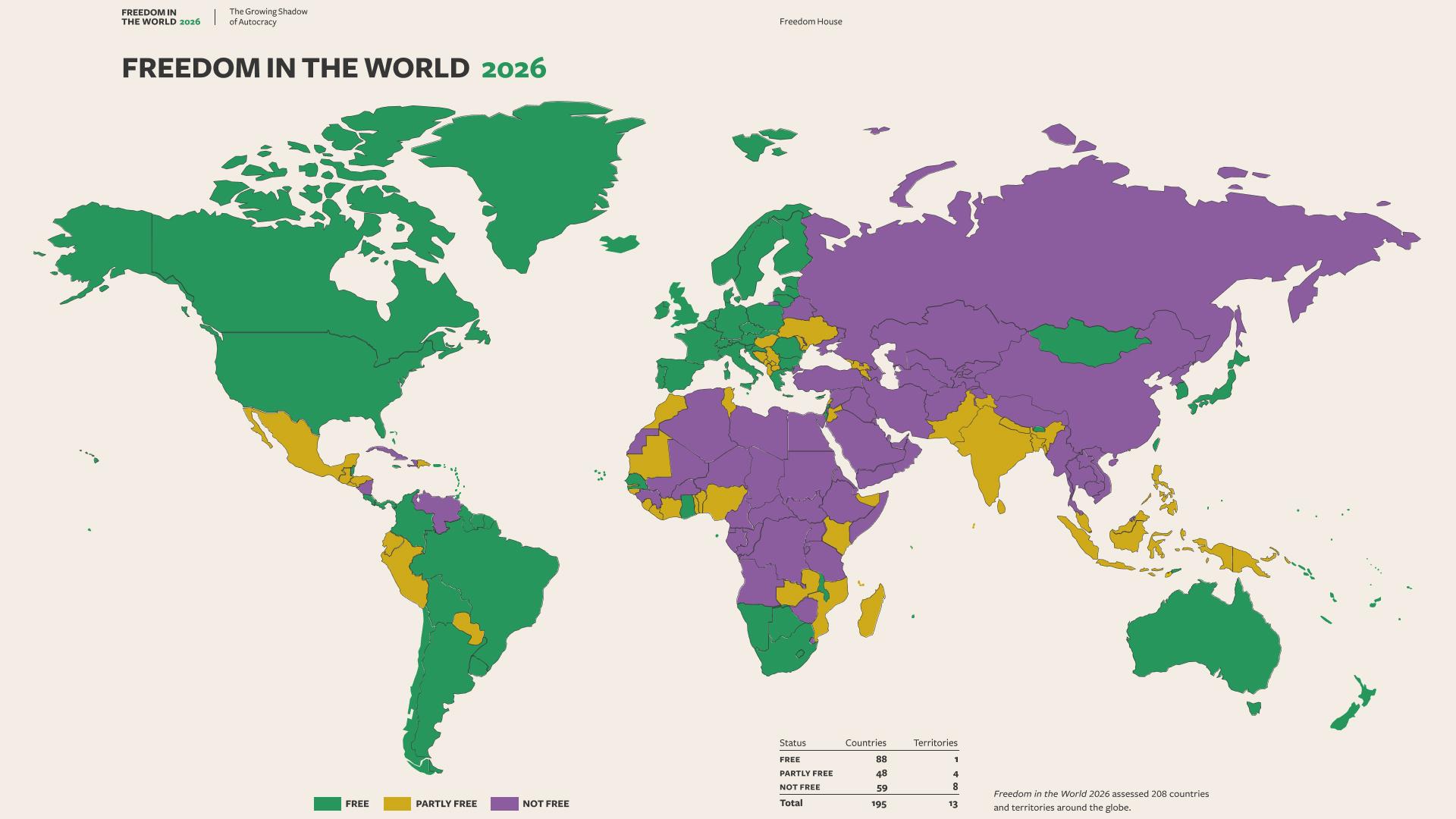
Freedom House addresses the deterioration of political rights and civil liberties — which are integral to democracy — in its report “Freedom in the World 2026: The Growing Shadow of Autocracy
L"Global freedom declined for the 20th consecutive year in 2025. A total of 54 countries experienced deterioration in their political rights and civil liberties during the year, while only 35 countries registered improvements"L
Of the 87 countries rated FREE in 2005, 76 (over 85%) remained FREE as of 2026. This conclusion is based on an assessment of 195 countries and 13 territories across 25 indicators.
39% of the world's population lives in 48 partly free countries;
40% of the world’s population lives in 59 countries that are not free;
21% of the world's population lives in 88 free countries.
Africa (1.5 billion people, 54 countries): 57% live in unfree countries, 33% in partly free countries, and only 10% in free countries.
America (population of two continents: 1 billion people across 36 countries): 72% live in free countries, 22% in partly free countries, and 6% in unfree countries.
Asia-Pacific region (4.3 billion people, 39 countries): 40% live in unfree countries, 54% in partly free countries, and only 6% in free countries.
Eurasia (295.8 million people, 12 countries): 84% of the population lives in non-free countries, 16% in partly free countries, and there are no free countries in this region of the world.
Middle East (288.1 million people, 13 countries): 91% of the population lives in unfree countries, 6% in partly free countries, and only 3% in free countries.
Europe (637 million people, 42 countries): 83% of the population lives in free countries, 4% in partly free countries, and 13% in unfree countries.
L"Although many rights and liberties have been diminished over the last two decades, media freedom, freedom of personal expression, and due process have suffered the heaviest impacts. Coups, armed conflicts, attacks on democratic institutions by elected leaders, and intensified repression by authoritarian regimes have been the main drivers of deterioration during this 20-year period"L
What was once a united group of free, democratic nations, speaking with one voice to champion the values and institutions of liberal democracy, has fallen apart, and the transatlantic partnership has failed to withstand the trials of the Russian-Ukrainian, Iranian-American, and Iranian-Israeli conflicts, as well as the “green” DEI/ESG agenda.
ILLIBERAL DEMOCRACIES — A NEW TREND IN GLOBAL SOCIETY
Western countries, which have traditionally been regarded as the embodiment of liberal democracy (EU member states, G-7 countries, and NATO), have significantly reduced the resources allocated to promoting their fundamental values around the world.
Against the backdrop of economic stagnation in most EU member states, the extravagant foreign, trade, and industrial policies of the United States, the dynamic development of totalitarian China and fascist Russia, and the Indian balance of interests among over 100 countries worldwide — which is sliding toward authoritarianism — the balance has shifted in favor of undemocratic, authoritarian legal and socio-economic models. Many refer to them as illiberal democracies (illiberal democracy).
The term “illiberalism” has become part of contemporary philosophical and political-economic discourse to describe the hybrid models and institutions that have emerged over the past 25 years. This is a political and legal system in which the balance of powers is tilted in favor of the executive branch, and in favor of the sovereignty of the nation-state over supranational institutions and international law.
It emphasizes traditional values and rejects multiculturalism, the demands of various social groups, and state intervention in the economy, particularly in innovation, industrial, and trade policy.
“Illiberalism” has become yet another form of the model of a state characterized by widespread interventionism. At the same time, left-wing intellectuals use it to impose their interpretation of what they claim is true liberalism, in which, paradoxically, the state plays an even greater role in the economy.
In the aforementioned report on the state of freedom in the world, Freedom House experts emphasize:
L"It is important to note that conditions for freedom dramatically changed not only within many countries, but also at the global level, as a growing number of authoritarian regimes banded together to undermine civil society groups, international institutions, and election monitoring in a campaign to make the world safer for autocracy. Although wealthy democracies like the United States and member states of the European Union (EU) had long battled against these efforts, many have now pivoted significantly away from their traditional activities, like foreign aid programs designed to uphold and advance political rights and civil liberties. The consequences of these changes will continue to reverberate worldwide"L
THE CRISIS OF DEMOCRACY IS A COMMON FEATURE OF THE MODERN WORLD
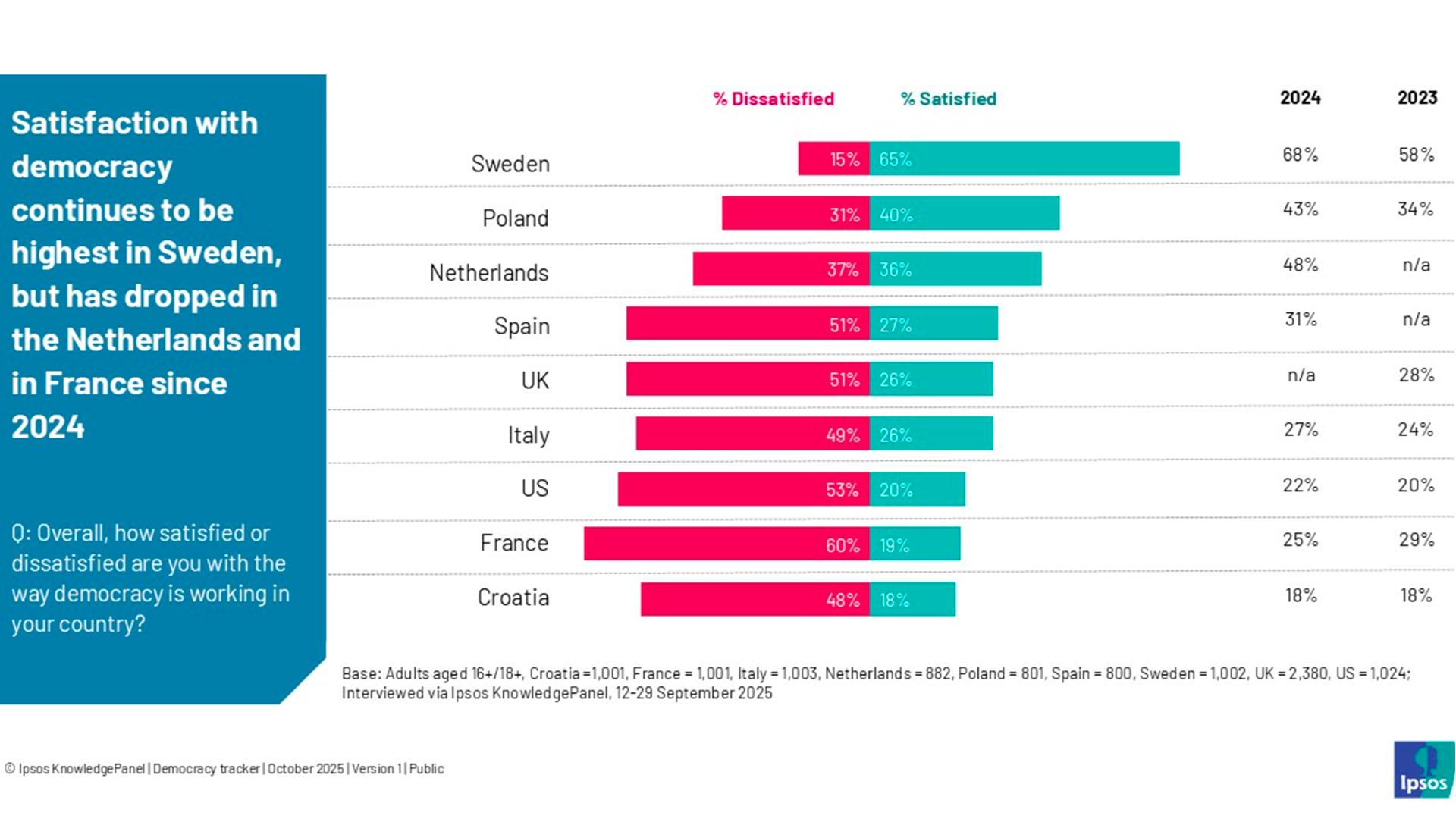
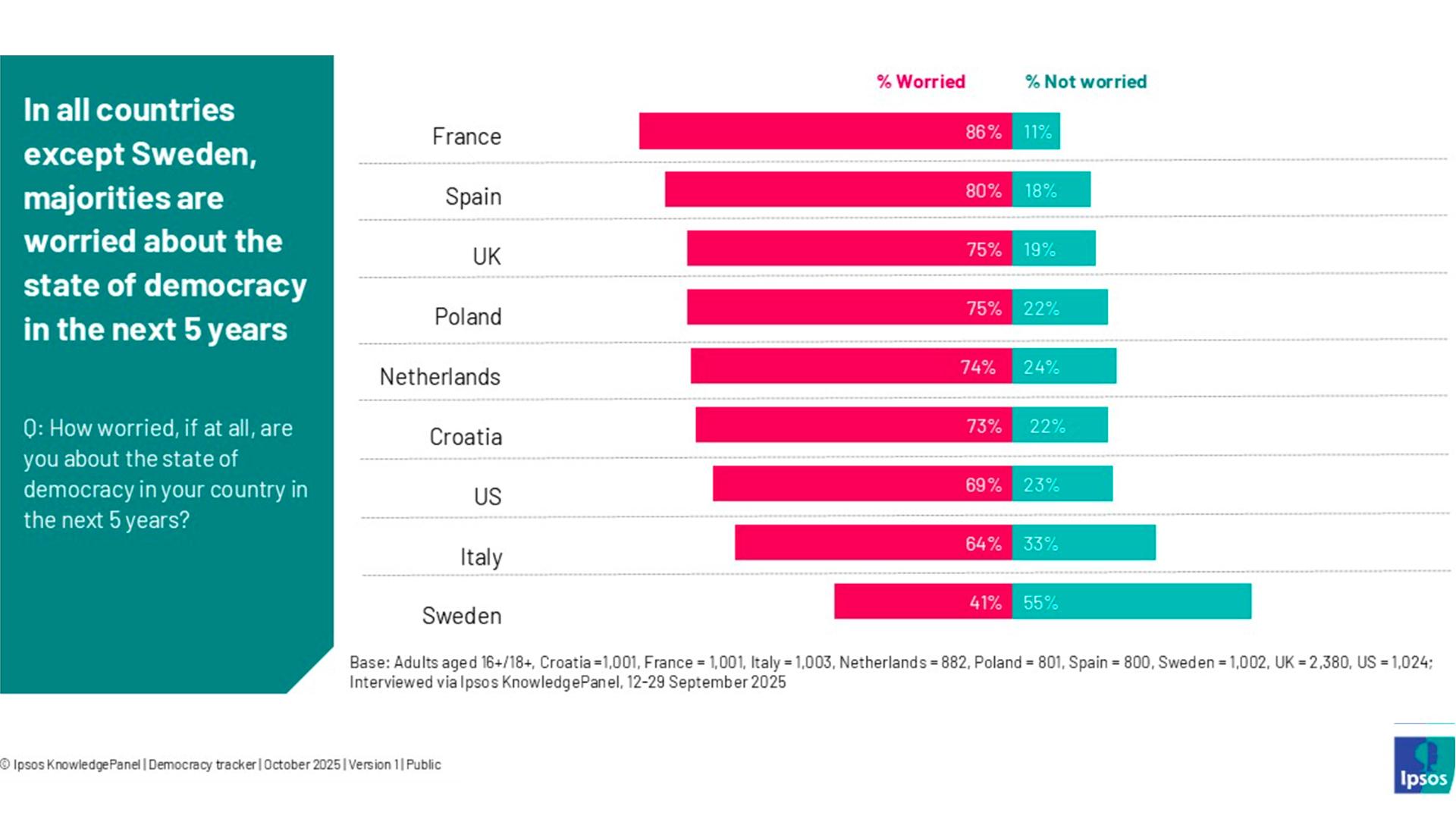
According to Ipsos KnowledgePanel, satisfaction with the functioning of democracy remains low. Among the EU member states surveyed in 2024, Sweden is the only one where the number of citizens satisfied with the functioning of democracy significantly exceeds those who are dissatisfied — 65% versus 15%. In other countries, the survey reveals a consistent trend of satisfaction with the state of democracy and concern about its prospects five years from now.
Sweden is the only exception; in most of the EU member states surveyed, the majority of citizens are concerned about the state of democracy five years from now.
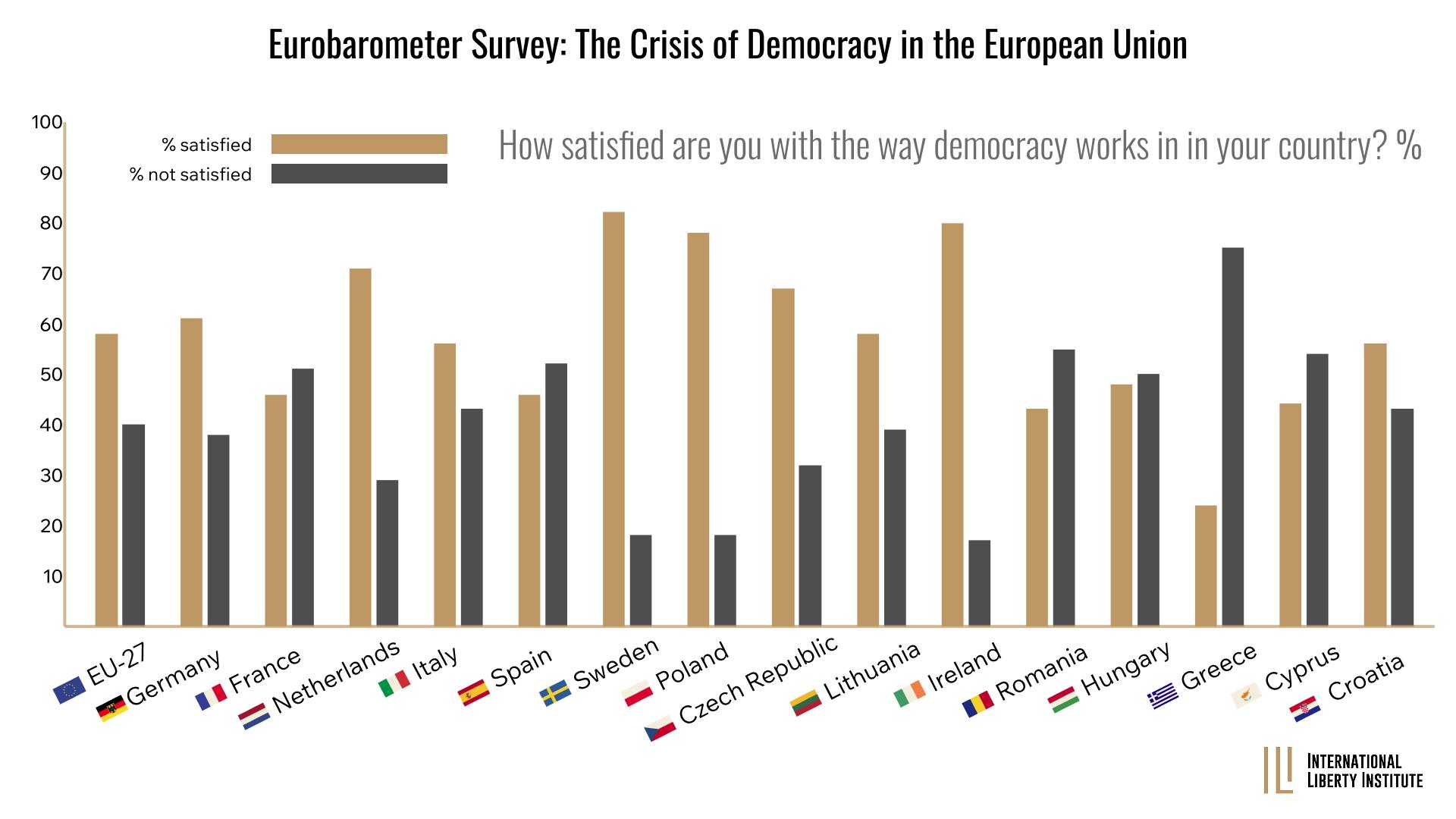
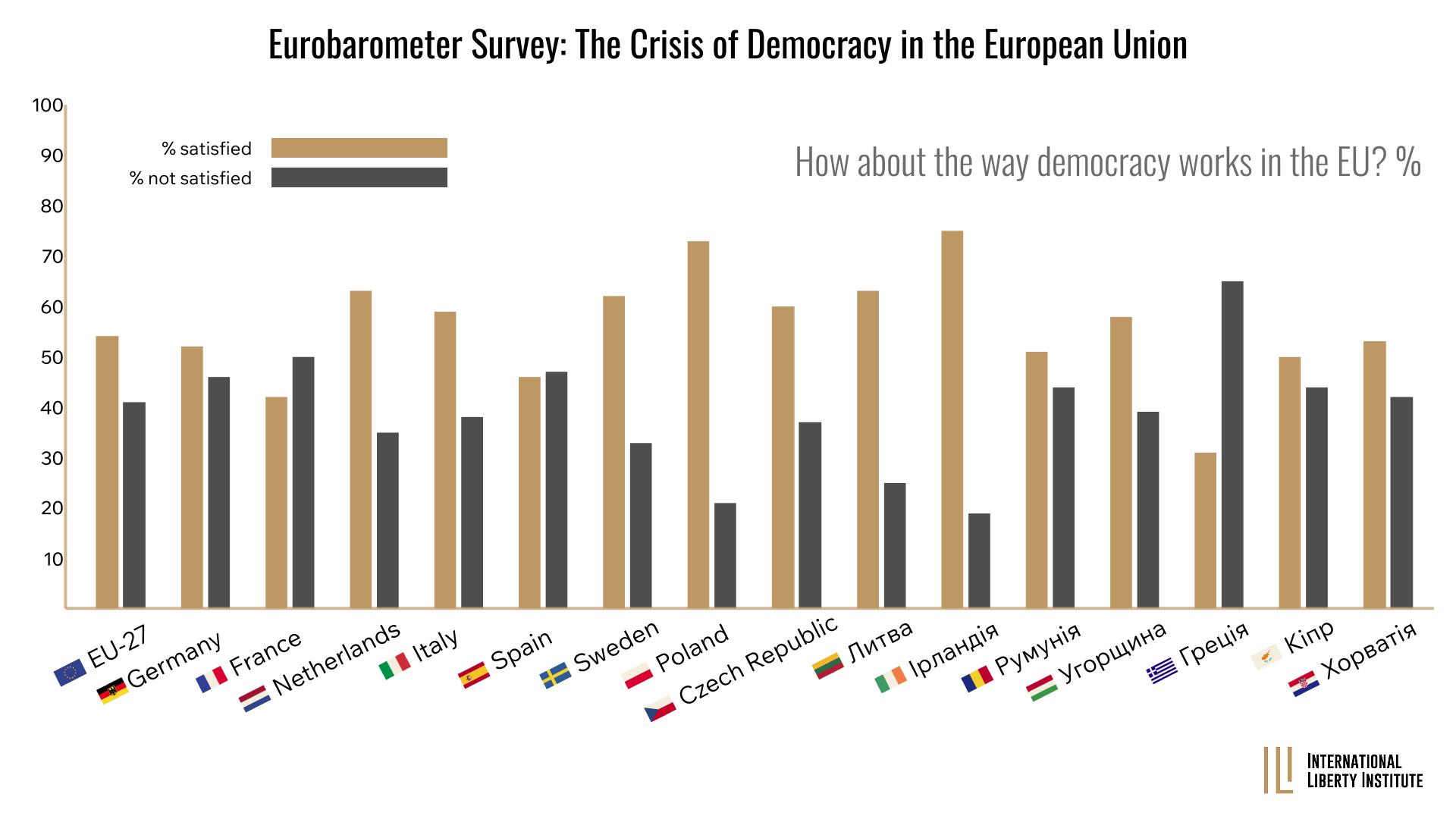
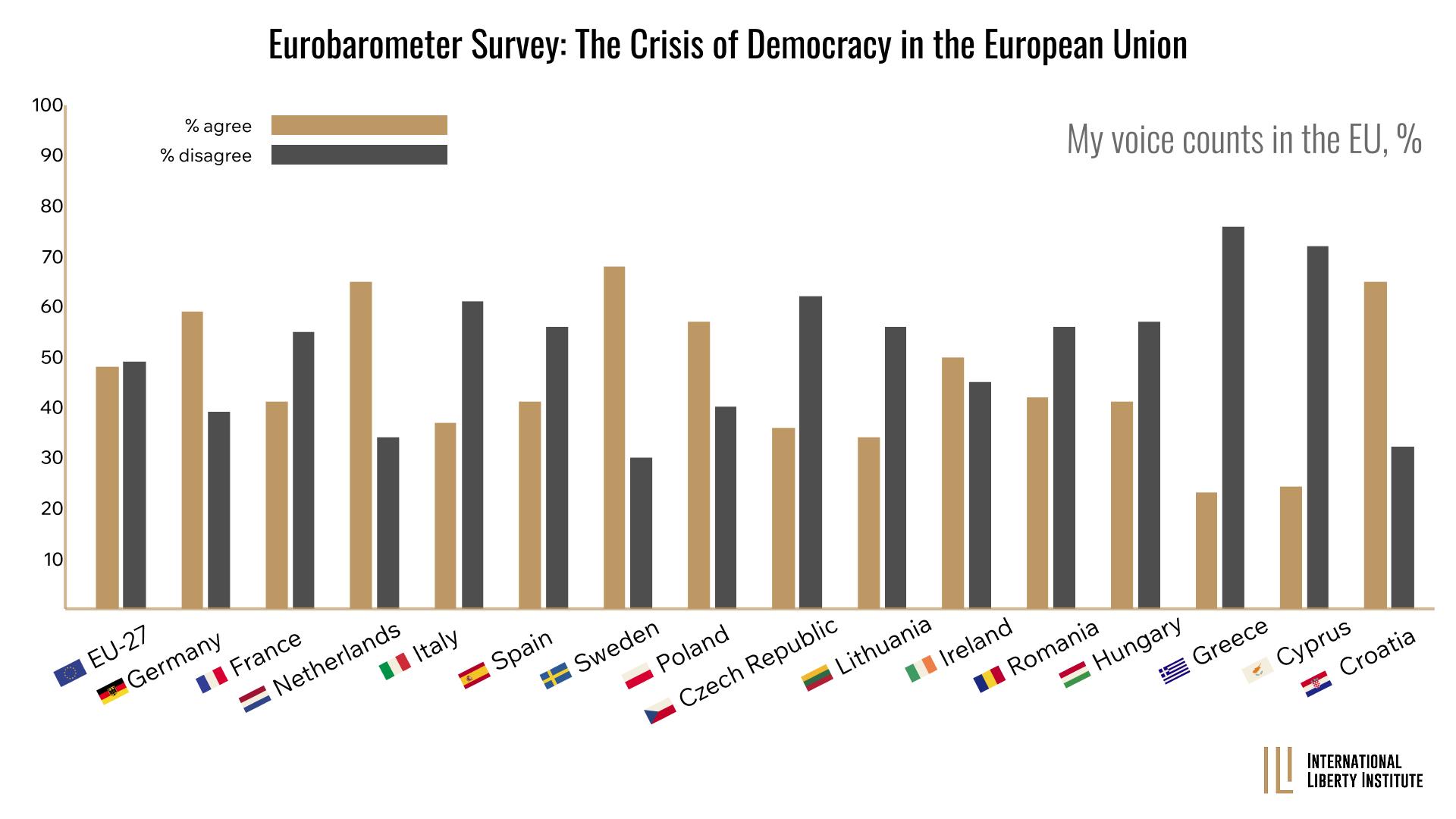
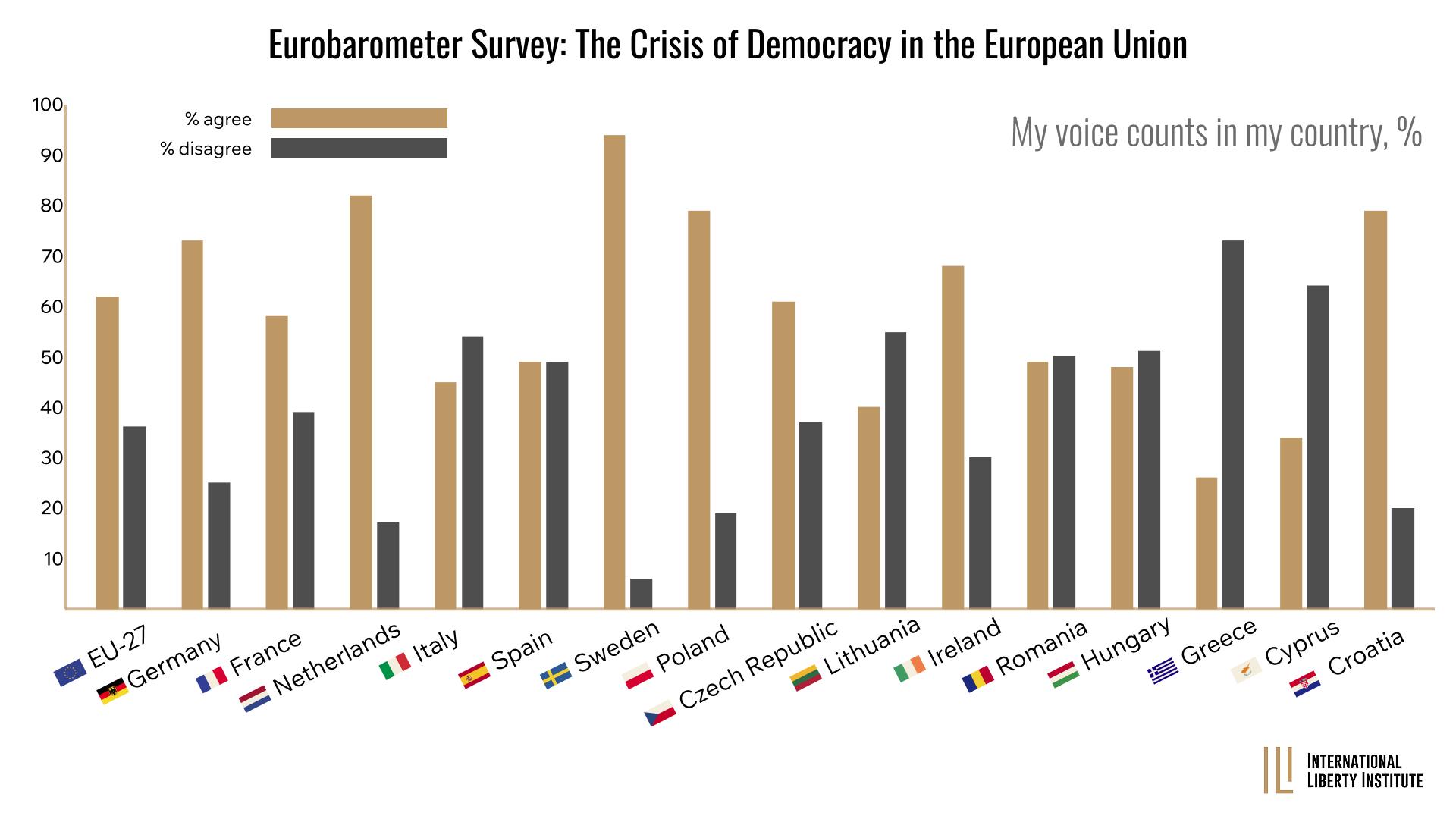
Eurobarometer survey data, published in February 2026, confirm the existence of a crisis of democracy in the European Union.
The high level of alienation citizens feel from the national decision-making process is reflected in EU residents’ responses to the question: “Does my voice matter in my country?” The highest proportion of such people is found among Greeks — 73%; moreover, 76% of the country's residents believe their vote carries no weight at EU level. Overall, an increasing number of EU citizens feel alienated from the decision-making process at the supranational level within the European Union, including 72% of Cypriots, 53% of Belgians, 55% of the French, 62% of the Czechs, 65% of the Latvians, and 56% of the Spaniards.
Overall, 49% of citizens in the United Europe-27 believe that their voice at the EU level is not significant.
A CLEAR MANIFESTATION OF THE CRISIS OF DEMOCRACY IS THE CRISIS OF TRUST, PRIMARILY DUE TO THE VERY LOW LEVEL OF TRUST IN THE GOVERNMENT, THE STATE, AND ITS BRANCHES OF GOVERNMENT.
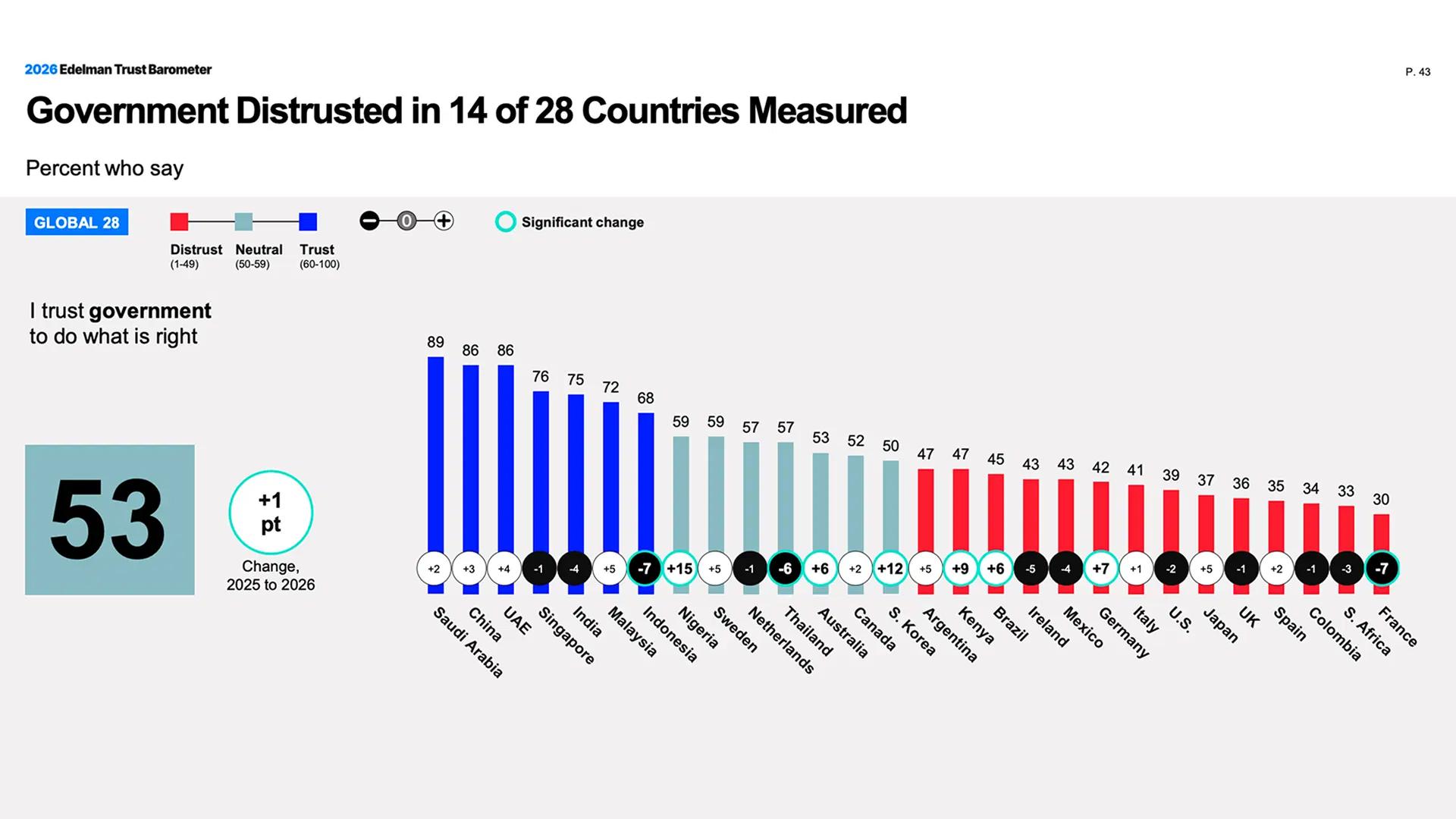
According to the Edelman Trust Institute, in 2026, among key institutions (the media, business, and NGOs), the level of trust in the government is the lowest. Overall, 53% trust it, which is close to the threshold of distrust.
The highest levels of trust in the government are found in Saudi Arabia (89%), China (86%), the UAE (86%), Singapore (76%), and India (72%).
Sweden (59%), Australia (53%), Canada (52%), and South Korea (50%) fell within the neutral zone.
The countries where public distrust of the government is high include Brazil (45%), Ireland (43%), Germany (42%), Italy (41%), the United States (39%), Japan (37%), the United Kingdom (36%), Spain (35%), South Africa (33%), and France (30%).
It should be noted that the countries with the highest levels of trust are not free or democratic. At best, they are hybrid regimes.
The crisis of trust is also highlighted by the results of the European Commission’s “Eurobarometer 104” survey (October–November 2025).
When asked whether they tend to trust or distrust their national government, 63% of respondents across the EU-27 tend to distrust it, while 33% tend to trust it %.
By country: in Germany, in the fall of 2025, 40% trusted their government and 55% did not; in France, 9% trusted the government and 86% did not; in Spain, the ratio was 28% to 68%; in Greece, 19% to 79%; and in Poland, 45% to 49%.
Of all EU member states, Denmark is the only one where the number of people who trust the national government exceeds those who do not — 53% versus 42% — as well as Portugal — 49% and 47% — and Luxembourg — 71% and 24%. A crisis of trust in the national government is evident in the United Kingdom: 25% trust the government and 70% do not; in Turkey, where democracy has serious flaws, 59% trust the government and 40% do not.
Trust in the national parliament is also at a critically low level. Across the EU as a whole, in the fall of 2025, 34% tended to trust their national parliaments, while 61% did not. In Germany, 44% trusted it and 50% did not; in France, 12% trusted it and 80% did not; in Italy, 41% trusted it and 56% did not; in Spain, 23% trusted it and 71% did not; in Poland, 32% trusted and 67% did not, and in Greece, 20% trusted versus 78%.
Trust in the national parliament exceeds distrust only in Sweden (63% vs. 34%), Finland (60% vs. 35%), Austria (56% vs. 39%), Luxembourg (60% vs. 26%), and Denmark (66% vs. 31%).
The UK is also following the EU's pattern. In the fall of 2025, 27% of the population trusted the national parliament, while 66% did not; in Turkey, a country prone to authoritarianism, 57% trusted it, and 42% did not.
DEMOCRACY, MACROECONOMIC INDICATORS, AND THE SIZE OF THE STATE
The romanticization and idealization of democracy intensified after World War II, when the world was divided into two unequal parts.
The first, much larger in terms of territory and population, was the totalitarian Soviet Union, with dozens of satellite states and countries willing to cooperate with it.
The second, much smaller part of the world, in terms of population and number of countries, was represented by the West. It included the countries of Western Europe, the European Union, the United States, Canada, Australia, New Zealand, Japan, and, since the end of the 20th century, South Korea.
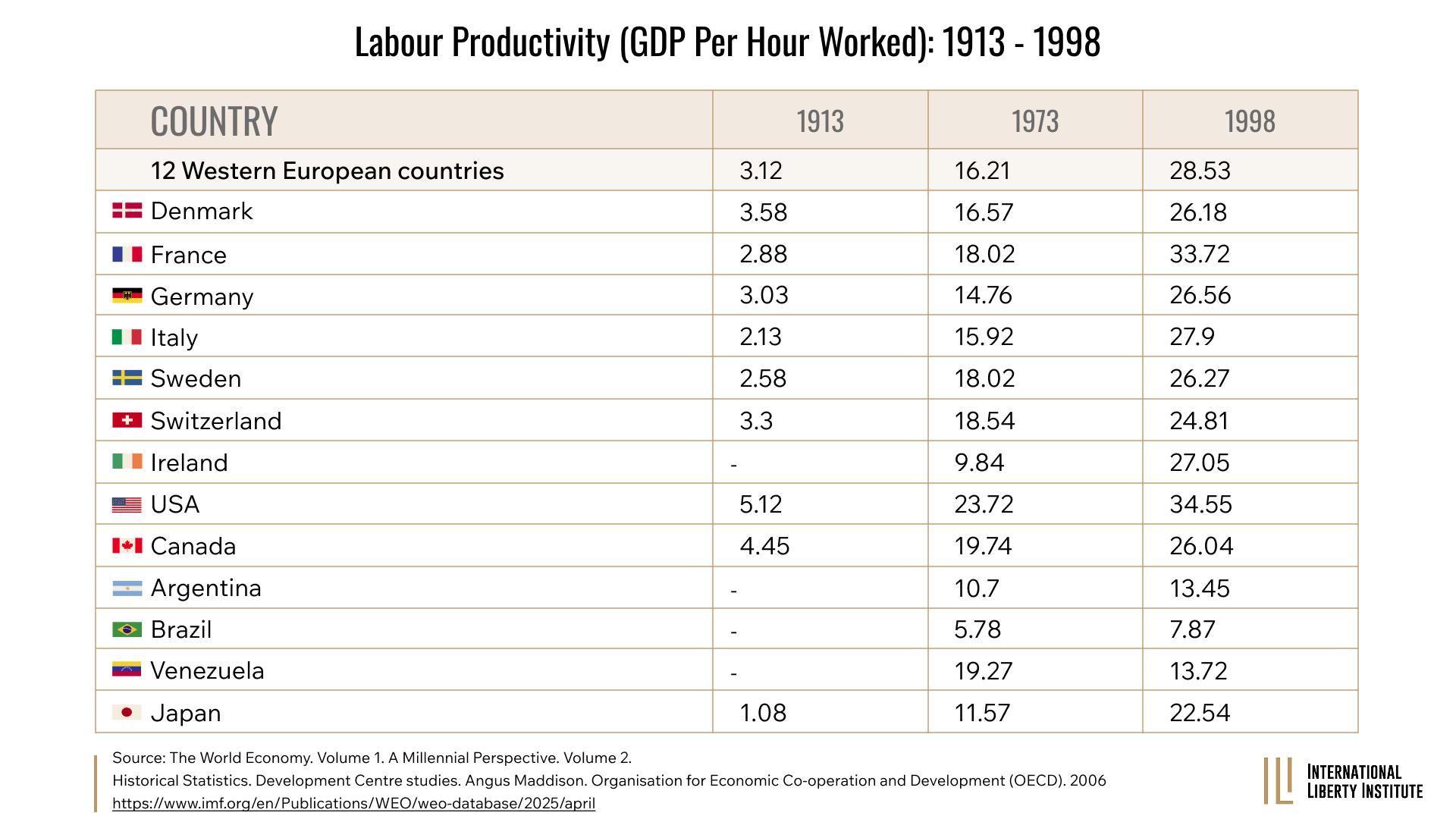
At the same time, income levels, wealth, and quality of life in the West were incomparably higher. The West, as the embodiment of democracy and the free market, has outperformed the non-West not only in terms of economic and financial indicators (GDP per capita, labor productivity, household material well-being, capital stock, market size, purchasing power, monetary stability, export volume, etc.), but also in terms of social indicators (life expectancy, the size of pensions and social transfers, infant mortality, quality of life, etc.).
According to A. Maddison and the Center for the Study of Development in Western Europe, the average life expectancy in 1900 was 46 years, in 1950 it was 67 years, and in 1999 it was 78 years.
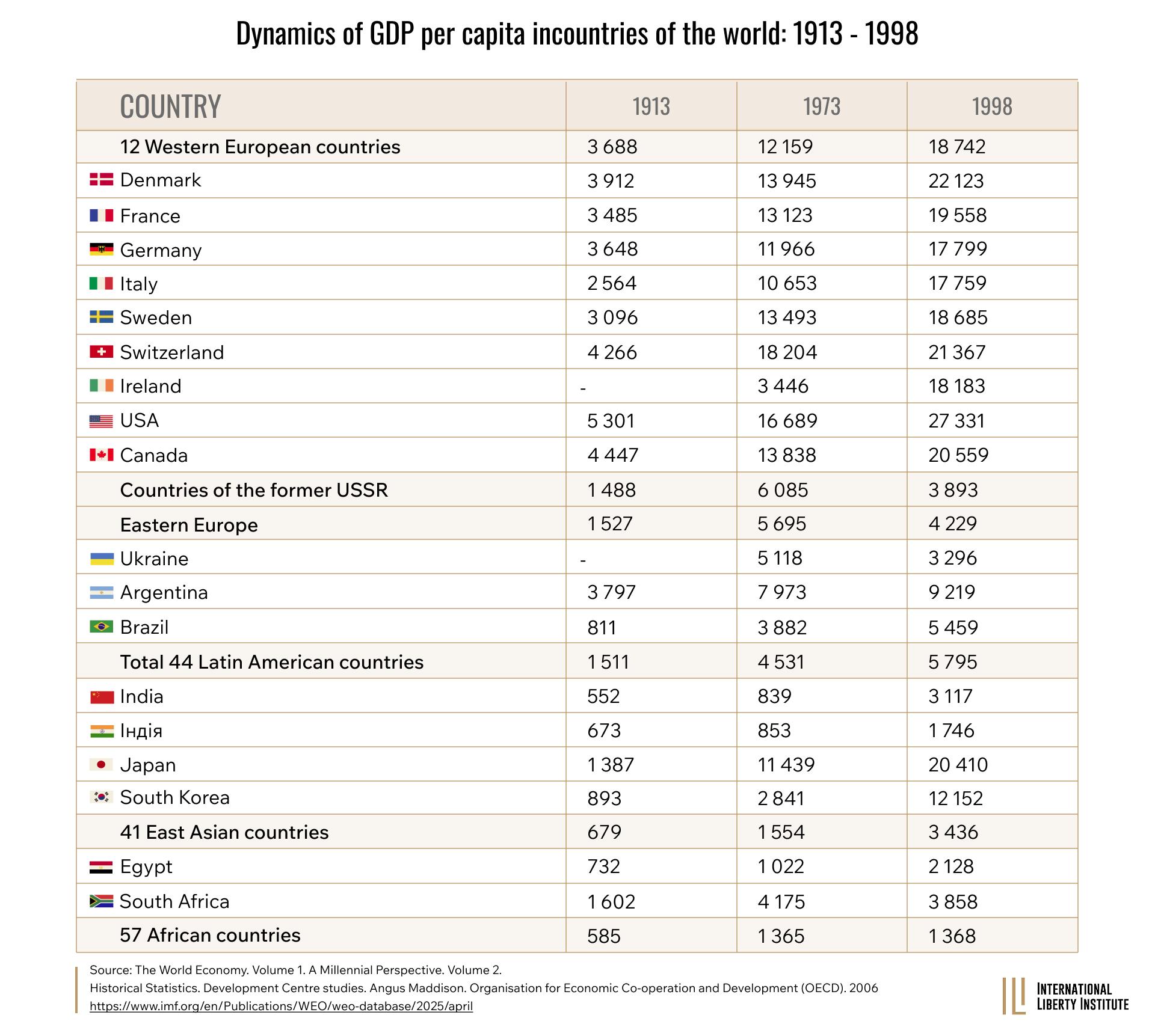
The data shows a correlation between the development of democracy and GDP growth in countries. Let’s compare the figures for the UK, France, and the US with data on per capita wealth growth in China and India. In countries with a severe lack of freedom and democracy, the trend is telling.
In 1913, in 1990 international dollars, the UK’s GDP per capita was $5,150; in 1950, it was $6,907; and in 1998, it was $18,714.
In France, GDP per capita was $3,485 in 1913, $5,270 in 1950, and $19,558 in 1998.
In the United States, per capita GDP was $5,301 in 1913, $9,561 in 1950, and $27,331 in 1998.
By comparison, in countries with a severe lack of freedom and democracy, the trend was quite different.
In China, per capita GDP was $552 in 1913, $439 in 1950, and $3,117 in 1998.
In India, GDP per capita was $673 in 1913, $619 in 1950, and $1,746 in 1998.
Historically unprecedented economic growth, the accumulation of capital and wealth, and an unprecedented improvement in the standard of living for the majority of people—not just the elites—occurred in tandem with transformations in the system of public administration, particularly in Western countries, and with a shift in society’s cultural norms. For example, when the right to vote became universal, technological and technical progress empowered women, allowing them to expand their participation not only in the labor market but also in the systems of government and corporate governance. At the same time, there was a rise in living standards, universal access to secondary education, and widespread access to higher education—which ceased to be the privilege of only the wealthy segment of the population—as well as the expansion of the information landscape (television, newspapers, radio, and later the internet with social media). Migration flows also intensified, and opportunities for travel and tourism increased—all of this coincided with the emergence of a group of high-income countries.
In 1913, Western Europe’s share of global GDP was 33.5%; in 1950, it was 26.3%; and by 1998, it had fallen to 20.6%.
Japan’s share of global GDP was 2.6% in 1913, 3% in 1950, and rose to 7.7% in 1998.
Asia’s share (excluding Japan) of global GDP was 21.9% in 1913, 15.5% in 1950, and 29.5% in 1998.
Africa’s share has remained virtually unchanged: 2.7% of GDP in 1913, 3.6% of GDP in 1950, and 3.1% of GDP in 1998.
The share of Western countries outside Europe in global GDP was 21.7% in 1913, 30.6% in 1950, and 25.1% in 1998%.
According to the World Bank's and OECD’s definition, a country is considered a high-income country if its gross national income per capita is $13,935. In 2025, there were 87 such countries worldwide.
Under current definitions, only three economies would be classified as high-income countries in 1950: Kuwait, Qatar, and the United Arab Emirates.
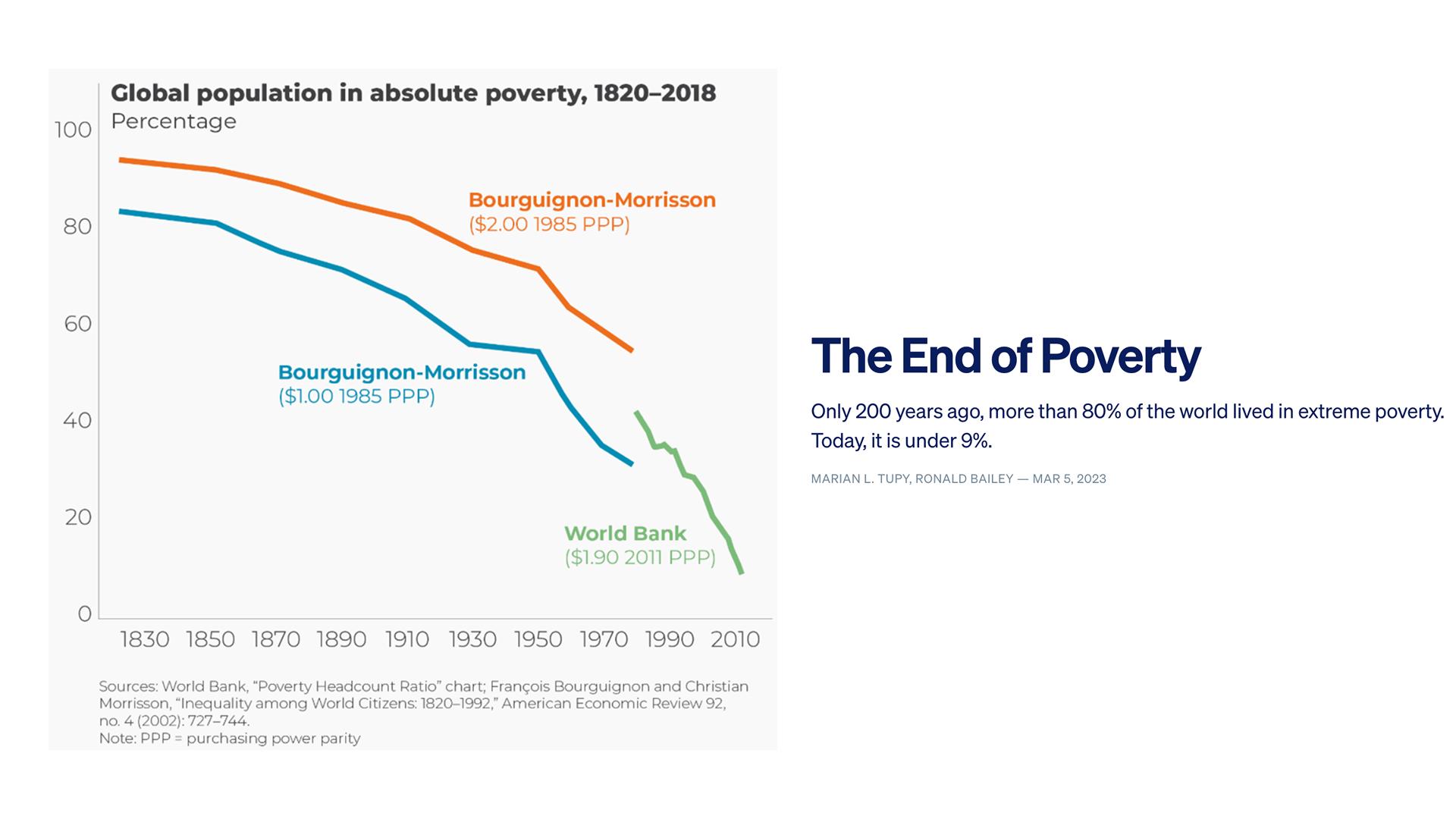
There is no doubt that after World War II, the standard of living rose sharply in both developed and developing countries.
According to estimates by French economists François Bourguignon and Christian Morrisson of the University of Paris, in 1820, approximately 84% of the world’s population lived in extreme poverty (less than $1.90 per person per day).
Source: Bourguignon, François, and Christian Morrisson. 2002. "Inequality Among World Citizens: 1820-1992." American Economic Review 92 (4): 727–744.
According to World Bank data, in 1981, only 42% of the world’s population lived in extreme poverty; by 2018, that figure had fallen to 8.6%. In other words, by the early 2020s, the number of people living in extreme poverty had fallen by 1.5 billion!
The mainstream of the social sciences, as well as academic and intellectual circles—particularly in the West — was quick to attribute this unprecedented historical progress to democracy on the one hand, and to the expansion of the state’s size and functions on the other.
FALSE ASSUMPTIONS OR BOMBS UNDER THE FOUNDATIONS OF DEMOCRACY AND FREEDOM
After World War II, the theory of welfare economics became widely accepted. It was based on the theoretical works of J. M.Keynes and formulated using the Harrod–Domar model, and later the Solow–Swan model and others. A. Pigou (Arthur Pigou, University of Cambridge), A. Bergson (Abram Bergson, Harvard University), J. Hicks (John Hicks, University of Oxford), Tibor Scitovsky (Tibor Scitovsky, University of California, Berkeley), N. Kaldor (Nicholas Kaldor, University of Cambridge)—all of them, together with theorists of the neo-institutional school, rational choice theory, behavioral economics, and game theory, transformed the model of the state of general interventionism into the mainstream of economic science.
Theorists of the “ideological revolution in economic science” have not refuted any of this using valid methodology, verification tools, or proofs of the theorems and postulates of the classical and Austrian schools of economics, or the philosophy of liberalism. They made a declarative, unsubstantiated claim that a new era had dawned, one that required a “new economy” and a new role for the state. To support their hypotheses, theorists and ideologues of the state of universal interventionism cited data on economic growth rates, income trends, life expectancy and quality of life, education, healthcare, research and development, the environment, and so on.
There was a gross manipulation of methodology and facts. Post hoc ergo propter hoc (after this, therefore because of this): ‘after this’ does not mean ‘because of this’.
Theorists and proponents of the model of the state of general interventionism, among the numerous factors influencing economic and social dynamics, pointed to Democracy and to the State, which was gradually becoming the primary economic actor. There has been a significant convergence of both economic indicators (GDP, aggregate demand, aggregate supply, domestic investment, gross savings, etc.) and parameters of the political and legal governance system as a whole, as well as the concept of “democracy” in particular. The very object of state governance has changed significantly—that is, its functions, the scope of resources and assets at its disposal, and the range of tools used to shape the legal, economic, and social frameworks of human activity.
Theorists and ideologues of the Great State have presented the concept of “democracy” as something ideal, optimal, and universal—an indisputable benefit for the country in terms of harmonizing the interests, resources, goals, and objectives of its citizens.
Two hypotheses formed the basis for the expansion of democratic institutions.
The first hypothesis: The collective institution, the concept of the “State” or “Government,” is presented as an objective, infallible, homogeneous, and impersonal institution that is immune to information asymmetry and subjective motivation. The goal is to achieve “sustainable development,” “social harmony,” “social justice,” “the protection of rights and freedoms,” and so on.
The error in this theoretical model arose from the spiritualization of a concept, a metaphor, or a verbal construct. In other words, it cannot objectively act on its own; it cannot make a choice based on a subjective goal-setting process. In reality, however, the only entity that acts with a specific purpose is a person or homo agens. Therefore, building a political, legal, or economic system or model based on the assumption that the state acts or possesses certain objective qualities and parameters amounts to substituting science with mythology or utopia.
The second hypothesis — A free market inevitably leads to market failures. The concept and metaphor of the “market” have been criticized for not being a magic genie that grants every wish, for failing to solve the problem of scarcity, and for either failing to produce certain goods and services or producing and offering them to consumers under conditions that these theorists and ideologues did not consider optimal, fair, or socially desirable.
The theory of market failures stemmed from the theory of perfect competition, a general equilibrium model in which there is hypothetical perfect mobility of all resources and full access to information for all market participants. In other words, the market was deemed a "failure" when compared to an ideal, utopian, fictional model that is impossible in real life. Such methodological fraud has had far-reaching consequences. As the size and scope of the state expanded, the number of so-called market failures increased; and in the 21st century, we have seen not only market failures at the national level, but also at the global level, in the form of environmental threats, epidemiological risks, cyber threats, man-made disasters, water shortages, deforestation, and so on.
Thus, two hypotheses—the allegedly corrupt nature of the market and the supposedly benevolent nature of the State—became a source of the erosion of democracy, transforming its instruments into the expansion of state control over private property, restricting freedom and, ultimately, weakening capitalism and the foundations of Western civilization.
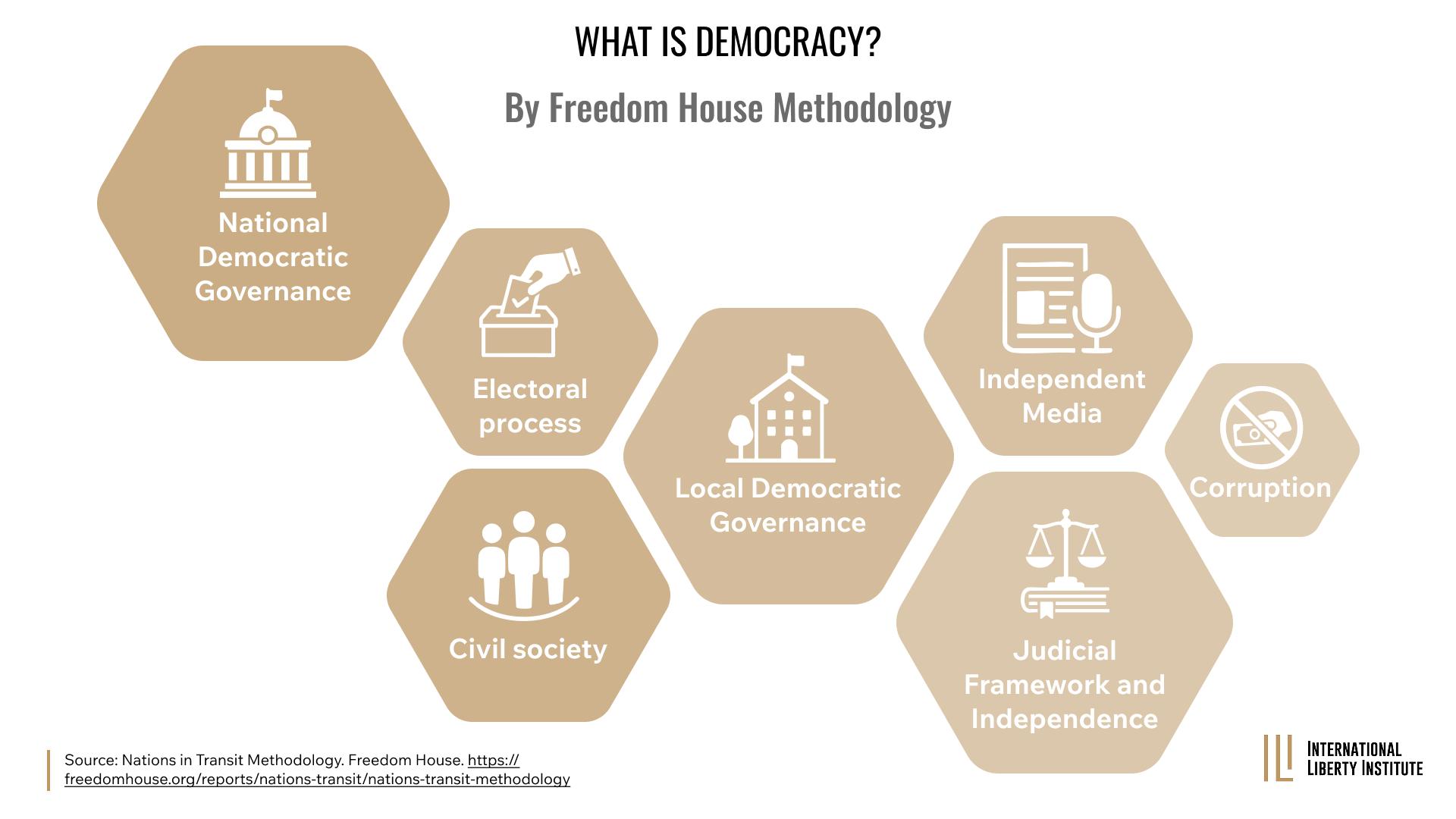
National Democratic Governance (balance of branches of power, effectiveness, accountability, transparency, implementation of separation of powers, independence of the judiciary, etc.);
Electoral process (all stages of local and national elections, functioning of the party system, public participation in the political process);
Civil society (organizational and financial sustainability of the NGO sector, legal and political environment in which it operates, participation of interest groups and lobbyists in government decision-making processes, countering extremism);
Independent Media (press freedom, harassment of journalists, editorial independence, financial viability of private media, functioning of public media);
Local Democratic Governance (distribution of powers and responsibilities between central and local authorities, transparency, and accountability of local authorities);
Judicial Framework and Independence (the protection of citizens' rights and freedoms, the status of ethnic minorities, the guarantee of equality before the law, the treatment of prisoners, and the enforcement of judicial decisions);
Corruption (conflict of interest, public perception of corruption, business interests of policymakers, disclosure laws on the income and assets of politicians and government officials, and effectiveness of anticorruption initiatives).
It is clear that the phenomenon of “democracy” is a complex, polysemous, multi-layered construct comprising hundreds of different indicators, parameters, and states. Moreover, not all of them lend themselves to quantitative assessment, but rather involve evaluative judgments.
Therefore, idealizing democracy in isolation from the concept of the “state,” outside the context of its functions, resources, and place within the system of human activity, constitutes a serious theoretical and methodological error.
Democracy is a set of institutions, mechanisms, organizations, and systems used to implement the principle of “government by the people”.
Greece in the 5th century BCE is one thing; the 21st century is quite another. The concept of “a government of the people or a government on behalf of the people” requires clarification and explanation. Its essence and meaning have evolved over the centuries. For the past 40 years, it has been strongly influenced by Marxism, socialist ideas, and the priests of Leviathan. They identified the weaknesses of the concept “a government of the people, by the people" and hurried to fill it with the necessary content.
In totalitarian and authoritarian countries, Leviathan has simply raped democracy. The mere shell of “democracy” remained, while the substance of political, economic, and legal relations and processes became, as in empires, kingdoms, or monarchies. At the very top of the pyramid of power, however, it was not a king, an emperor, or a pharaoh who stood, but a general secretary, a president, or a chairman.
Democracy has transformed even in those countries where it was the foundation of the state governance system.
STATE EXPANSION ON THE PATH TO SELF-DESTRUCTION
In the 19th and early 20th centuries, the right to vote and to be elected was universal and equal. On the other hand, the size and functions of the State differed greatly from what we saw at the end of the 20th century.
United States. According to the Tax Foundation, “in 1900, total government spending amounted to 5.5% of GDP. By 1992, this figure had increased more than sixfold, to 33.1% of GDP”.
In 1900, government transfer payments and budget expenditures accounted for 3% of total spending; by 2000, they accounted for 41.6% of total government expenditures.
Federal government spending rose from 2.3% of GDP in 1900 to 20.2% in 2000—an increase of nearly ninefold! At the same time, U.S. federal budget expenditures fell from 2.3% of GDP to 1.5% of GDP between 1900 and 1915, with national defense being the largest expenditure category. By 1930, total federal spending amounted to 3% of GDP, and by 1939 it had risen to 9.2% of GDP.
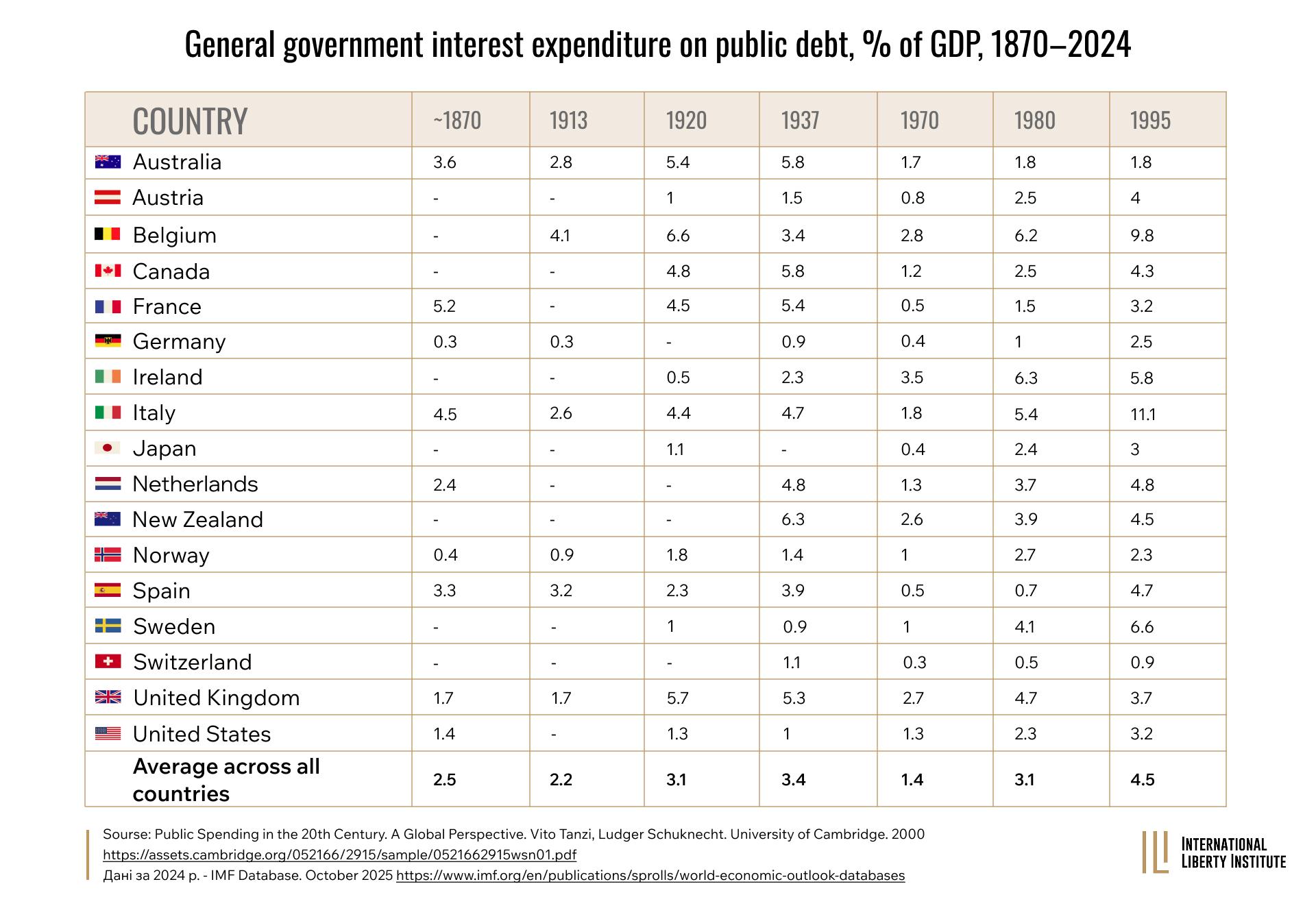
L"Participation in World War II led to a sharp increase in federal spending. In 1945, it reached 31.8% of GDP. In addition to massive spending on national defense, which rose from 1.3% of GDP in 1939 to 25.1% in 1944, federal interest payments associated with the issuance of debt obligations to finance the war also increased significantly."L
In 1970, U.S. defense spending accounted for 7.6% of GDP, while spending on social programs rose to 6.2% of GDP and then increased in the early 1980s to 8.7% of GDP.
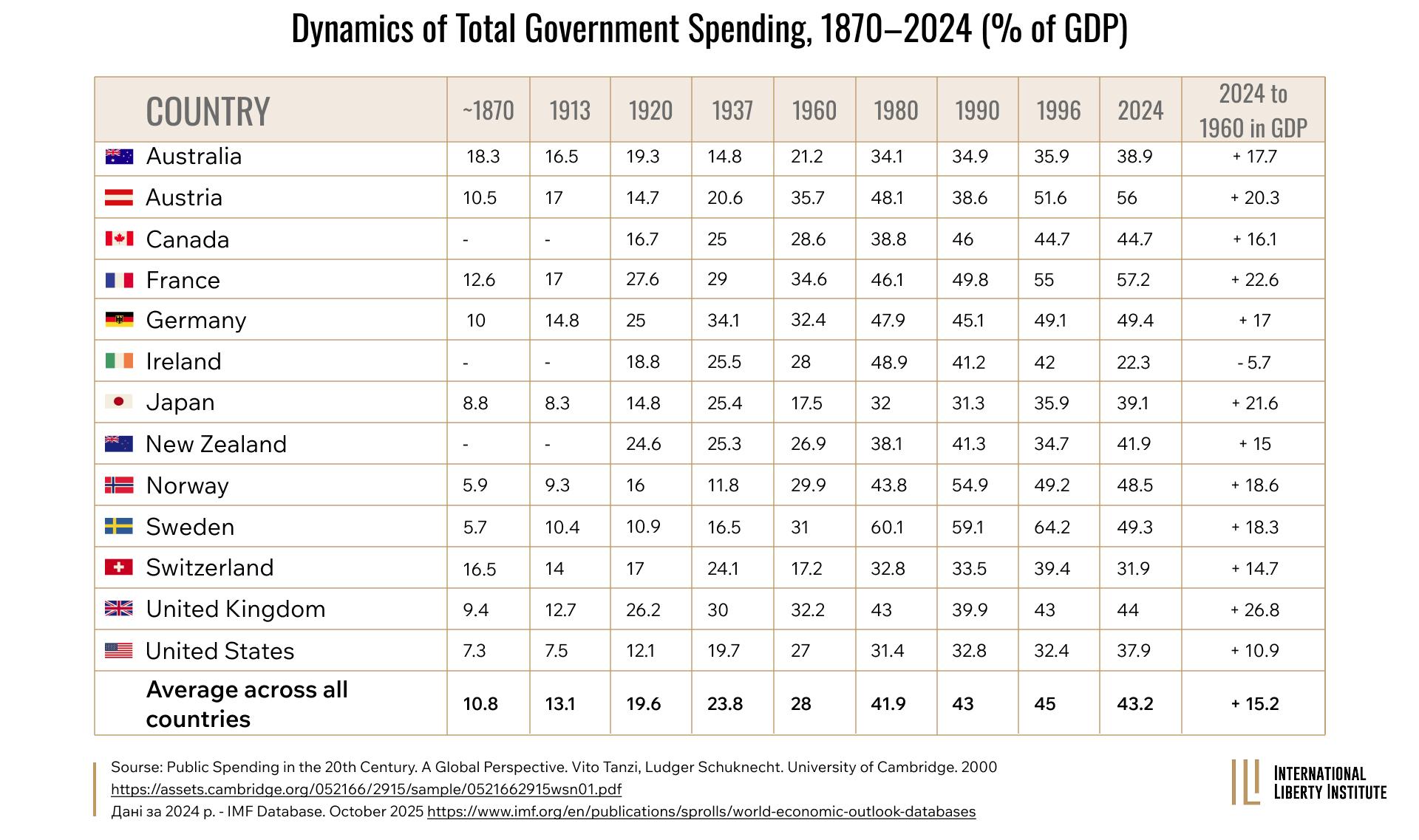
At the beginning of the 20th century, total government spending in the United States accounted for approximately 7.5% of GDP, in Sweden 10.4%, in Japan 8.3%, in the United Kingdom 14%, in France 17.0%, and in Germany 14.8% of GDP.
Active promotion of socialism through a state-run system of secondary and higher education, along with two world wars unleashed by totalitarian regimes, meant that by 1960, total government expenditures had already reached 27% of GDP in the United States, 17.2% of GDP in the United Kingdom, 32.4% of GDP in Germany, 34.6% of GDP in France, and 17.5% of GDP in Japan.
After World War II, the erosion of capitalism and freedom accelerated, and in the 21st century, it took on a destructive pace and form.
On average, across 13 Western countries, government spending rose from 13.1% of GDP to 28% of GDP between 1913 and 1960.
In 2024, government spending in 13 Western countries amounted to 43.2% of GDP. This is 15.2 percentage points higher than in 1960.
Over 100 years, the size of the State in the West increased by nearly 3.5 times.
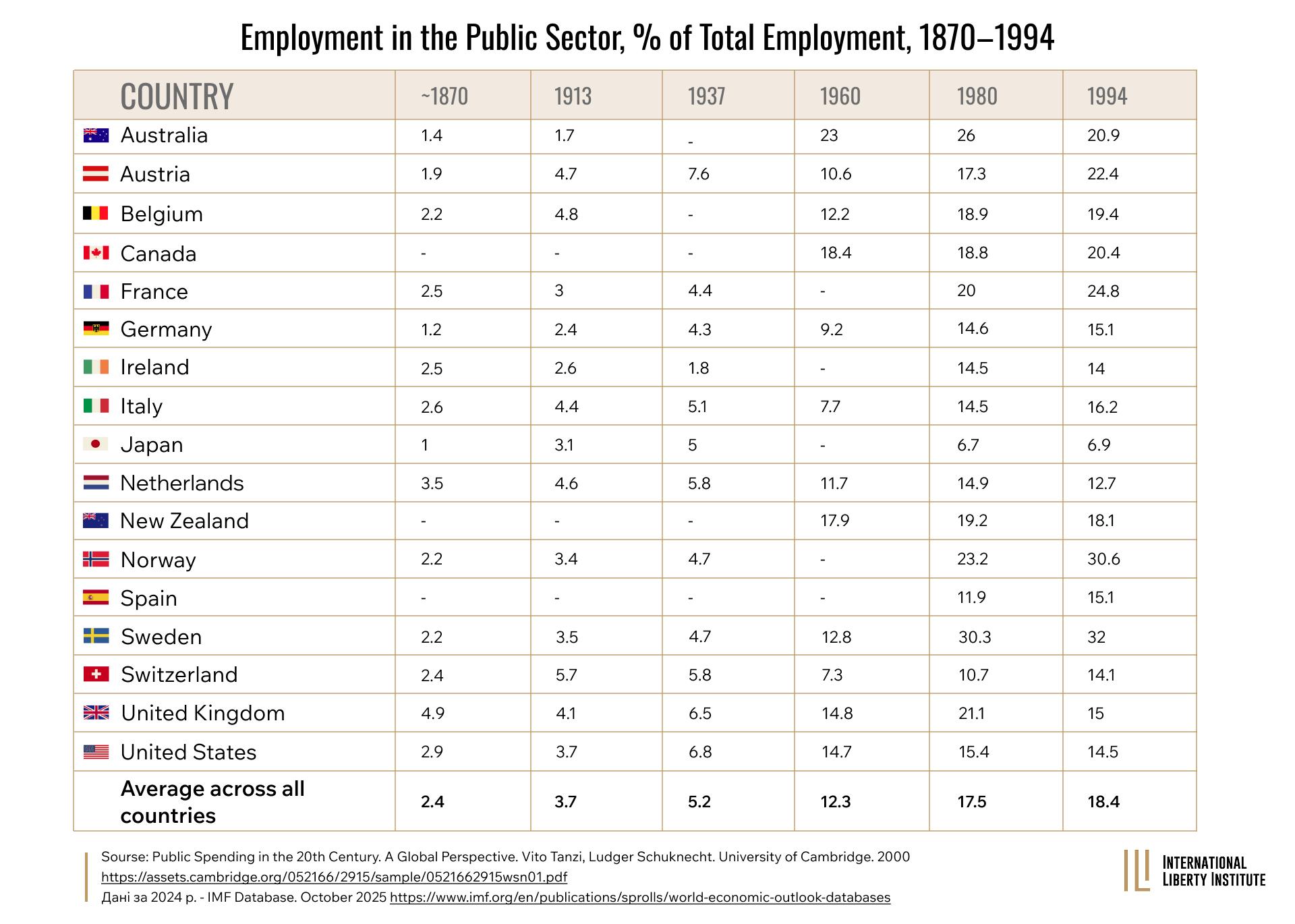
Total government expenditures are only part of the State’s overall demands on the citizen. At the beginning of the 20th century, when the State was concerned almost exclusively with security issues, employment in the public sector accounted for only 2% to 4% of all jobs, and what we now call “regulatory costs” were close to zero.
TODAY, THE STATE IS THE LARGEST PRODUCER OF GOODS AND SERVICES, THE LARGEST INVESTOR, THE LARGEST EMPLOYER, AND ALSO A MONOPOLIST/OLIGOPOLIST IN KEY SECTORS OF THE ECONOMY.
Thus, for an ordinary citizen in Western countries in the 21st century, the State costs 4.5–5 times more than it did before.
The West did not create sufficient checks and balances or counterweights, nor did it introduce limiting safeguards on democracy as the will of the majority, which led to the erosion of property rights and the restriction of freedom of human activity. As a result, democratic countries that were by inertia considered capitalist began to lose in international competition to others that did not have “pure” classical democracy but had a small state in the economy—i.e., low taxes, a low regulatory burden, and macroeconomic stability. Through democratic institutions, the West has eroded private property, expanded state control over the economy, and strengthened incentives to obtain free or subsidized benefits at the expense of others.
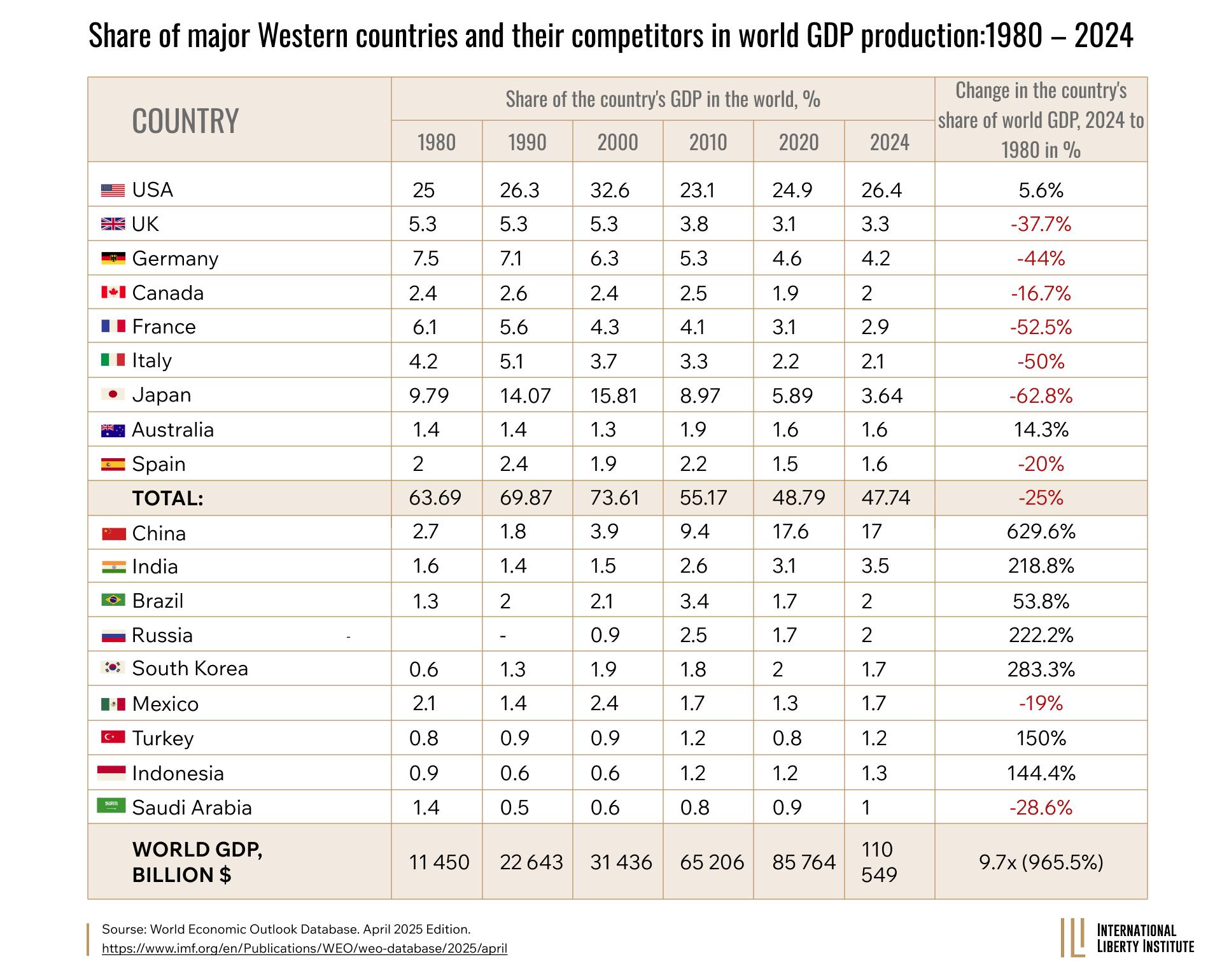
As a result, by the mid-2020s, its prestige, standing, and competitiveness within the global competitive landscape had declined significantly. In turn, the appeal and influence of authoritarian and hybrid models—which exhibit clear democratic shortcomings regarding political rights and civil liberties—have grown significantly in the 21st century.
The historical trends in government spending during the 20th century, in the first three decades of the 21st century demonstrate the influence of democracy on the redistribution of resources and assets, economic and political power in favor of the State, the increased role, standing, and opportunities of politicians, bureaucrats, the nomenclature, regulators, law enforcement agencies, as well as their consultants, advisors, and other support staff—in other words, those who manage others’ assets, funded by taxpayers’ money.
Without a culture of respect for private property and entrepreneurship, without strict constitutional limits on government spending, and without an objective assessment of state intervention in the economy, democracy gradually shrinks the market sector (the free, voluntary exchange between private owners) and expands the non-market sector (the state sector).
This long-term trend leads to the erosion of personal, political, and civil rights and freedoms, and to the state being hijacked by various lobbying groups and activist social groups, which incorporate their own goals and objectives into the concepts of “national interests,” “state interests,” and “sustainable development strategy,” thereby ensuring their achievement at the expense of taxpayers.
The current crisis of democracy in Western countries is the result of a long-term trend toward the transformation of the State due to built-in mechanisms of democratic self-destruction.
EIGHT STAGES OF THE EROSION OF FREEDOM THROUGH THE ABUSE OF DEMOCRACY
Vito Tanzi, Director of the IMF’s Fiscal Policy Department from 1981 to 2000, and Ludger Schuknecht, Chief Economist of the European Central Bank’s Fiscal Policy Division, analyzed the evolution of the State, its size, functions, revenues, and expenditures from the late 19th to the late 20th century and concluded that the significant increase in the size and role of the state in the economy after World War II had minimal or no positive impact on improving economic and social indicators.
They presented a compelling case for reducing the size of the state from 46% of GDP (the share of total government spending in 17 OECD countries in 1996) to approximately 28% of GDP in those countries in 1960.
The recommendations of these scholars, as well as those of representatives of the Austrian School of Economics over the past 30 years, have been ignored. As a result, virtually all developed countries and most developing countries found themselves in the second half of the 2020s in a zone of high risk—facing macroeconomic, debt, financial, and social crises. This, in turn, has created a crisis of trust in democracy as a whole.
Democracy has been captured by representatives of various interest groups and lobbyists who have seen significant opportunities to obtain material and non-material benefits and assets at the expense of taxpayers. From the business world, we know how a hostile takeover of a corporation or firm takes place.
Democracy, as a system of government, has also become the target of a hostile takeover. However, unlike in the business world, this process has dragged on for decades. Let us identify the main phases of this process:
Providing a theoretical rationale, followed by the practical implementation of policies to expand the functions, powers, and objectives of the government and, accordingly, the resources needed to achieve them. In addition to the original, primary function of security (protection against external and internal enemies), the following functions were gradually added:
poverty alleviation;
hunger eradication;
elimination of illiteracy and ensuring access to quality education services;
ensuring access to quality healthcare services;
ensuring adequate income in old age;
ensuring adequate and affordable housing;
ensuring stable production of essential goods and services, including transport, utilities, energy, and telecommunications;
support for socially vulnerable groups of the population;
protection of the population from unfair producers of goods and services
protection of “public morality”;
protection of “national interests”;
ensuring long-term sustainable development;
ensuring balanced regional development within the country and equalizing opportunities for rural and urban populations;
ensuring innovative development;
support for a competitive human capital base;
creation of a dynamic and productive labor market and high-tech jobs;
ensuring food, technological, and financial security;
protection against global warming, cooling, ozone layer depletion, climate change, and extreme natural events;
protection of biodiversity;
protection of employees from employers;
protection of various minorities and their group interests across different dimensions (gender, race, religion, psychological condition, age, social and material status, etc.)
Every function and task requires money, assets, and resources. These are obtained through taxes, loans, and the commercial use of resources and assets, including through the sale of commercial operating rights and the creation of monopolies or oligopolies in various market segments.
The introduction of universal suffrage for all citizens over the age of 18. In the first half of the 20th century, most citizens lived in rural areas and lacked even a basic education and fundamental knowledge of politics, economics, and public administration. People paid minimal taxes, supported themselves, and viewed the family as the primary source of education, upbringing, and social protection. Gradually, various groups of intellectuals, theorists, ideologues, and advocates of a Big State began to seize control of the State through democratic institutions, using it to advance their own agenda. A group of net beneficiaries of Government activities has emerged and grown. These are the people who, in various forms, received more money, assets, and resources from the state budget than they paid in taxes. Behind the nominal free nature of education and healthcare, subsidies for transportation and housing and utility services, and subsidized housing for certain categories of citizens lie large-scale state support programs for the ruling elite and political leaders (corporate welfare).
As a result, a situation has arisen in which, under the democratic model of the welfare state, approximately 95–97% of citizens are net payers, while 3–5% of the population—most of whom are connected to a syndicate of high-ranking officials—are net beneficiaries of this system. These include monopolies, oligopolies, participants in state investment and innovation programs, and government procurement entities—all those who, either directly or through a network of civil society organizations, finance political parties and advocate for expanding the size and scope of the State. According to the theorists and ideologues of the welfare state model, citizens—ignoring the laws of economics and human behavior—supported policies for decades that, in the long run, worsened their material circumstances and reduced their freedom.
The involvement in the political struggle of scholars, professors of the humanities and natural sciences, intellectuals from the arts (literature, music, media), and representatives of numerous NGOs, including labor unions, religious groups, women’s organizations, human rights groups, and environmental organizations. They have become influential lobbyists for their narrow corporate, sector-specific agenda. They actively influenced the formation of political party programs and even the substance of the activities of the legislative and executive branches of government. In return, they provided support to politicians and political organizations during elections. The syndicate comprising “political parties and large, networked NGOs,” together with theorists and ideologues of socialism in the form of the welfare state from the educational and scientific-analytical community, has created mechanisms to pressure the State into continuously expanding its functions and, consequently, its resources. A phenomenon has emerged: sciencetainment (science + entertainment). It was a way to popularize science through entertainment; on the other hand, under the banner of “science,” hypotheses, claims, and theories began to appear more and more frequently that distorted and misrepresented science, failing to withstand validation by scientific methods. At the same time, intellectuals who had earned academic degrees, titles, and positions in a single specialized field became influencers, speakers, and opinion leaders on issues related to the economy, the political system, and strategies for socioeconomic development. They were actively promoted by international organizations (the UN, the WEF, the OECD, the World Bank, the IMF, etc.), as well as major international consulting firms, which sought to enhance their status and prestige in the eyes of governments.
A gradual convergence of positions and policy platforms among mainstream political parties, and the formation of an interparty consensus on the functions, powers, and resources of the State. Left-wing and right-wing parties began to differ not in their attitude toward the State, its place in the life of the citizen, or in the economy, but in where it is better to direct taxpayers’ money, which sectors or enterprises should be included in the category of “strategically important,” which technologies should be considered breakthrough and promising, which preferential regimes (benefits, subsidies, credit support), auditing and control mechanisms should be created, and how concepts such as sustainable development, social justice, DEI/ESG (DEI—Diversity, Equity, and Inclusion), and ESG (Environmental, Social, and Governance) should be understood. It was not until the 2020s that political parties and interest groups began to emerge in developed countries, reigniting the debate over the functions, powers, and size of the State; however, their representation in government bodies remains, unfortunately, minimal. A prominent and influential figure in this discourse is Argentina’s current president, Javier Milei.
The politicization and ideologization of mainstream media, primarily television and print publications. Journalists, like university professors, are mostly supporters of left-wing views, and a model of the state based on widespread interventionism. They believe that it is through the state that "social justice," sustainable development, and ecological balance can be achieved, and that the greed and risks of private business can be mitigated. The development of the internet, social media, and communication platforms has not made the media more objective, but has instead intensified their polarization. The phenomenon of infotainment has emerged, in which news, informational reports, and television programs have become part of entertainment, driving an immediate demand for clicks, views, likes, and subscriptions. The new media did not become independent, but merely expanded the tools and resources available to political forces, most of which continued to maintain a consensus in support of a model of the State based on widespread interventionism.
The creation of a network of international and global organizations and discussion forums that have begun to influence the shaping of both the global agenda and the national development strategies of most countries around the world. First and foremost, these include the annual World Economic Forum in Davos, the Club of Rome and its events, the United Nations, the Bilderberg Group, G7 summits, the OECD, the IMF, and the World Bank, which have been holding regular meetings and conferences of finance ministers, central bank governors, and economy ministers since the mid-20th century. Through such measures, macroeconomic policies were coordinated and synchronized, their norms and standards were established, and certain management models were defined. These organizations acted as marketers and promoters of theories of the welfare state, including Keynesianism, neo-institutionalism, and numerous models based on rational expectations theory, game theory, and behavioral economics. The theoretical and political-economic mainstream promoted by these organizations has used and continues to use the tools of cancel culture against scientific research and works that objectively assess the nature and role of the State in the economy, as well as the consequences of its interventionism.
The emergence of international networks of expert, technocratic, and consulting organizations that offered their services to national governments in the areas of industrial, innovation, trade, labor, and environmental policy, as well as in education, healthcare, pensions, and public administration. Representatives from organizations such as McKinsey, BCG, Bain, Deloitte, PwC, EY, KPMG, Accenture, AlixPartners, Booz Allen Hamilton, Capgemini Invent, Kearney, Oliver Wyman, the Brunswick Group, and others actively work with governments, international development agencies, and national and international foundations that advance their agendas through grants. The technocratic approach of these consulting organizations, as well as that of international institutions such as the IMF, the World Bank, and the EBRD, is based on knowledge developed at leading Western universities, including prestigious Ivy League Institutions”. They serve as academic hubs for developing models, modifications, and variations of economic policy within a state characterized by general interventionism. And by default, they accept democracy as a system for legitimizing and validating this model, paying no heed to either the theory or the practical failures of the state. They apply standardized institutional solutions and recommend the economic policies of developed countries without taking into account the capacity to implement them, particularly in developing countries. As a result, the Big State becomes an object of capture by powerful corporate lobbyists, who carry out this process through democratic institutions.
Expanding the powers, resources, and scope of operations of law enforcement, specialized, and counterterrorism agencies in the areas of military, financial, biological, nuclear, environmental, information, and cybersecurity. The scope of people's private lives has shrunk dramatically as technologies for monitoring and tracking people's physical movements, financial transactions, information flows, and communications have come into widespread use. The security services have become a special force, a state institution that, under the banner of protecting the constitutional order, democracy, and the rights and freedoms of citizens, has increased the risks of losing those very freedoms and democracy. Under the pretext of combating terrorism, corruption, organized crime, and external enemies, security agencies have been granted powers that are far from always being used to protect human rights. The inclusion of climate change, disinformation, political polarization, migration, inequality, international organized crime, trade, currency, technology, regulatory wars, and discrimination creates a favorable environment for an even greater expansion of the state’s sphere of activity as a whole and that of its special and law enforcement agencies in particular. In their book “Why Nations Fail: The Origins of Power, Prosperity, and Poverty” (2012), Daron Acemoglu and James Robinson describe how institutions shape and influence prosperity. Here we have an example of the idealization—even the romanticization—of democracy and the oversimplification of the complex cause-and-effect relationships in the modern world. Nobel laureates freely juggle abstract concepts and terms such as “institutions,” “democracy,” “equality,” and “inclusivity,” leading to the hypothesis that inclusive political and economic institutions ensure the fastest rates of economic growth. According to the authors, inclusive institutions encourage broad participation in the economy, competition, and innovation. They ensure equal opportunities and respect for private property. And it is these factors that create an environment in which the majority of the population can take advantage of opportunities to improve their well-being. As a result, we have sustained economic growth. Extractive institutions concentrate power and resources in the hands of a small political and economic elite. This elite blocks changes that threaten its interests. In this system, access to education, innovation, and entrepreneurship is restricted. Such a system hinders economic development and perpetuates poverty and inequality. The authors do not provide clear terminology that would preclude different interpretations of the very concept of “institution” (one of the main shortcomings of institutionalism in general), nor do they provide definitions of “inclusive” and “extractive.” The authors of the book do not mention any tools for assessing the inclusiveness or extractiveness of various institutions. This gap leaves ample room for interpretation. They propose accepting on faith the hypothesis that democracy and the rule of law, as the foundation of inclusive institutions, ensure a country’s prosperity, yet say nothing about economic freedom, property rights, and a small government as the cornerstones of capitalism.
Ignoring the Mises-Hayek-Schumpeter theory of entrepreneurial growth, on the one hand, and the theory and practice of state failure—particularly within democratic institutions—on the other, prevents us from understanding and grasping the causes of the global crisis of democracy, the erosion of freedom, and the foundations of the West itself.
SCENARIOS FOR THE TRANSFORMATION OF DEMOCRACY BY 2070
Democracy, the very concept of the state, and the country’s system of governance must undergo a significant and profound transformation in light of the acute security threats facing the world:
the Russian-Ukrainian war;
Iran-Israel one;
the Iran-U.S. war;
U.S. actions in Venezuela and potentially in Cuba;
the risks of military conflict between China and Taiwan;
the war between Pakistan and Afghanistan;
military conflicts in Africa;
the erosion of the transatlantic partnership, particularly NATO and the OSCE;
the irrelevance of the UN and its agencies;
the crisis of multiculturalism and illegal immigration;
the sovereign debt crisis of more than 100 countries worldwide;
the cost-of-living crisis and the affordability of goods and service;
the crisis of trust in government;
overall globalization of the production of goods and services;
the global demographic situation and the enormous volume of unsecured social and pension obligations that the state owes its citizens.
There are various options and scenarios for reforming the institutions, procedures, and mechanisms that make up the concept of “democracy.” The main ones are as follows.
Option 1. Rejection of democracy in favor of authoritarianism and totalitarianism. In this case, electoral procedures ultimately become mere rituals within the framework of backroom deals among powerful factions in the political world. Such a system of government can manifest itself in the form of fascism, syndicalism, or National Socialism.
Option 2. Rejection of universal equal suffrage, the introduction of different electoral “weights” for different categories of citizens—in other words, legalized segregation in the name of countering populism, a culture of dependency, and demands for free goods or services at the state’s expense.
Option 3. Rejection of democracy in favor of anarchy. Proponents of anarcho-capitalism and other forms of anarchism put forward such ideas. In their view, this political system of citizen self-organization is superior to democracy. Anarchists, like utopian socialists, describe static ideal models while ignoring the transition from the current state of affairs to them.
Option 4. Rejection of democracy in favor of monarchy or some advice from highly advanced technocrats (an authoritarian aristocratic technocracy). This is yet another utopian construct that romanticizes monarchy by appealing to the good old days, when there was supposedly harmony and the rule of law, and none of the negative consequences that democracy produces.
Option 5. Constitutional limits on the size, functions, and powers of the state, provided that universal and equal suffrage is preserved.
Read more about these options in the PDF study file
The source of historically unprecedented economic growth and development in the 19th–21st centuries was not democracy in and of itself, but rather freedom (personal, political, economic) and capitalism (protection of private property rights, implementation of the rule of law, open competition, free trade, and personal responsibility through the “profit-loss” mechanism).
The institutions of democracy have been hijacked and undermined by theorists, ideologues, and those who profit from a model of the state based on universal interventionism. Private property was gradually eroded and destroyed. Restrictions were introduced on the system of free exchange between individuals, and the spheres of voluntary, mutually beneficial exchange were reduced through the expansion of the state into all areas of human life. Democracy without constitutional checks and balances—without red lines defining the limits of the majority’s power when it comes to safeguarding private property and individual freedom of choice—first paralyzed capitalism and the free market, and then fell victim to its own expansion.
One way or another, the key problem for both democracy and the economy is the State. To overcome the crisis of electoral democracy and a state-controlled economy, it is advisable to enshrine in the Constitution maximum limits on the role and size of the state in the economy, which we refer to as a “straitjacket for the government”:
10% — the share of state-owned resources and assets in the total volume.
25% of GDP — the level of total government spending.
2% of GDP — a budget deficit for government agencies or a complete ban on deficits.
20% of GDP — the amount of public debt.
10% — employment in the public sector, including the military and law enforcement agencies, as a percentage of the total labor force.
2% per year—inflation under a state monopoly on money. Once the state monopoly on money is abolished, this factor is eliminated, as market forces will influence price dynamics.
These figures are targets. Each country will have its own transition period for achieving them, particularly in the areas of public assets, the budget, debt, and employment. However, if the country is not at war, the transition to such a system is possible within 5–7 years.
Such a legal regime neutralizes political populism and the influence of destructive ideologies (socialism, fascism, Nazism, Leviathanism in its various manifestations, including the welfare state) and strengthens the sources of growth and development that have made Western civilization—with its democracy, capitalism, and freedom—the most successful in human history.
CONCLUSIONS
The crisis of democracy in the 2020s is a direct consequence of the long-term neglect of its nature, the specific features of its functioning under conditions of universal equal suffrage, and the transformation of the minimal state first into a welfare state and subsequently into a highly interventionist state.
Democracy is somewhat similar to nuclear energy. It can be an unconditional good, an economic value, and a source of development. However, it requires strict adherence to the laws of science, the use of technologies, and procedures. Otherwise, it may lead to a catastrophe similar to Chornobyl (1986) or Fukushima (2011).
From the very outset of the adoption of democracy as a fundamental model of governance, scholars in the fields of philosophy, politics, and public administration warned politicians and society of the need for caution in the exercise of democracy.
Charles Louis de Montesquieu warned of the decline of democracy in two ways. The first is the spirit of inequality, in which a small group of elites seizes all power, while the "common man" is ignored. The second is a spirit of extreme equality, where everyone wants to be in charge, but no one wants to live by the law or respect authority. This is when “virtue” gives way to a desire for complete lawlessness. The result is chaos, which brings to power a dictator tasked with restoring order.
Ch. Montesquieu argued that a country’s most important asset is its “soul,” which must be built on a system of core values. Once they are rejected or eroded, the collapse of the state is only a matter of time. Throughout the 20th century and the first quarter of the 21st century, we have witnessed the “capture of the soul”—to borrow Montesquieu’s metaphor—by the theorists and ideologues of a highly interventionist state.
Through the democratic will of the majority, the state VIP bureaucracy has set in motion mechanisms that erode the very essence of Western civilization: personal, civil, and economic freedom; private property; personal responsibility; the “profit-loss” mechanism; open competition; and free trade. The principle of individual self-ownership was replaced by belonging to a particular group, class, institution, or organization (the state, Christians, men, white people, workers, the educated, the poor, etc.).
Governments' hijacking of democracy has led to even more negative consequences than Charles Montesquieu had warned—namely, apathy and passivity among citizens. They do not see themselves as active creators of the laws and rules by which society lives, but rather accept these legal instruments as a given, bestowed from above by certain high priests.
L"The tyranny of a prince in an oligarchy is not as dangerous to the common good as the apathy of a citizen in a democracy"L
Government technocratization, the creation of non-democratic supranational bodies and international organizations, the separation of the governing caste from ordinary citizens, and the shrinking of the sphere of voluntary market exchange—all of this has led to the alienation of citizens from the state.
As a result, we are facing a crisis of trust and a growing crisis of legitimacy regarding the system of governance that currently dominates the world. The state has brought both business and society under its control. As a result, the legal system and the enforcement of the law are being undermined, in particular because the law has become a source of conflicting discretion for regulatory, law enforcement, and judicial authorities.
And this situation was foreseen by the great Charles Montesquieu: “When laws cease to be obeyed—and this can only be the result of the decline of the republic—the state is already lost.”
The great French thinker warned that a democratic state is, by definition, not free, and that political freedom can only be found in the model of a “moderate government,” and even then not always.
L"It exists only when there is no abuse of power. However, everyday experience shows us that anyone entrusted with power is prone to abusing it and exercising their authority to the fullest"L
Therefore, democracy—and, consequently, the State — must be subject to strict limitations, a system of checks and balances, and a clear separation of powers. These recommendations and principles were formulated at a time when universal suffrage did not yet exist, and government spending in the United States did not exceed 5% of GDP, while in Western European countries it ranged from 10% to 13% of GDP.
In the 21st century, the bureaucratic apparatus has established control over the mechanisms and procedures of democracy, over the major political parties, influential NGOs, and networked organizations such as trade unions, thereby usurping all power (legislative, executive, and judicial) into its own hands.
The evolution of democracy in the 20th century, especially after the Second World War, took place in the exact opposite direction—toward the concentration of political and economic power within the framework of a highly interventionist state model. In this system, freedom was not allowed to operate in a way that would lead to natural consequences, as recommended by theorists of the public choice school.
The ruling syndicate violated another recommendation of J. M. Buchanan and G. Tullock: “The apparent inconsistency between individual preferences and social interests is resolved through exchange and voluntary agreement.”
Voluntary exchange and agreement are the foundation of the free market and capitalism. When the state expanded to 45–50% of GDP (in terms of public expenditure), and its regulatory requirements exceeded 10% of GDP, while transaction costs increased to 5–7% of GDP, and the state displaced the private sector from many types of commercial activity, including the financial sector, there can no longer be any meaningful talk of voluntariness or a market.
This outcome was brought about by democracy and the state not being constrained by strict limits.
Citizens have been instilled with a fear of an unregulated free market, which supposedly inevitably leads to the formation of monopolies. The theorists of democracy and the Big State introduced into economics a pseudo-scientific theory of market externalities, and in reality produced a whole set of mutually reinforcing government failures.
Within the framework of public choice theory, he called for the introduction of constitutional limits on the government’s activities, pointing out that politicians and bureaucrats are not angels, but people with their own interests.
The political and economic history of both the Western world and the rest of the globe clearly demonstrates that a lack of oversight over democracy and the State leads to the erosion of democracy and freedom themselves. Moreover, economic freedom is the first to be undermined, followed by political, civil, and personal freedoms.
Both representatives of the Austrian School of Economics and the Public Choice School have written persuasively on this subject, analyzing the consequences of the practical implementation of John Maynard Keynes’s recommendations.
The current crisis of democracy and the State requires deep, systemic solutions. Cosmetic measures cannot resolve this problem. For the first time in history, we are facing a crisis of three civilizational components:
Democracy as a system of government.
The State as a set of institutions for organizing the daily lives of citizens.
The mainstream economic model of the highly interventionist state (welfare state).
This multi-level crisis is unfolding against the backdrop of large-scale, bloody wars: totalitarian Russia is waging war against Ukraine; the Iran–U.S. and Iran–Israel wars are escalating; the Pakistan–Afghanistan war is ongoing; and armed clashes in Africa continue unabated.
State interventionism, including in social policy, has had a negative impact on the demographic situation, triggered a migration crisis, deepened the crisis of trust, weakened democracy, and increased demand for authoritarianism. Fulfilling all of a country’s obligations in the areas of healthcare and pensions as early as the first half of the 2030s poses a risk of default not only for developing countries but also for developed countries. The structural and investment failures that have accumulated within the welfare state model make it impossible to neutralize the numerous sources of crisis through fine-tuning alone.
Following the collapse of the Soviet Empire, the new nations underwent a transition from totalitarianism to democracy, from a planned economy to a market economy, and from isolationism to openness and integration into the international division of labor. In the 1980s, the West—represented by think tanks, universities, and development agencies—lacked both a theory and practical experience of transition for post-totalitarian countries; therefore, the welfare state, or the model of a highly interventionist state, was chosen as the basic model.
Today virtually the entire world is on the cusp of a systemic, multi-level transit system. Theories of transition—from a state-planned economy to a free market, and from Leviathan democracy to market democracy and a minimal state—do not exist. The current system of governance in most countries, which relies on political parties, is in deep crisis.
Share
Traditional intellectual centers studying democracy and development models in Western countries, as well as their clones in developing countries, continue to produce intellectual output by inertia, without taking real-world conditions into account. They behave in much the same way as NATO in the context of the Russia–Ukraine war.
THE WORLD, UNDER CONDITIONS OF RADICAL UNCERTAINTY, IS ENTERING AN ERA OF THE SIMULTANEOUS TRANSITION OF THREE KEY CIVILIZATIONAL ELEMENTS, WITHOUT HAVING ANY VISION, STRATEGY, OR PROGRAM.
The complexity and multidimensional nature of the problems facing both developed and developing countries require the establishment of interdisciplinary, multi-profile, international intellectual working groups (task forces) for the precise scientific diagnosis of the state of affairs in the world and the development of strategies and programs for the preservation of Liberty through a profound reform of democratic institutions, the economic model, and, accordingly, a reconsideration of the functions, role, and size of the State.
A well-known Ukrainian and Belarusian economist, popularizer of the Austrian economic school in the post-Soviet space. He specializes in reforms in transitional economies in the post-socialist space.
The editor-in-chief of the website of the International Freedom Institute, a manager of media projects. With a background in journalism, media management, consultancy, and business leadership, she works to advance the ideas and philosophy of AES in the media space.
Tetiana Stroiko, science editor of ILI. Doctor of Economic Sciences, Professor of the Department of Intelligent Digital Economy at the National University of Shipbuilding named after Makarov (Mikolayiv).