


Economic Freedom

Yaroslav Romanchuk
Mainstream economics caused the crises and now offers the same failed solutions. Why does the Austrian School of Economics provide a better strategy — and why do governments ignore it?



Competitiveness
Yaroslav Romanchuk
Britain gave the world capitalism, the Industrial Revolution, and the global financial system—and then abandoned that legacy. What happens to a country that traded economic freedom for socialism and state intervention?
Latest publications
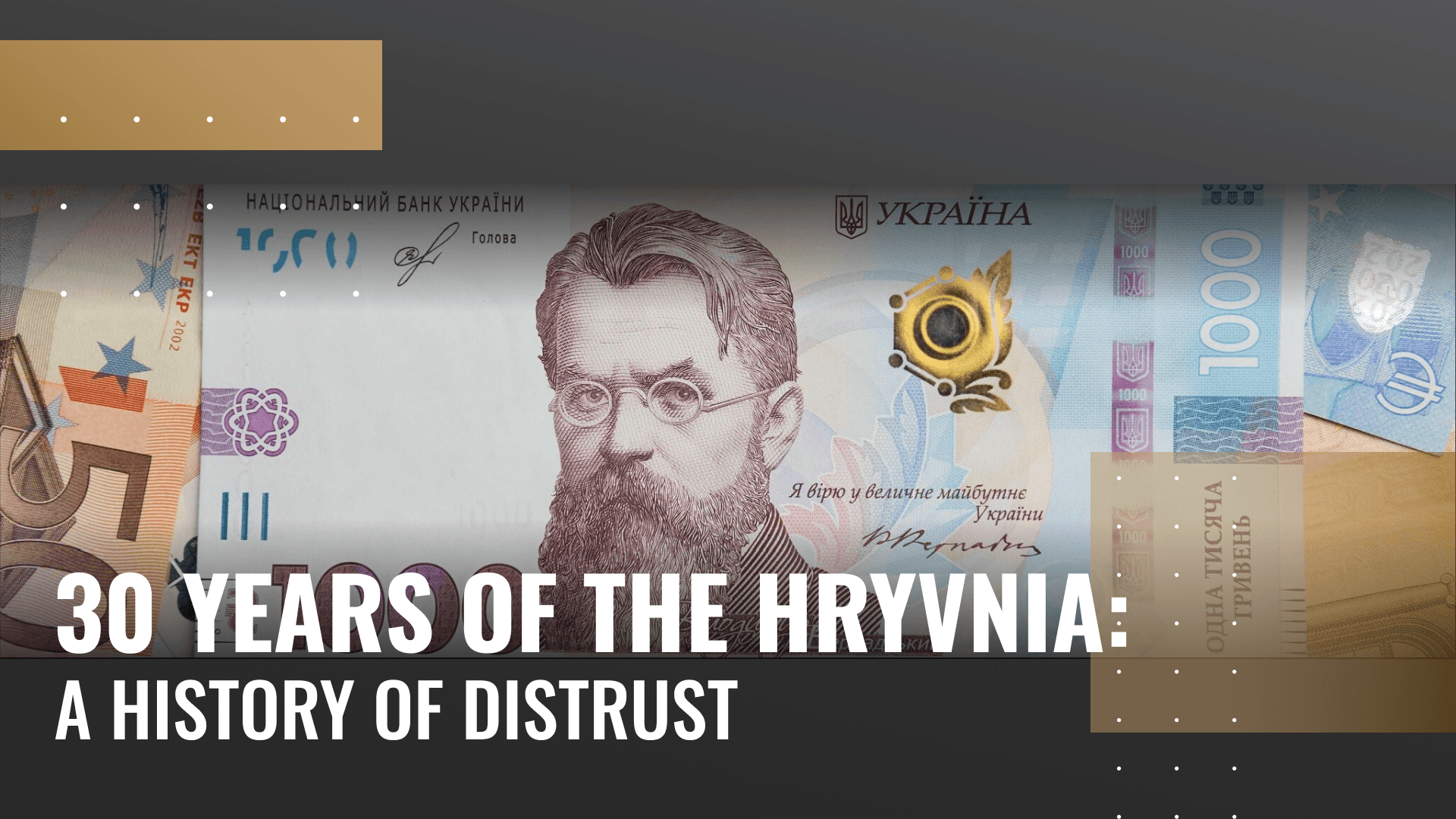
30 Years of the Hryvnia: A History of Distrust
Lessons from a Thirty-Year Monetary Experiment That Failed.
Why do Ukrainians keep their money in foreign currencies and distrust the hryvnia?
Read more




30 Years of the Hryvnia: A History of Distrust
Lessons from a Thirty-Year Monetary Experiment That Failed.
Why do Ukrainians keep their money in foreign currencies and distrust the hryvnia?
Read more

AI Manifesto: the New Techno-Oligarchy
The new industrial policy for artificial intelligence in this new era is leading to tighter government regulations and the emergence of new, powerful corporations at the expense of smaller companies. It runs counter to the principles of the free market and fair competition.

The Nature vs the State. Who is Responsible?
Аlternative approaches to addressing nature conservation and sustainable natural resource management. A fresh look at old problems and an attempt to determine whether only the state is capable of preserving natural resources or whether the institution of private property can prove its environmental effectiveness.
Trending
US stagflation risk 2026
US tariffs Supreme Count ruling
AI buble burst risk
Europe fiscal crisis inflation
Stagflation risk 2027
Indexes

Index
2026 year
Shows the degree of government orientation towards the application of scientific knowledge, the best historical experience and axioms of common sense or the economic IQ of the country.
Index
2025 year
The Index shows the effectiveness and reliability of the country's legal and economic institutions and management system for the implementation of all participants will in the mode of open international competition for material and intangible resources and assets.
Index
2025 year
Shows that the period of time one needs to work to purchase a basic set of goods and services is determined by the balance of time and resources.
Events

28Жовтня


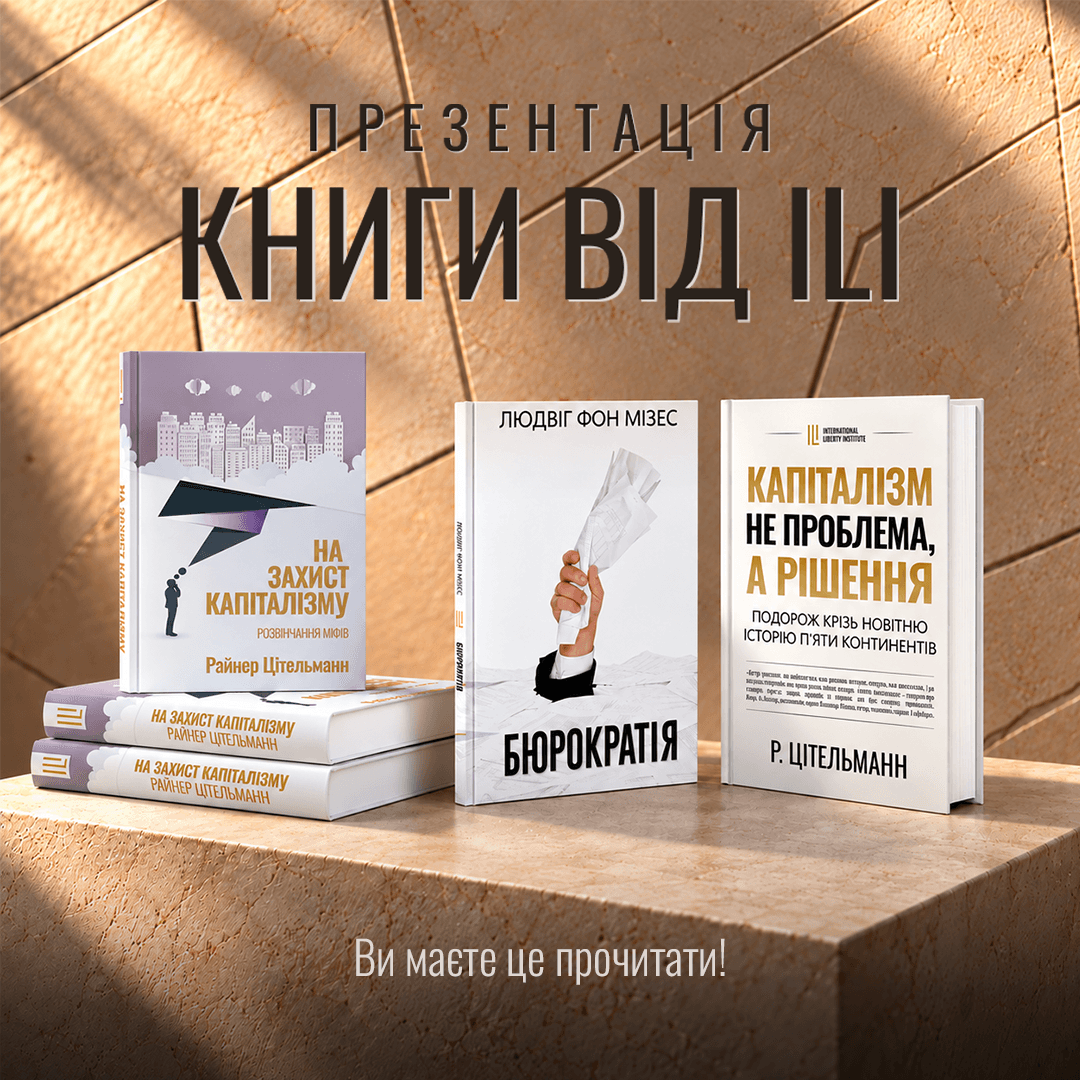
Presentation of Books R. Zitelmann and L. von Mises
We invite you to the presentation of four books, translated into Ukrainian and published by the International Liberty Institute (ILI). The Institute’s team spent an entire year working on the publication of these international bestsellers. As a result, Ukrainian readers now have access to three works by Rainer Zitelmann (two of which are already available for purchase) and Bureaucracy by Ludwig von Mises—a book now available to the general public that is highly relevant to contemporary Ukraine.
The published books are already available in bookstores across Ukraine, as well as on the Wellbooks publisher’s website.
- Ludwig von Mises, Bureaucracy;
- Rainer Zitelmann, In Defense of Capitalism: Debunking the Myths;
- Rainer Zitelmann, Capitalism Is Not the Problem, but the Solution: A Journey Through the Recent History of Five Continents;
- Rainer Zitelmann, How Nations Overcome Poverty: Vietnam, Poland, and the Origins of Prosperity.
- Volodymyr Popereshnyuk, philanthropist, co-founder of Nova Poshta, and co-founder of the ILI, who supported the publication of these books;
- Mykhailo Kamchatnyi, Director and expert at the ILI;
- Dmytro Dusheiko, ILI expert.
More about the books to be presented at the event:
Bureaucracy, a concise yet fundamental work by the renowned economist Ludwig von Mises, describes the logic behind the functioning of a bureaucratic system, the ideas that drive it, and the societal consequences resulting from its expansion. Mises emphasizes that the problems arise not from the bureaucrats themselves, but from the state’s deepening encroachment into the economy. As the government begins to regulate business and supplant market mechanisms, the capacity for economic calculation is lost, and society gradually drifts toward totalitarianism. The book provides a comprehensive analysis of why bureaucracy is effective only within a state that is small and limited in its functions.
This book is essential reading for scholars, policymakers, managers, and anyone interested in issues of public administration and economics. It was translated and edited by ILI expert and Ukrainian scholar Mykola Bunyk. This publication was made possible with the support of Volodymyr Popereshnyuk and the NGO "Mises MEM — Museum of Entrepreneurship and Money in Lviv."
The international bestseller "In Defense of Capitalism: Debunking the Myths," by German historian and sociologist Rainer Zitelmann, provides a comprehensive response—grounded in statistical data and historical facts—to the key arguments raised by critics of capitalism. The author systematically refutes 10 of the most common myths regarding the alleged negative consequences of the capitalist system. These include claims that capitalism is driven by the greed of capitalists; that it breeds hunger and poverty, exacerbates inequality, destroys the environment and the climate, triggers crises, fuels wars and monopolies, and poses a threat to democracy. A dedicated section of the book analyzes the tragic experience of attempts to build socialism in the USSR, China, and Cambodia. The publication also presents the results of an international sociological survey, commissioned by the author and conducted in 36 countries, which captures the attitudes of citizens from various regions of the world toward capitalism and economic freedom. A separate section is dedicated to the findings of this survey specifically in Ukraine. The book has been translated into 30 languages; the Ukrainian translation was produced by Serhiy Rachynsky, a renowned translator of works by authors from the Austrian School of Economics.
"Winning the war for freedom is not enough. Immediately afterward, a battle begins on the economic front—a battle for economic freedom," writes Rainer Zitelmann in the preface to the Ukrainian edition of one of his most famous books, "Capitalism Is Not the Problem, but the Solution: A Journey Through the Recent History of Five Continents" This book is about how to win that second war. Moving beyond abstract theories, the author guides the reader through the recent history of five continents: China, which rose from the famine of the Mao era to become a prosperous nation; Africa, where the market proved more effective than foreign aid; the two Koreas and the two Germanys; Chile and Venezuela; as well as Sweden, Britain, and the United States. Each example demonstrates one point: capitalism is not the problem, but rather the solution to problems and crises.
Rainer Zitelmann’s book, "How Nations Escape Poverty: Vietnam, Poland, and the Origins of Prosperity," serves essentially as a collection of practical recommendations for the Ukrainian government, drawing on survey data, personal accounts, and an analysis of historical events. Through facts and figures, the book demonstrates how two nations—Vietnam and Poland — escaped poverty thanks to market reforms. Both countries faced completely collapsed post-socialist economies; however, through Vietnam’s Doi Moi reforms (1986) and Poland’s “shock therapy” (early 1990s), the population's standard of living rose sharply, and their economies became among the most dynamic in the world. The author draws upon Adam Smith’s ideas, positing that the only way to overcome poverty is through economic growth — which, in turn, is impossible without economic freedom and the protection of private property. The author also highlights a fundamental shift in how the populations of these countries view wealthy, successful entrepreneurs: they are no longer perceived as “class enemies”, but rather as role models, especially among the youth.
The translation and academic editing of these two books were carried out by Dmytro Dusheiko, an expert and co-founder of the ILI.

Support ILI as an investment in economic and individual liberty, the development of a free society in Ukraine and the world. Your support is highly appreciated!
Donate

Support ILI as an investment in economic and individual liberty, the development of a free society in Ukraine and the world. Your support is highly appreciated!
Donate
Reforms

How to Eliminate Corruption in Ukraine: Concept
Step-by-Step Action Plan. From Chronic Ineffective Efforts to Full Elimination.


Stay Connected to ILI
Sign up for the newsletter and be the first to know about our events and new publications
By subscribing, you agree with our Privacy policy
Media-center





ILI partners


