Economic Security Index 2025
Share


National Economic Security – a new field of research for scientists, politicians, and anyone interested in issues of economic freedom and security. The importance of this topic is growing because of the increasing “hot” wars and conflicts in the modern world against the backdrop of sharply escalating international trade disputes and contradictions, increasing national debts of over 100 countries worldwide, and the reboot of global value chains. Optimisation of production costs in a competitive jurisdiction environment requires the development of effective economic policies addressing external and internal factors: sources of tangible and intangible resources, human capital, modern technologies, and access to commodities, infrastructure, and information networks.
The structure of the Economic Security Index allows it to be used as one of the benchmarks for economic policy within the framework of implementing the country's strategy for rapid, long-term economic growth and development.
The innovation of the International Liberty Institute lies in the fact that we integrate the theory of economic growth on the one hand and the concept of national security on the other, focusing on the values and institutions of Western civilisation. A distinctive feature of the Economic Security Index is its human-centred approach. We view national security through the prism of the foundation laid by the state for the personal and economic freedom of its citizens, through the rule of law and integration into the European and global division of labour.
Indicator groups of the Economic Security Index 2025
The Economic Security Index from the International Liberty Institute (ILI) is a comprehensive tool for assessing economic security based on statistical data and indices, public opinion polls, and expert groups' evaluations. It is based on 60 indicators, which are grouped into eight categories. The economic security index is assessed on a scale from 0 points (no economic security system) to 100 points (highest quality and reliability of the economic security system). Each indicator is rated on a scale from 0 to 100 points. The value for each group is the arithmetic mean of all indicators in the group. The value of the Index is the arithmetic mean of the numerical values of all eight groups.
- Group 1. Legal and institutional factors (10 indicators)
- Group 2. Macroeconomic factors (10 indicators)
- Group 3. Monetary and financial factors (6 indicators)
- Group 4. Tax and budget factors (5 indicators)
- Group 5. Regulatory factors (6 indicators)
- Group 6. Infrastructure factors (6 indicators)
- Group 7. Social factors (9 indicators)
- Group 8. Intangible factors (8 indicators)
Depending on the value of the country index, countries are assigned to one of four groups.

Results of the Economic Security Index 2025
The 2025 Index includes 10 countries — Ukraine, Argentina, Poland, Germany, Romania, Finland, the Czech Republic, Turkey, the United States, and Israel — whose economic security was assessed by ILI experts due to 27 risk factors.
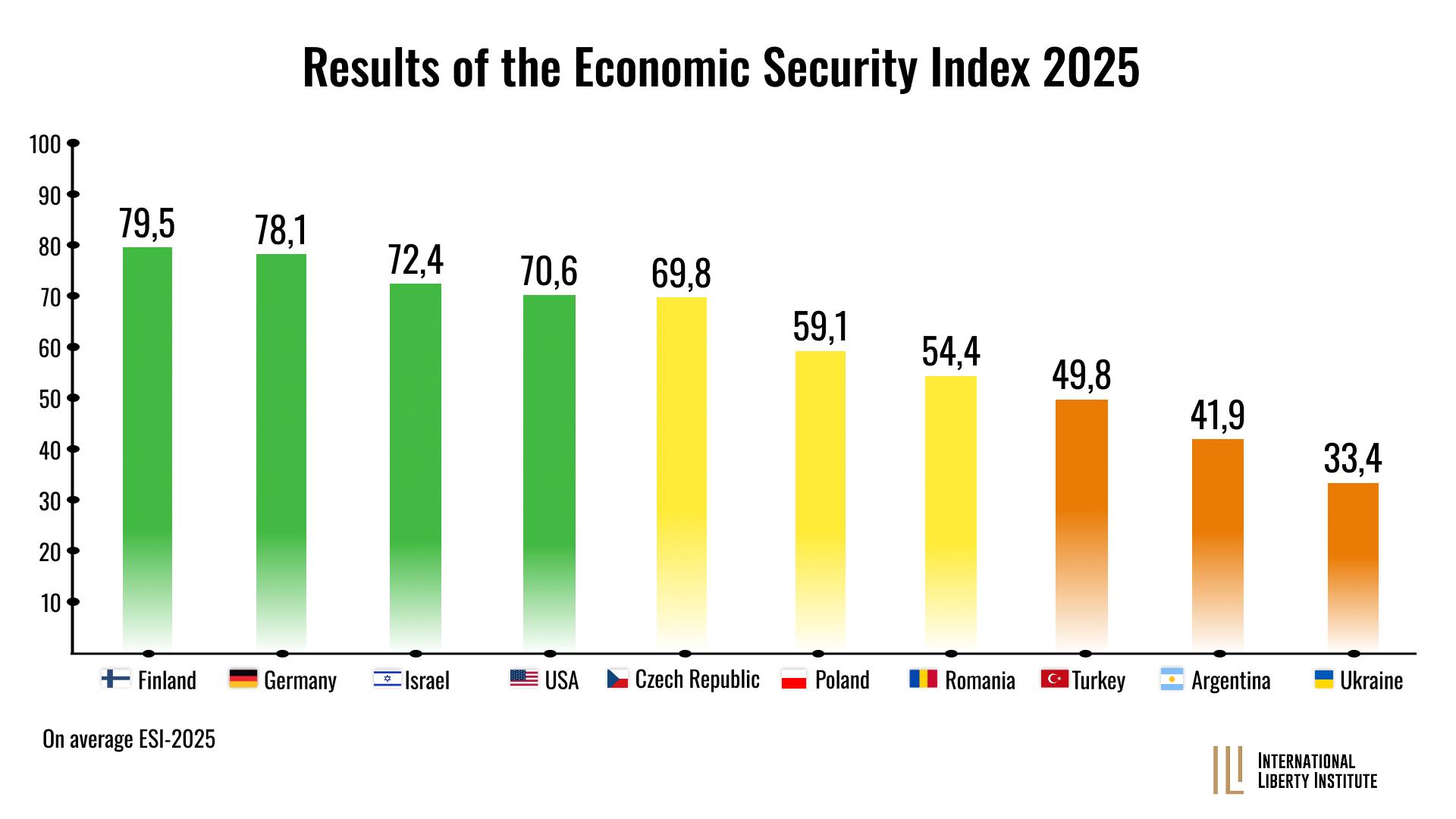
In countries of orange (Turkey, Argentina, Ukraine) and yellow (Czech Republic, Poland, Romania) risk levels, one source of risk is the inability to responsibly manage public spending on pensions, education, and healthcare, as well as high taxes, budget deficits and public debt, the low quality of the national currency, a weak and dysfunctional judiciary, poor-quality legislation, state monopolies, high barriers to market entry, and so on. When these problems persist against the backdrop of a critical demographic situation and the outflow of both human and entrepreneurial capital, they turn into a growing source of threat to the country’s economic security.
Countries in the green sector of the Index — Germany, Finland, the United States, and Israel are the examples of relatively resilient institutions and systems for ensuring both military and economic security. Israel is not a member of NATO and, for many decades, has pursued economic policies that have enabled the country to build a powerful military security and defense system, as well as ensure a high level of national competitiveness. Studying this model and development strategy provides a better understanding of Ukraine's economic security system.
Ukraine Economic Security Index
Ukraine's Economic Security Index 2025
33,4 points
orange level of insecurity

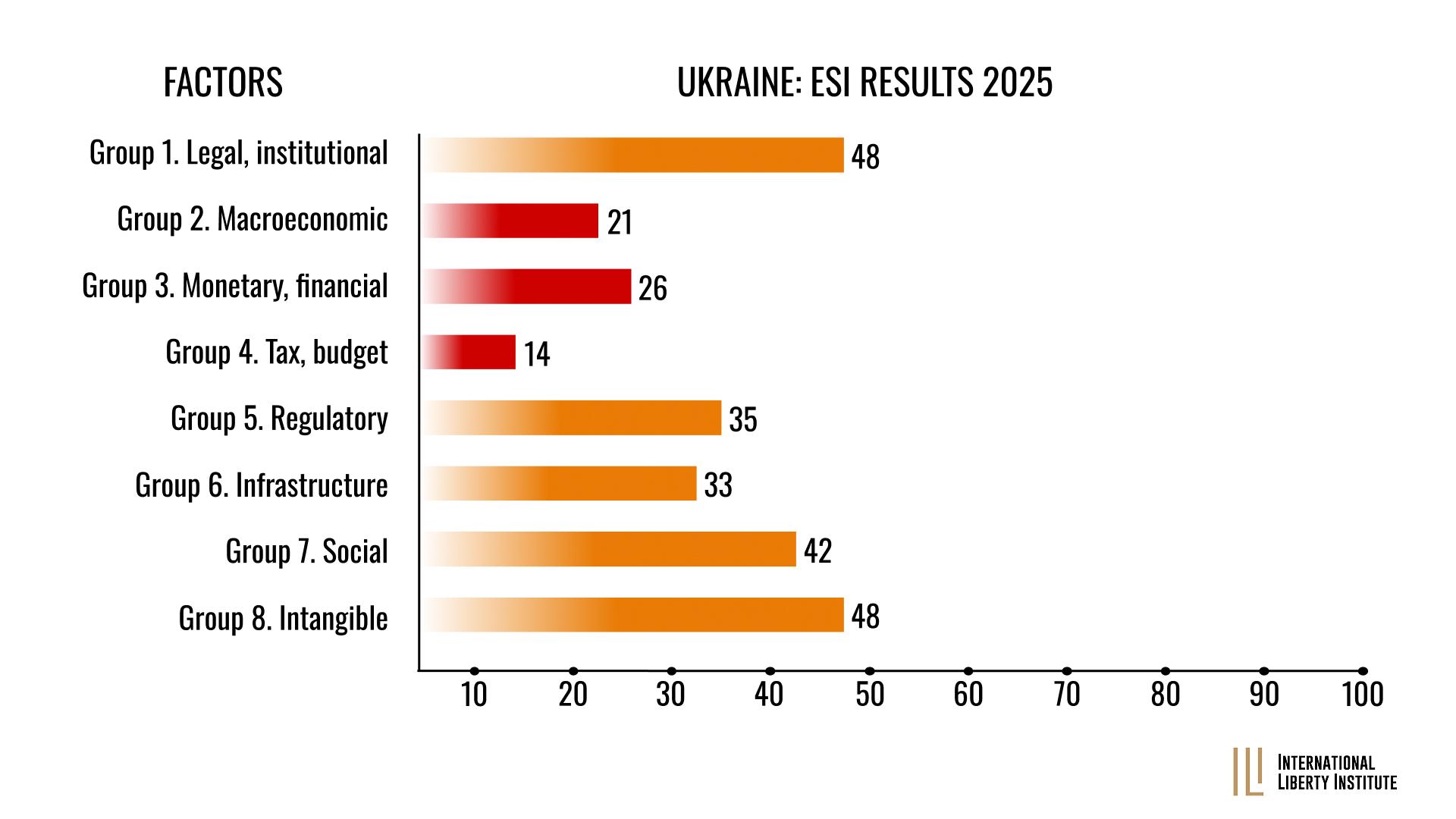
Ukraine's worst result among eight groups of factors, according to the tax and budget factors indicator, is 14 points. The budget and tax system is one of the key elements of the economy. When it is in the red zone, the country weakens itself through the actions of its government and parliament, causing damage.
The second group of factors that led Ukraine to be placed in the red group of factors is macroeconomic factors — 21 points out of a possible 100. This is further evidence that the Ukrainian government is the biggest source of risks and threats to the national economy.
In terms of monetary and financial factors, Ukraine has 26 points, which is also on the border between the red and orange risk zones.
General conclusions of the Index
For a high level of economic security is the creation and maintenance of high-level legal, economic, and administrative institutions that guarantee the country a high level of personal, political, and economic freedom, reliable protection of property rights, ensuring freedom of choice for producers and consumers in a regime of open competition and macroeconomic stability.
Central and Eastern European countries have managed to take advantage of their membership in the European Union to increase their economic security. The countries that have achieved the highest level of economic freedom, managed to curb the expansion of state intervention in the economy, integrated their countries into global and regional value chains. EU membership alone, without internal legal and economic transformations, high-quality macroeconomic policy, and protection of the economy from state interventionism, does not guarantee the creation of a reliable national economic security system in the country.
Israel, despite facing constant military threats, has managed to create powerful institutions for economic growth and development based on Mises/Schumpeter's theory of entrepreneurial growth. The solid foundation of his national economic security system is high-quality macroeconomic policy, reliable money, full integration into the global financial system, and an unconditional focus on human and entrepreneurial capital.
Get the full text and recommendations
Download 
Subscribe and get a fresh research every month
Subscribe for the newsletter and be the first to know about our events and new publications
By subscribing, you agree with our Privacy Policy Privacy policy