The wars that break out around us almost every day make it feel as if the whole world has gone mad. The question inevitably arises: where is all this heading, and how will it end?
The prospect of a global "world" war seems quite real today. Let’s try to assess how realistic this prospect is and briefly analyze the factors that influence it. Since wars are started and ended by states, not “nations,” we should begin our analysis with this remarkable creation of the human mind.
The first thing we need to understand is that the state is a product of war.
The state is a means of institutionalizing war, that is, of institutionalizing the forcible redistribution of wealth in favor of the aggressor. "Tax" is such a decision. It replaces robbery—a situation where an aggressor comes and goes. Instead of “let’s loot as much as we can and run away,” the new mindset is “let’s settle among the vanquished, who will keep paying us”.
The "spontaneous emergence" of a state, as believed by some reckless believers, is impossible under customary law. In a stateless society, the only way this technology can be replicated is once it has already become known and popular among actual and potential criminals. But the initial emergence of this technology is the result of "entrepreneurial ingenuity," the result of the evolution of looting and robbery techniques.
Under customary law, which is based on the principle of membership, one can only rob others with impunity, non-members of their legal community. For a state to emerge, there must be a war between “us” and “them,” and after victory, armed with technological knowledge, “us” will establish a state among “them”. Their people” will regularly pay “our people; otherwise, “our people” will imprison them or kill them.
As a side note, Olson’s interpretation of this process turns everything upside down. In his view, the replacement of the "nomadic bandit" with the "sedentary bandit" is a positive development (for the victims of robbery). In reality, it is the bandit who makes the choice here, and if “nomadic banditry” were more profitable than “sedentary” banditry, it would never have become “sedentary”.
Victims lose far more when a criminal moves from raiding to operating as a state. In a zero-sum game, there is no such thing as a win-win situation.
Everything we know about the state is the result of the refinement of this technology of institutionalizing war, which, in its original form, consists of seizing and holding territory by force and imposing a tax on everyone within it for its own benefit. Since its inception, this technology has evolved primarily to reduce the impact of aggression—that is, to make taxation as unnoticeable as possible to those affected.
We must acknowledge the fact that the state is always at war with “its own” population: it was created for this purpose, and this is its modus operandi.
Share
An "external" war—that is, military operations against another state—is an optional course of action within the scope of core activities.
Internal war always dictates the goals of external war.
The second thing we must keep in mind is methodological individualism.
"The state" is a description; it is an abstraction. It is always specific individuals who act, and the consequences of their actions—both intentional and unintentional—that shape the current social landscape. Individuals act only after making a choice, and that choice is shaped by many factors—most importantly, incentives, i.e., persistent influences that tilt decisions in a particular direction.
Incentives shared by large groups of people lead them to act in the same or similar ways, even if they do not know one another.
This manifests itself, in particular, as trends - that is, the anticipated direction of development of a particular activity within a specific framework. This is especially important in the case of the state, because the incentives shaping those who constitute it—bureaucrats and politicians—differ radically from those of everyone else in society. Officials are the only ones who can coerce others with impunity to achieve their aims. This fact makes the group we call the “state” distinct and clearly identifiable among all other groups, and allows us to identify trends in its movement.
In the scenario of an external war we are considering, there must also be deliberate decisions on the part of the actors involved, rather than merely semi-automatic reactions to incentives within the framework of prevailing trends. The interplay of these two factors—deliberate calculation and trends—will ultimately determine what happens.
To begin with, let’s consider the obvious factors that influence the decision to support or oppose an external war.
The people who make the actual decisions about the war are not personally risking anything. They themselves do not take part in combat operations. Moreover, there is a kind of unwritten rule among the elite regarding the immunity of “political leaders”. By killing some Iranian leaders, the U.S. violated this convention, causing quite a bit of butthurt among progressive circles.
Progressive circles are now doing their utmost to argue that "this will lead nowhere”. In reality, physically eliminating the beneficiaries of war is the only truly effective strategy if you genuinely want to win or at least stop the war, but it works for the defending side, not the attacking side.
Bureaucrats aren't really taking any risks either. This point is even more important than the first one, and it could be said that the unspoken pact regarding the immunity of top officials is the creation of the “bureaucratic international” itself, rather than of politicians.
The bureaucracy, whose actions lead politicians to choose war, is considered “non-combatants” and, following the defeat of “their” state, they easily and readily switch to serving the new administration. After all, someone has to build roads and catch criminals! This point is important because it is not a matter of choice for individual private citizens, but a trend. The bureaucracy won't necessarily be "for the war," but it won't be strongly against it either.
The people who make decisions about war do not spend their own resources, but those of others. This is a crucial factor. It is not understood, for example, by those who argue that, “under your libertarianism,” private military companies would immediately go to war with one another. They would not, because they could only spend their own money on it. They do not have an inexhaustible source of funding in the form of taxation and inflation.
States on the world stage are in a state of anarchy. At the same time, given the reasons mentioned above, this is a very specific form of anarchy. In a state of natural anarchy, because everyone risks their own life and is personally responsible for the consequences, law inevitably emerges. In a situation where no one is held accountable for anything, no right can exist. This is a key factor in favor of war as a political decision.
The state system of governance is the worst of all possible systems, for the reasons discussed at the beginning of this note. Understanding these reasons shows that the state was not created to “manage the common good,” as is commonly assumed in popular opinion. It is an extractive institution, and it can be nothing else. Even if one assumes that some “common good” genuinely requires management, it is certainly not the kind of management the state claims to provide. This factor neither promotes nor restrains war; rather, it guarantees systemic inadequacy in all forms of decision-making.
Speaking of the present moment, in fact, the growth of markets has made the war less destructive. This is evident in the case of Ukraine: despite the inhuman efforts of the Russian and Ukrainian governments, the markets are holding up, providing Ukrainians with basic necessities and other essentials. The trend toward reduced destruction—if this is understood to mean not only the physical destruction of certain objects but also a decline in living standards—clearly favors the decision to go to war, if it is deemed necessary.
Why do Politicians Start Wars?
Now, let’s talk about why politicians are generally tempted to decide to wage an “external” war. Here, two facts are important for us.
Fact number one: the state is always expanding.
This is a characteristic of all systems of this type. The expansion of the state occurs through an increase in its power over you and a decrease in your power over yourself.
This process leads to an expansion of the government's authority and a corresponding increase in its budget and staff.
Maximum expansion is the very purpose of a state’s existence; it is an inevitable process, and political decisions can only slow it down, but cannot stop it, since it is the result of the same incentives acting upon a large number of people. These incentives can only be eliminated together with the state itself.
The second point is that, as has been known since the time of David Hume, all authority is based on consent.
Nothing seems more surprising to those who view human affairs from a philosophical perspective than the ease with which the majority submits to the minority. Power always lies with those who are governed, while those who govern have nothing but public opinion.
Source: Hume D. Of the first principles of government. In: Haakonssen K, ed. Hume: Political Essays. Cambridge Texts in the History of Political Thought. Cambridge University Press; 1994:16-19.
“Consent” is a rather unfortunate term; it’s easy to confuse it with “approval.” In reality, the point is that there are limits to a state’s behavior that it would be wise not to cross, otherwise that particular government will face problems with “its own” population.
Thus, the expansion of the state almost always occurs through a "search for consent," through the shifting of the boundaries of authority in one's own favor. To put it simply, before taking away any of your power, the government must have a compelling reason to do so.
The classic approach involves first intimidating you and then “solving” the problem by forcing their “services” on you, which always means you lose your right to resolve the issue yourself (if it even exists at all). As our own experience once again demonstrates, an external war is the ideal scenario for expanding the state’s victims’ acceptance of the loss of a significant portion of their autonomy.
It is important to note here that this rule applies equally to both the aggressor state and the victim state. Both sides stand to gain from the war. This makes the decision to go to war more popular among the political elite.
However, while war is an excellent way to expand a state, it also poses risks for the elite. War is an unpredictable process, and things can easily go awry (especially given the quality of the state’s “governance”). A crushing defeat in war can result in losses not only for politicians but also for the state itself, since people in such situations tend to disregard the state and act on their own initiative.
Furthermore, the possibility of using war as a means of expansion depends to a large extent on the nature of the consent. If the public tolerates you because they believe your power is somehow linked to the fact that “our grandfathers fought in the war,” then it will be quite easy for you to start a war with an external enemy—especially one you’ve been nurturing in your propaganda for many years.
If you have a green transition, eating insects to save the planet, and you can’t distinguish a man from a woman, then war will be a very bad decision for you.
The Crisis of Democracy
When are politicians more likely to make decisions in favor of war?
As we have already mentioned, when the terms of the consent allow them to do so. Countries that have “sworn enemies” (Serbia–Croatia, India–Pakistan, Greece–Turkey, etc.) or a religious justification that calls for the destruction of infidels (Muslim states such as Iran and Afghanistan), find it much easier to go to war against the respective adversary.
Countries in a state of crisis are far more likely to resort to conflict.
Such countries make up the majority on our planet, and their number is growing.
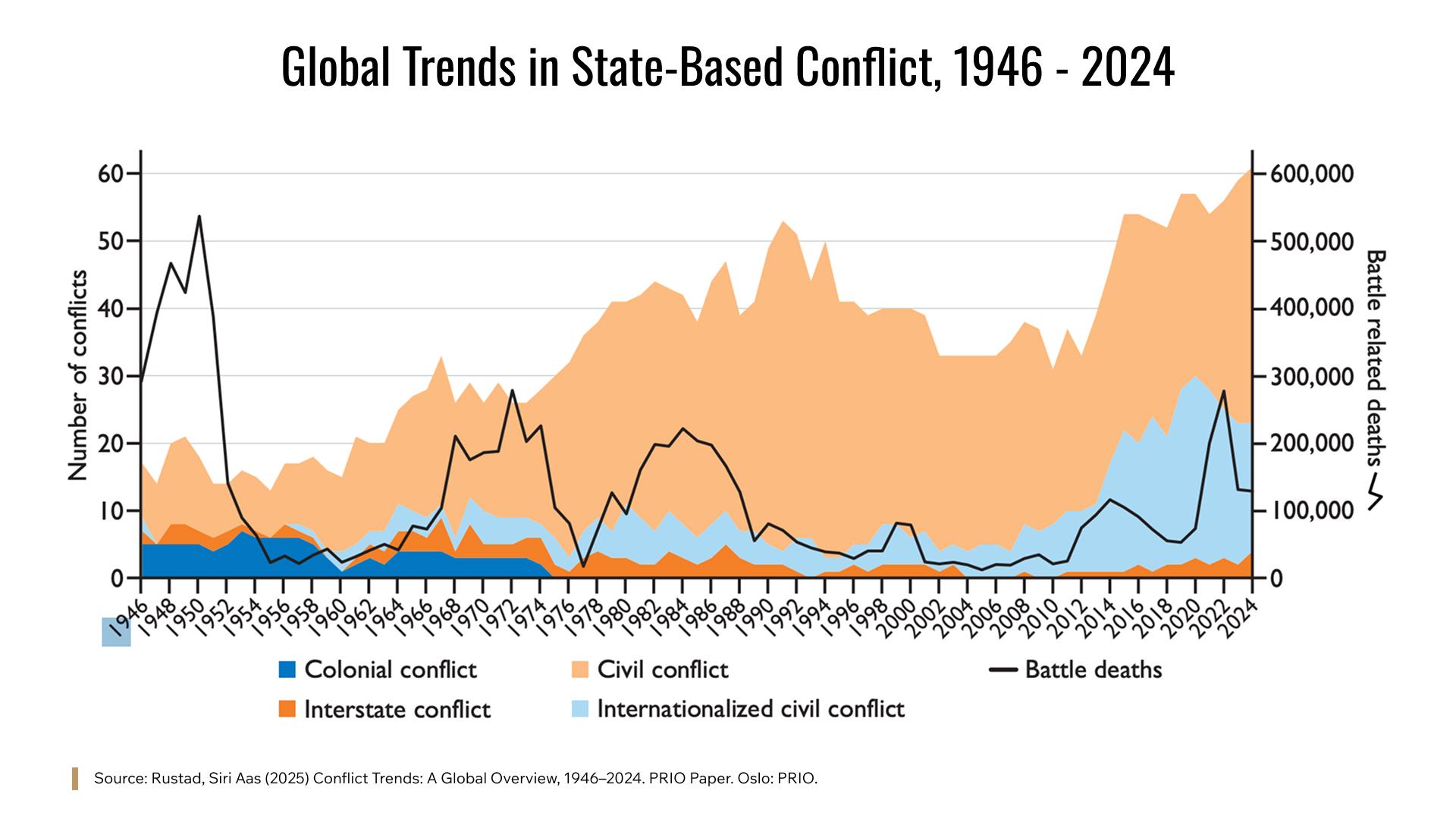
According to various estimates, the number of failed states (now politically correctly referred to as “fragile”) ranges from 20% to 60%. It is therefore not surprising that there were 86 wars in the 19th century and 230 in the 20th. At this point, someone might tell me that this explosive growth is linked to the increase in the number of countries following the collapse of the colonial system. Having come into existence, they all, of course, wanted to go to war first and foremost. However, in the 1950s, there were “only” 15 wars, whereas in the 2020s—which are far from over—there are already more than 40, according to the report “Conflict Trends: A Global Overview.”” So the progress is clear.
Source: Rustad, Siri Aas (2025) Conflict Trends: A Global Overview, 1946–2024. PRIO Paper. Oslo: PRIO.
Politicians are more likely to opt for war when a country faces a crisis, since war wipes the slate clean.’ The increasing number of wars indicates that a crisis exists and is intensifying.
Share
Not every crisis can become a cause of war.
It is commonly believed, for example, that poverty causes wars, but this is not the case. On average, the standard of living is steadily rising, and today only about 9% of the world’s population lives “below the poverty line” (compared to about 50% as recently as 1966).
Source: Hans Rosling, Anna Rosling Rönnlund, Ola Rosling. Ten Reasons We're Wrong about the World--And Why Things Are Better Than You Think, https://tuningjohn.com/book/fact/
At the same time, the number of wars is also increasing.
So, a state crisis is not related to increasing poverty, but rather to increasing wealth.
This is not correlation but causation, because an increase in wealth means an increase in opportunities and greater complexity, and this is the main challenge for states.
It should be noted that this complexity is growing rapidly; (Hans Rosling) emphasized that the bulk of the increase in wealth occurred in the 20 years before the publication of his book, when poverty was cut in half.
This connection is not surprising. As I have already said, the state is the worst form of government, incapable of coping with increasing complexity for the simple reason that it is not a “system of governance.” As we have already established, the state is not neutral and can be considered a “system of governance” only within the narrow scope of tasks related to its extractive activities.
However, the modern “democratic state” (which accounts for the vast majority of countries on the planet) claims to be a neutral “system of governance” capable of addressing any “socially significant” issue. It builds its consent on this claim. This claim runs up against the complexity of the surrounding world, and the state inevitably collapses. It tries to fight the causes of increasing complexity. This is not difficult to understand if we pay attention to the fact that the state devotes most of its efforts to making its citizens poor (in most countries, activities related to securing means of survival are prohibited and require special state permission). Poverty means simplicity and ease of control.
However, these efforts do not produce the desired results. The state fails to cope with the increasing complexity, generating a crisis of consent that today also affects “prosperous” countries.
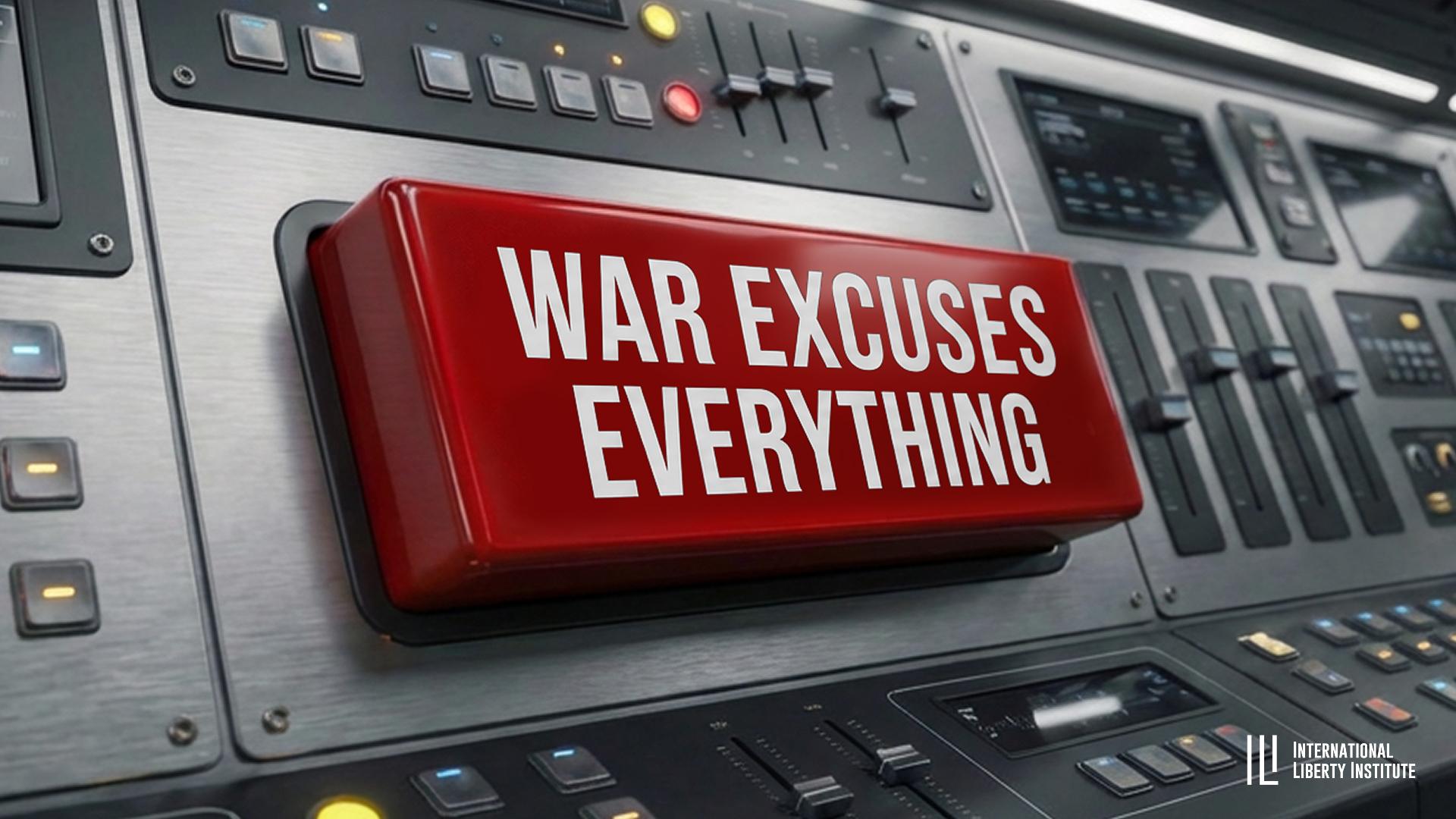
In these conditions, a button labeled “War wipes the slate clean” becomes increasingly attractive.
The scientific editor of “WellBooks” publishing house, head of Liberty Education Project. He has many years of experience in political activity and consulting, as well as work in mass media. The author of the books “Plan B for Ukrainians” and “Libertarian Perspective”.
Implementing the conclusions and benchmarks of the Economic Security Index guarantees quick results that will be felt in the country's defense capabilities and economic growth within a year.
A case study for Ukraine. British entrepreneurs created a powerful military aviation industry under the bombardment of the Third Reich in just six months.
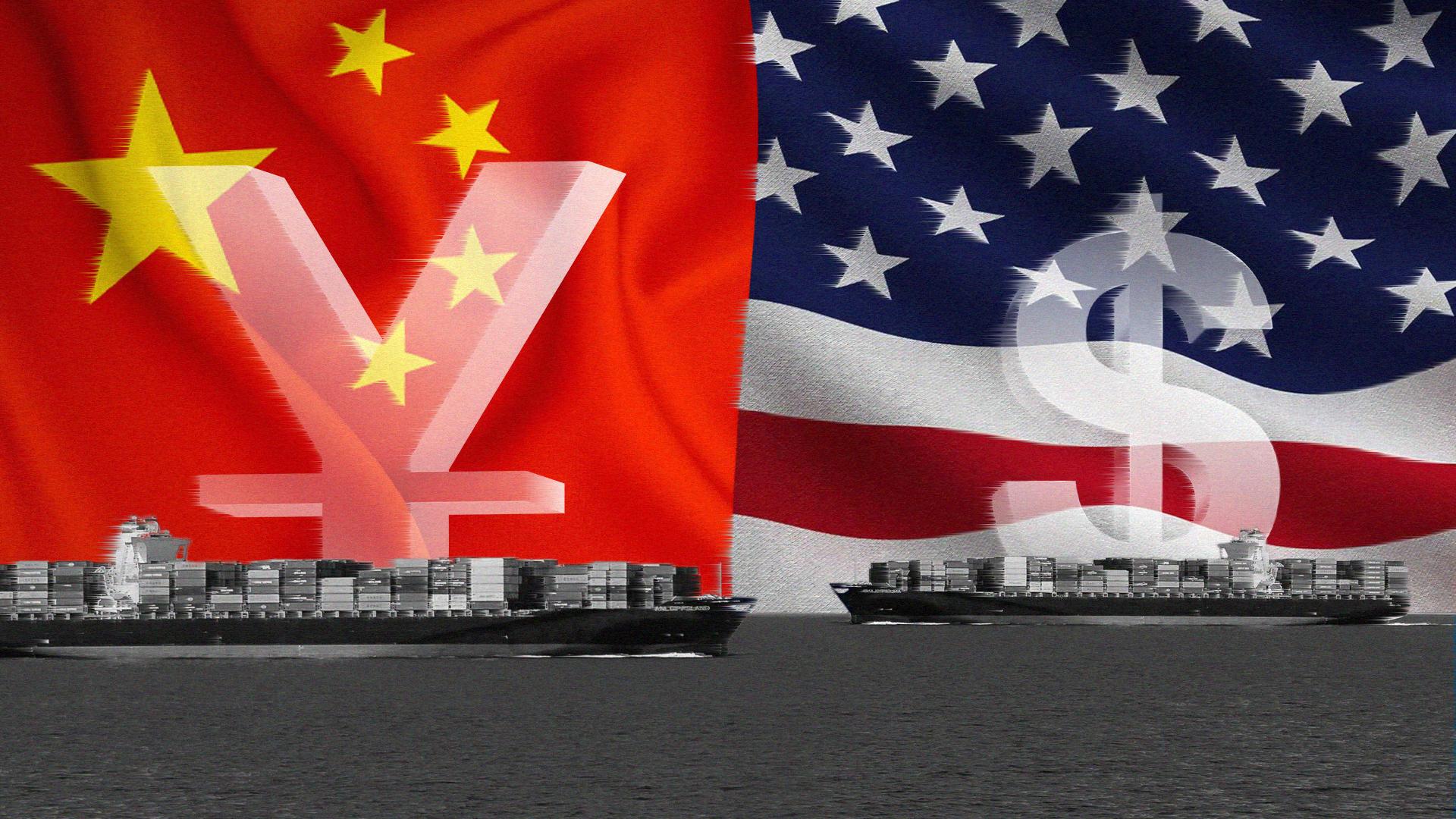
The cost of the US-China trade war. How China defeated the EU and the US with their weapons. Why democracy will lose the war against totalitarianism. Principles of the new international trade system.