


Economic Security: Index 2025
Implementing the conclusions and benchmarks of the Economic Security Index guarantees quick results that will be felt in the country's defense capabilities and economic growth within a year.
Share
A few years ago, economic security was considered to be limited to issues such as ensuring the country's supply of food, energy resources, and critical components for domestic production. Within the framework of their own understanding of economic security, governments resorted to trade protectionism, introduced special regulatory regimes, practicing discrimination, and leadership. Due to the war, such economic policies slowed down economic growth, hampered investment, and increased the opportunity costs for both producers and consumers. But no conclusions were drawn, with imbalances being attributed to "market imperfections" or "external circumstances".
https://commission.europa.eu/document/download/e6cd4328-673c-4e7a-8683-f63ffb2cf648_en?filename=Political%20Guidelines%202024-2029_EN.pdf
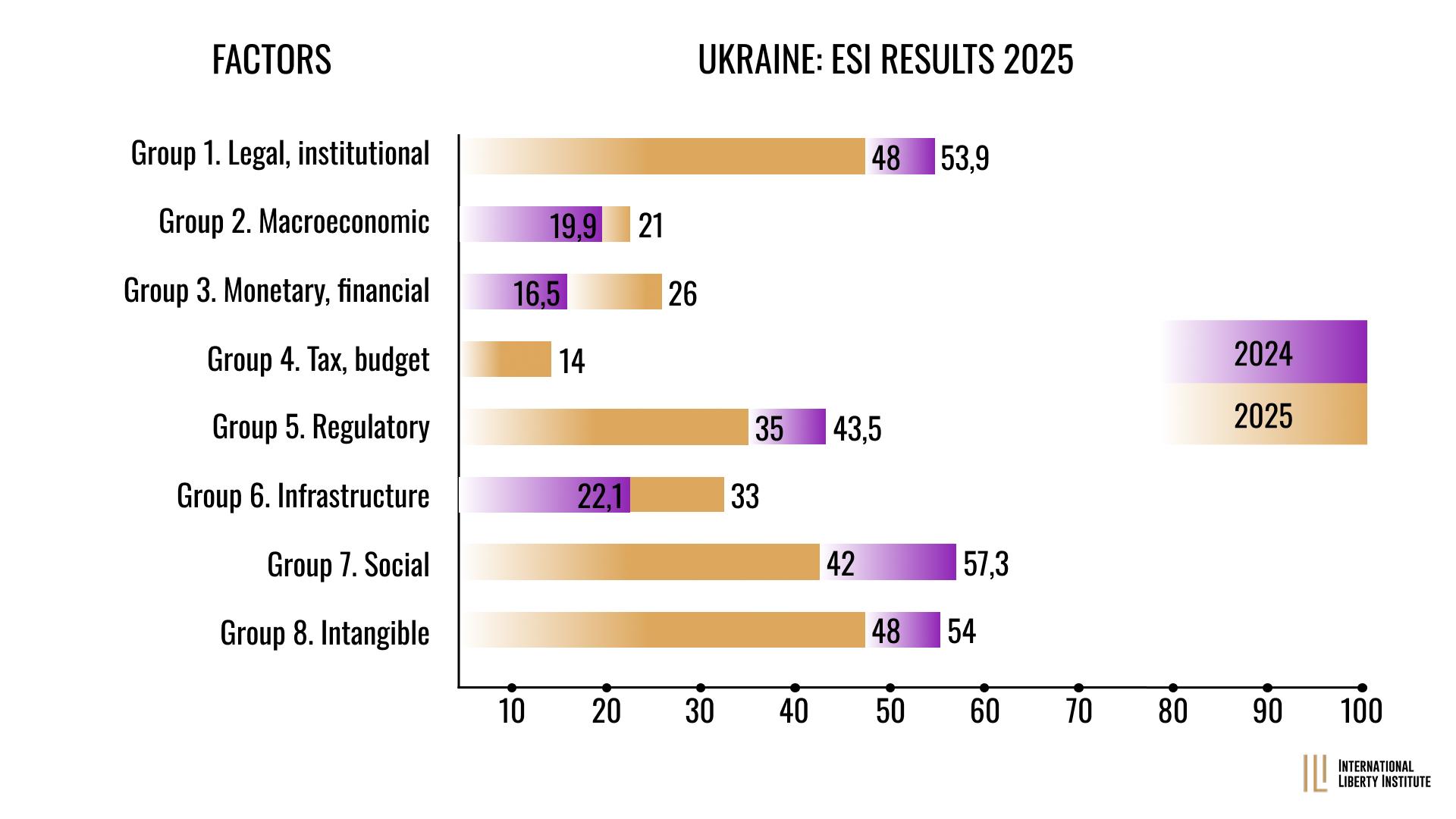
https://d2c4wny57m91c4.cloudfront.net/Index_Economic_Security_2025_ukr_3617019129.pdf
Without changing the relationship between the state and business, the erosion of Ukraine's comparative advantages after victory in the war will accelerate.
The only model that Ukraine has not used in all the years of its independence is the model of a free market and capitalism.
Unfortunately, the IMF is a source of negative practices and policies that do not improve but rather undermine Ukraine's economy. Most European Union countries have a lower tax burden in peacetime than Ukraine has during wartime. At the same time, the IMF is forcing further increases in this burden. They do not understand the nature of small businesses in Ukraine and how it affects not only budget revenues, but also stability, solidarity among entrepreneurs, and the spirit of Ukrainian identity in general. We recommend that the government, in light of the index's findings, not implement the IMF's recommendations.
Human-centered approach to Ukraine's Economic Security Concept
It is the individual, as an integral part, who should be at the center of the national economic security system.
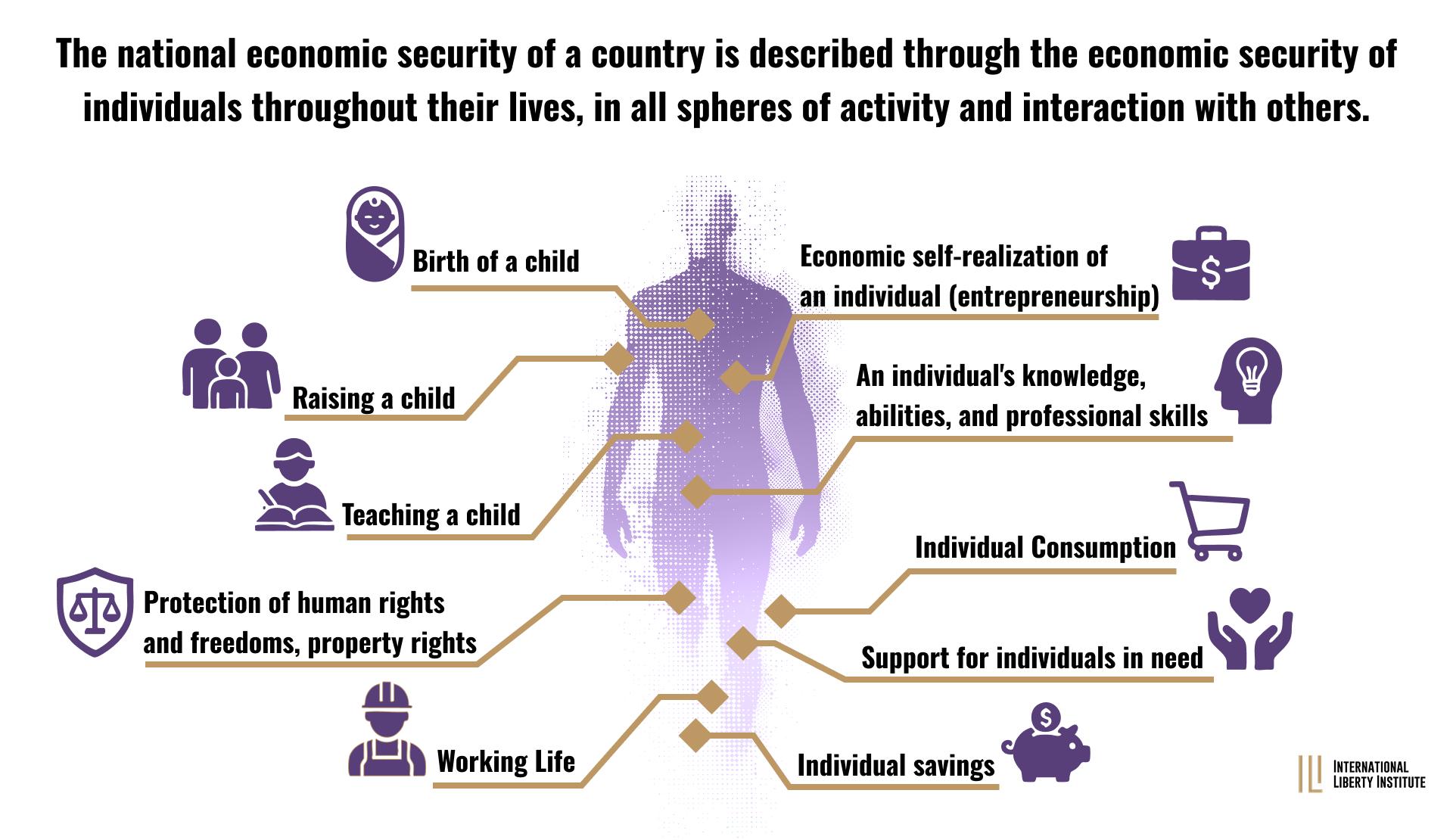
We proceed from the assumption that economic security should be based on the protection of human rights and freedoms, property rights, and equal opportunities in labor and entrepreneurship. This requires a clear legal and institutional framework that limits the functions, size, and powers of the state in the economy. In fact, in Ukraine, an official possesses the state. The straitjacket for the government proposed in the Index Recommendations serves as a beacon toward which we should move.Share

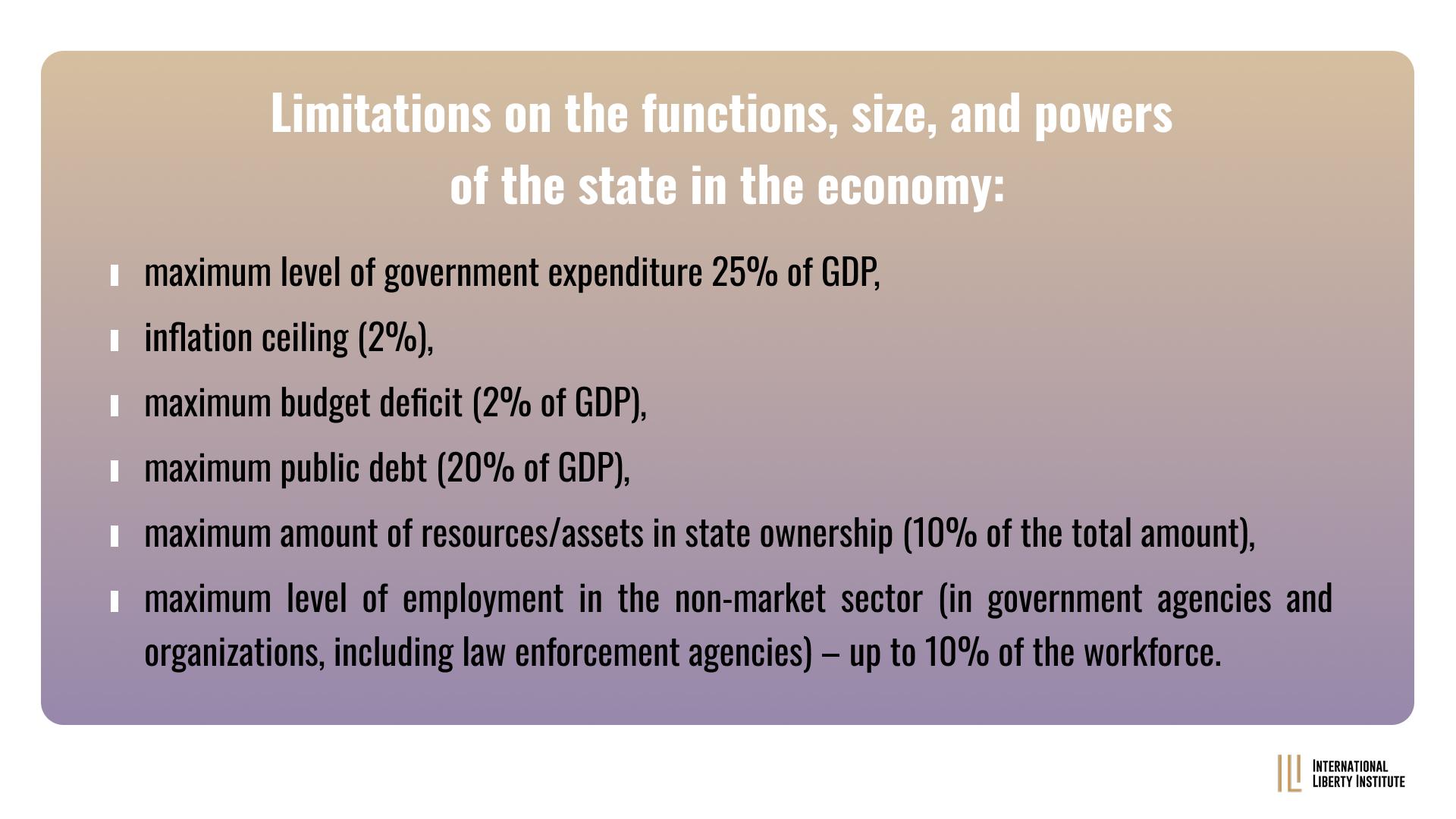
Recommendations to the Government of Ukraine and the governments of the countries in the “orange zone” of the Index
- Conducting a thorough review of legislation, taking into account scientific findings and empirical observations;
- Reduction of the functions, size, format, and mode of the State's presence in the economy;
- Abandonment of the practice of “growth points” and strategic sectors;
- Ukraine's entry into the Top 30 countries in the world according to important global indices;
- Deregulation, privatization, and new fiscal and monetary policies;
- Conducting an annual audit of the state, setting clear deadlines for improving economic policy parameters;
- Make the main laws that define the parameters of economic policy consistent with the Mises-Hayek-Schumpeter model of entrepreneurial growth.
Share
Topics
Trending
Natalia Slyusar
The editor-in-chief of the website of the International Freedom Institute, a manager of media projects. With a background in journalism, media management, consultancy, and business leadership, she works to advance the ideas and philosophy of AES in the media space.


Tetiana Stroiko
Tetiana Stroiko, science editor of ILI. Doctor of Economic Sciences, Professor of the Department of Intelligent Digital Economy at the National University of Shipbuilding named after Makarov (Mikolayiv).
Yaroslav Romanchuk
A well-known Ukrainian and Belarusian economist, popularizer of the Austrian economic school in the post-Soviet space. He specializes in reforms in transitional economies in the post-socialist space.

We recommend
Economic Security
The orange level of the National Economic Security, in which Ukraine is currently located, is a natural result of many years of "activity" of the State. What prevents the rapid development of a country with such high potential?
Deglobalization 2.0
The path to an "all against all" regime in the global economy is open. Consequences of the New US Foreign Trade Policy for the Countries of the World and Ukraine
Common sense economics
A true people's economics is the one when people themselves choose goods, services, investments, and governance under conditions of open competition, free trade, personal responsibility, and social solidarity.