Is Ukraine fighting the war at the expense of other countries? An analysis of the actual military and financial expenditures of Ukraine’s partners in 2022–2025 relative to their GDP. Assessment of military and non-military expenditures and sources of increased funding for the Armed Forces of Ukraine.
Ukraine needs military and financial support from our partners and allies. Without it, it is impossible to defeat a powerful, well-resourced enemy. But in the fifth year of the war, it is important for us to explain to the world that Ukrainians are working at the limit of their capabilities, supporting the Armed Forces, and financing the defense. Clearly, we are at the epicenter of an existential armed conflict between the West and the Axis of Evil (Russia, Iran, North Korea, China, and Belarus). The old global order — its rules, norms, and institutions—is breaking down, and the eroded system of international law is beginning to fracture.
On the one hand, this is necessary so that our foreign partners can see an objective picture of fiscal policy and the amount of domestic resources that Ukraine allocates to defense.
On the other hand, such information makes it possible to assess the volume and scale of assistance provided by the EU, the U.S., and our other partners, to avoid the impression that Ukraine is defending itself and waging war against the Russian aggressor primarily at the expense of foreign aid.
Russian propaganda, operating through agents of influence in Western countries, constantly spreads the claim that the U.S., the EU, Canada, and other G7 countries are spending enormous sums of money on Ukraine, thereby depriving their own citizens of social and economic opportunities. One of the key messages of Russian propaganda in the West goes like this:
L"Ukraine receives enormous sums of money from the West, which are funneled through the corrupt state system rather than being used to support the Armed Forces of Ukraine. Ukraine is abusing the West’s trust, and its government is funding corrupt projects and schemes run by oligarchs."L
Well, let’s use facts and figures to analyze whether there is any basis for such a claim.
What does the modern world look like in light of escalating conflicts and the erosion of old treaties and institutions? The World Trade Organization (WTO) has become a mere shell. The weaponization of foreign trade, combined with an active industrial policy, is gradually dismantling the division of labor that has developed over decades.
The Iran-U.S. conflict, the Iran-Israel conflict, armed clashes between Pakistan and Afghanistan, and the Russia-Ukraine war are creating an unprecedented situation and atmosphere within the global security system. Wars and conflicts around the world are reshaping the structure of capital and transforming production and logistics chains. As a result, the energy commodities market came under significant pressure.
The escalation of military threats calls for a thorough review of the national budgets of developed and developing countries, with a view to increasing funding for the armed forces, arms production, and the entire defense infrastructure. Since these sectors of the economy, especially in the European Union, have been significantly underfunded over the past 25 years, today it is necessary to increase military spending not by a few percentage points, but several times over.
With public expenditure in the EU currently at nearly 50% of GDP and public debt at 80% of GDP, along with a chronically high-budget deficit and slow economic growth, reordering budgetary priorities requires strong political will and a willingness to abandon a range of programs that taxpayers have been funding for more than 20 years.
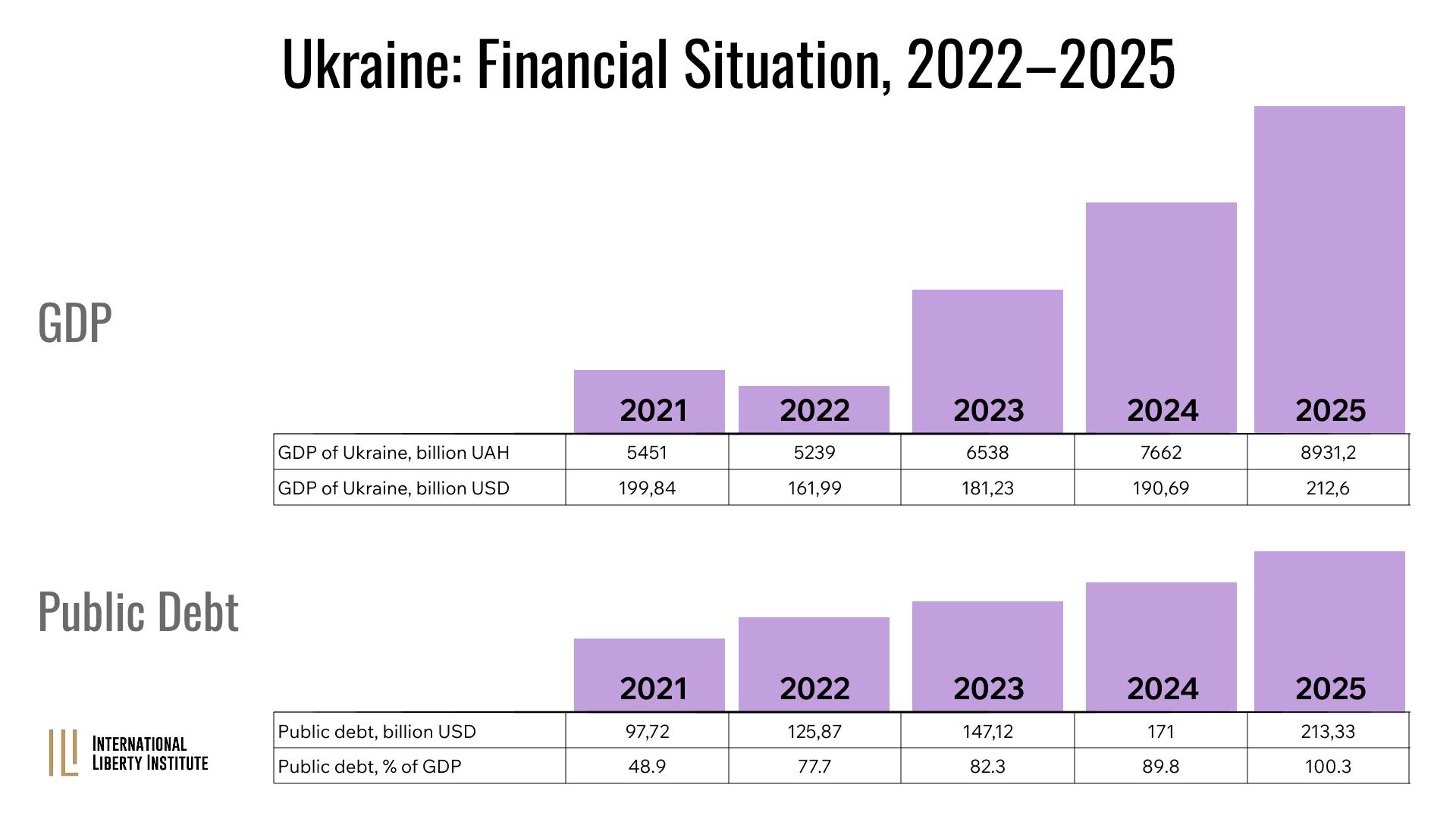
In 2024, public debt in the EU stood at 80.7% of GDP, and in the euro area at 87.1% of GDP. Total government spending in the eurozone countries amounted to 49.5% of GDP in 2024, and 49.2% of GDP in the EU. In the United States, public debt has long exceeded 100% of GDP. According to IMF estimates, public debt in the G7 countries exceeded 125% of GDP.
Military and Financial Assistance from Partners and a Comparison with Expenditures from the Ukrainian Budget
Assessing the contributions of Ukraine and its foreign partners to the financing of our country’s military and non-military expenditures for the period 2022–2025 is becoming increasingly important for understanding actual, rather than merely verbal, support. The data on military and non-military expenditures are based on information from the Ministry of Finance of Ukraine, and data on foreign aid, according to the Kiel Institute for the World Economy were published on February 11, 2026.
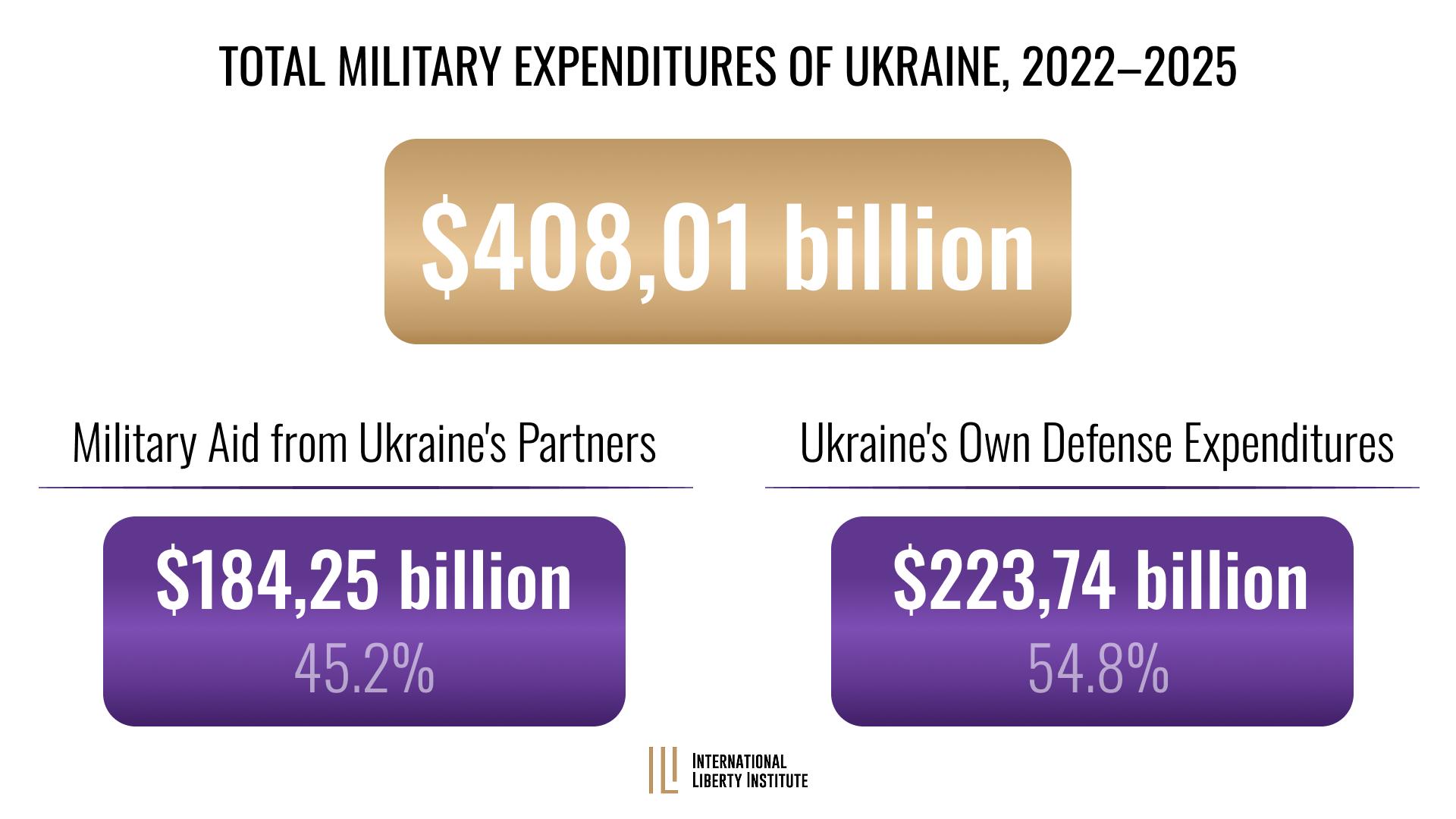
Between 2022 and 2025, military aid to Ukraine from foreign partners totaled $184.27 billion.
This refers to a military allocation—that is, a decision to provide military aid—rather than the aid actually received by Ukraine during this period.
During the first four years of the war, Ukraine allocated $223.74 billion in budgetary expenditures under the “defense” category.
The total military expenditure amounts to $408.01 billion.
Ukraine’s share was 54.8%, while that of foreign partners was 45.2%. It should be noted that this refers to allocated resources, not those actually received.
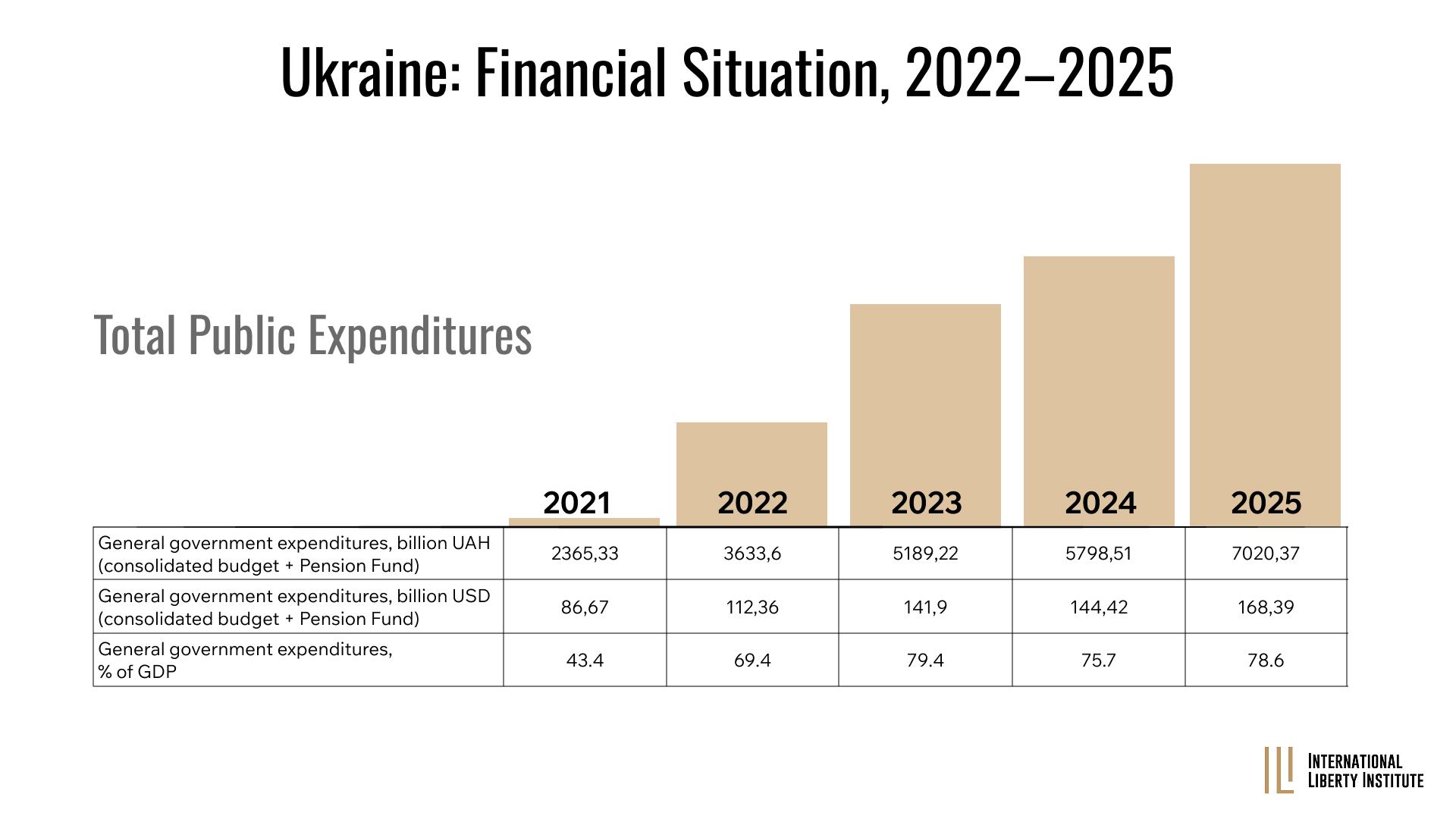
On average, during this period, 46.2% of GDP was spent on non-military purposes.
Actual financial support provided to Ukraine by foreign countries during this period amounted to $179.46 billion, or 52.3% of total expenditures.
Assuming that all funds allocated by foreign governments were transferred to Ukraine’s budget, their share of total expenditures in 2022–2025 amounted to 52.3%, while domestic Ukrainian resources accounted for 47.7%.
The revenue side of Ukraine’s consolidated budget for this period includes EU aid totaling $51.76 billion. It is likely that the rest of the funds are accounted for as off-balance-sheet expenditures. In total, between 2022 and 2025, foreign countries decided to provide Ukraine with financial, humanitarian, and military aid totaling $390.67 billion (this accounts for 40.8% of all expenditures by Ukraine's government agencies and total foreign aid).
During this period, expenditures by Ukraine’s government agencies totaled $567.07 billion (59.2%).
If the situation regarding external financing deteriorates, the reallocation of budgetary resources between the military and non-military sectors is the primary additional source of funding.
At the same time, it is necessary to significantly reduce non-military spending.
Between 2022 and 2025, average annual non-military expenditures amounted to 46.2% of GDP.
Ukraine’s weak economy—with limited participation in the European and international division of labor, weak institutions for protecting property rights, poor-quality public administration, and state dominance in the economy—cannot afford a level of government spending amounting to 70–75% of GDP. This hinders economic growth, fuels corruption, demoralizes private enterprise, and exacerbates the crisis of confidence in the country.
Share
Thus, a deep fiscal reform—that is, a radical change in the structure of the tax system, including tax administration on the one hand, and a review of the budget’s expenditure side on the other — taking into account the state of the armed forces and the needs of the front, is not only a comprehensive measure to achieve macroeconomic stability. It is also part of efforts to strengthen defense capabilities and improve support for the armed forces.
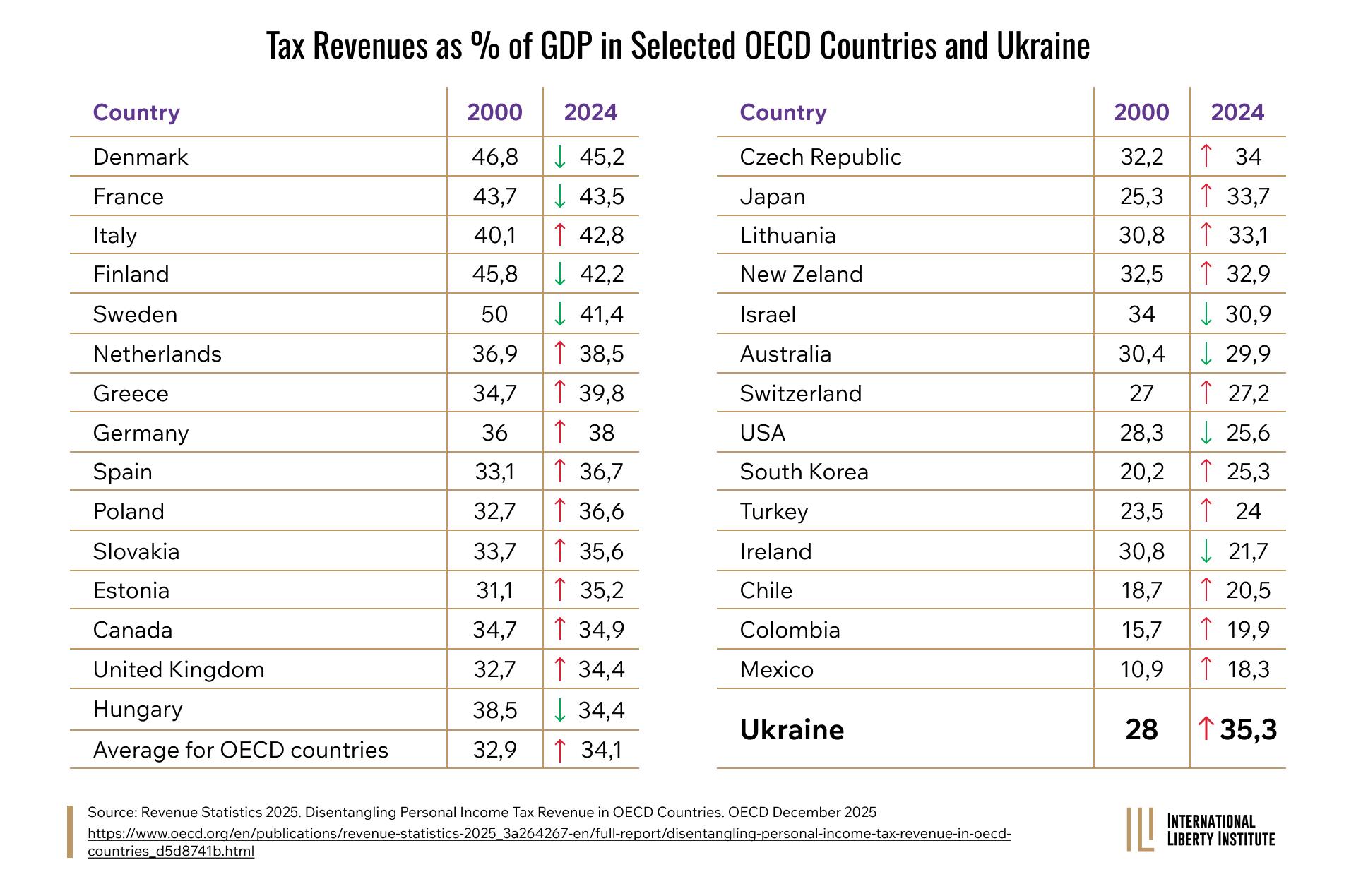
The option of increasing the tax burden in Ukraine has long been exhausted—it is already excessive.
In 2025, Ukraine's tax revenues amounted to approximately 37% of GDP, exceeding the OECD average. Both raising existing tax rates and introducing new taxes—including those on micro- and small businesses—will only lead to an expansion of the “shadow” economy and an outflow of entrepreneurial capital, with negative consequences for budget revenues.
Is Aid to Ukraine an Unbearable Burden for our Partners?
It is clear that the Ukrainian economy is operating at the limits of its capacity. A high tax burden, regulatory burdens, high transaction costs amid high security risks, power outages, and the crowding out of private commercial activity by the state have significantly slowed Ukraine’s economic growth.
In 2023, GDP grew by 5.5%, in 2024 by 3.2%, and in 2025, real GDP growth was only 1.8%. Compliance with the demands of foreign partners, including the IMF, to increase the tax burden and incorporate the European Acquis communautaire into Ukrainian law—which entails high administrative costs—will weaken the Ukrainian economy, increase budgetary pressures, and undermine funding for the Armed Forces of Ukraine and the defense industry. It is critically important to convey this message to our foreign partners.
It is also critically significant to convey to our partners the actual figures for the assistance (military, financial, and humanitarian) provided to Ukraine, considering the size of their economies and government spending. Ukraine’s enemies and opponents, those who oppose supporting us, constantly parrot Russian narratives claiming that the EU, the U.S., and the G7 countries are providing Ukraine with massive aid, thereby revealing their own national priorities.
The core of one of the popular narratives in Russian propaganda is that developed countries are depleting their budgets and cutting social programs, thereby exacerbating the cost-of-living crisis. A comparison of the total amount of support and funding provided to Ukraine by developed countries debunks this myth. From 2022 to 2025, support for Ukraine from developed countries in the EU and the United States remains meager and completely inadequate given the nature and scale of the threats that Nazi Russia poses to the West.
For example, the total U.S. GDP for 2022–2025 was $113.8 trillion, while total government spending over the four years was $42.7 trillion. The total amount of aid provided to Ukraine amounted to $131.45 billion, or 0.12% of GDP, or 0.31% of total government spending. There is no doubt that this level of funding has no impact on the budgetary sustainability of U.S. fiscal policy, nor on social programs or any other programs. The Trump administration, which constantly talks about the huge sums Ukraine has received, likely does not view U.S. aid through the lens of GDP and government spending.
The situation is roughly the same for the EU as a whole. Thus, total European aid for the period 2022–2025 amounted to $95.81 billion. This represents 0.13% of the EU countries’ GDP or 0.26% of their total public expenditure.
Considering that the Russian war is ongoing on the European continent and that over the past four years (2022–2025) the nature and objectives of the Russian totalitarian empire toward Ukraine have become clear, actions of this kind by the EU—especially by its more developed countries—are completely irresponsible and infantile.
When less than half a percent of total government spending is allocated to neutralizing and eliminating the main real threat to peace in Europe, we have grounds to speak of a deep crisis in the pan-European security system. It also reflects the inability of the main EU policymakers, G7 countries, and NATO to set their priorities in light of Russia’s protracted war against Ukraine and the West. The resources actually allocated to support Ukraine are mere crumbs compared to the hundreds of billions of dollars that continue to be spent on energy subsidies, agricultural subsidies, and numerous government programs related to the “green” climate agenda.
Conclusions
It is crucial for the Ukrainian government, as well as for Ukrainian civil society, the business community, and all those involved in political, diplomatic, humanitarian, and commercial activities between Ukraine and our Western partners, to demonstrate the actual extent of the support provided to Ukraine.
In a situation where Ukrainian households and businesses are operating at the limits of their capacity, the expenditures of the EU, the US, and G7 countries remain within the margin of statistical error of their budgetary policies.
Maintaining this situation undoubtedly plays into the aggressor’s hands. This scale and format of aid increase Ukraine’s losses, costs, and damages; prolong the war; and exacerbate the crisis of confidence both within Ukraine and within Western countries, particularly the EU. Moreover, such an attitude toward Ukraine at a time when Western civilization faces one of its greatest existential threats seriously damages the reputation of the West itself. It is so deeply immersed in the inertial processes of a state of general interventionism and so infantilized that it is incapable of confronting the civilization of barbarians—not only in the form of Nazi Russia but also totalitarian North Korea and China, as well as fundamentalist Iran.
A fundamental reassessment of Western countries’ priorities in the areas of security, military-industrial policy, fiscal and tax policy, and partnership with Ukraine in countering Russian aggression is necessary for all members of the Forces of Good—that is, the West and Ukraine.
On the agenda are not minor day-to-day issues under “miscellaneous" but the very problem of Europe’s survival as we know it today.
A well-known Ukrainian and Belarusian economist, popularizer of the Austrian economic school in the post-Soviet space. He specializes in reforms in transitional economies in the post-socialist space.
A sober analysis of events, probable positive and negative developments in the new year for the world, the US, the EU, and Ukraine, and the conditions for their realization, without all-encompassing scientific “futurology” and illusions.
The state regulations and the expansion of State functions are demoralizing Ukrainians meanwhile the bureaucracy increases non-military expenditures, as in peacetime