Most countries in the world, including Ukraine, faced an acute shortage of common sense in their economies by the mid-2020s. This is confirmed by assessments of the current state of the global economy, as well as medium- and long-term forecasts.
The debt crisis around the world is deepening. At the end of 2025, the gross public debt of the United States amounted to 125% of GDP, that of the United Kingdom to 103% of GDP, that of the developed countries in the G-20 to 121% of GDP, developing countries in the G-20 – 79% of GDP, and in the eurozone, public debt amounted to 88% of GDP.
With few exceptions, governments have become the dominant economic actor—serving as producer, investor, asset manager, and the lender and insurer of last resort.
The rejection of freedom as a unique form of intangible capital for ensuring rapid, long-term economic growth is yet another telling sign of the growing lack of common sense in the economy. This is evidenced by the Cato Institute’s annual survey on human freedom.
“This means that 89.6 percent of the world’s population saw a fall in human freedom from 2019 to 2023, with many more jurisdictions decreasing (121) than increasing (42) their ratings and 2 remaining unchanged. The sharp decline in freedom that began in 2020 comes after years of slow descent following a high point in 2007. Four years after the outbreak of the pandemic, global freedom remained at a level far below what it was in 2000.”
L"... з 2019 по 2023 рік 89,6% населення світу зіткнулося з погіршенням ситуації зі свободою людини, причому набагато більше юрисдикцій знизили свої рейтинги (121), ніж підвищили (42), а дві країни залишилися без змін. Різке зниження свободи, що почалося у 2020 році, сталось за роками повільного спаду після піку у 2007 році. Через чотири роки після початку пандемії рівень свободи у світі залишився набагато нижчим, ніж у 2000 році."L
According to Freedom House, the majority of the world's population lives in countries that are not free. 40% of the world’s population lives in unfree countries, 40% in partially free countries, and only 20% in free countries (in terms of political rights and civil liberties). If we narrow the definition of free countries to those that are politically and economically free and have well-developed civil society institutions, then less than 2% of the world’s population lives in such countries.
Despite the clear link between individual freedom and economic freedom on the one hand, and material well-being, economic growth rates, and numerous social indicators of quality of life on the other, this resource remains largely untapped. The results of the new Common Sense Economy Index clearly confirm this.
The Economy of Common Sense — An Alternative to the Economy of Illusions
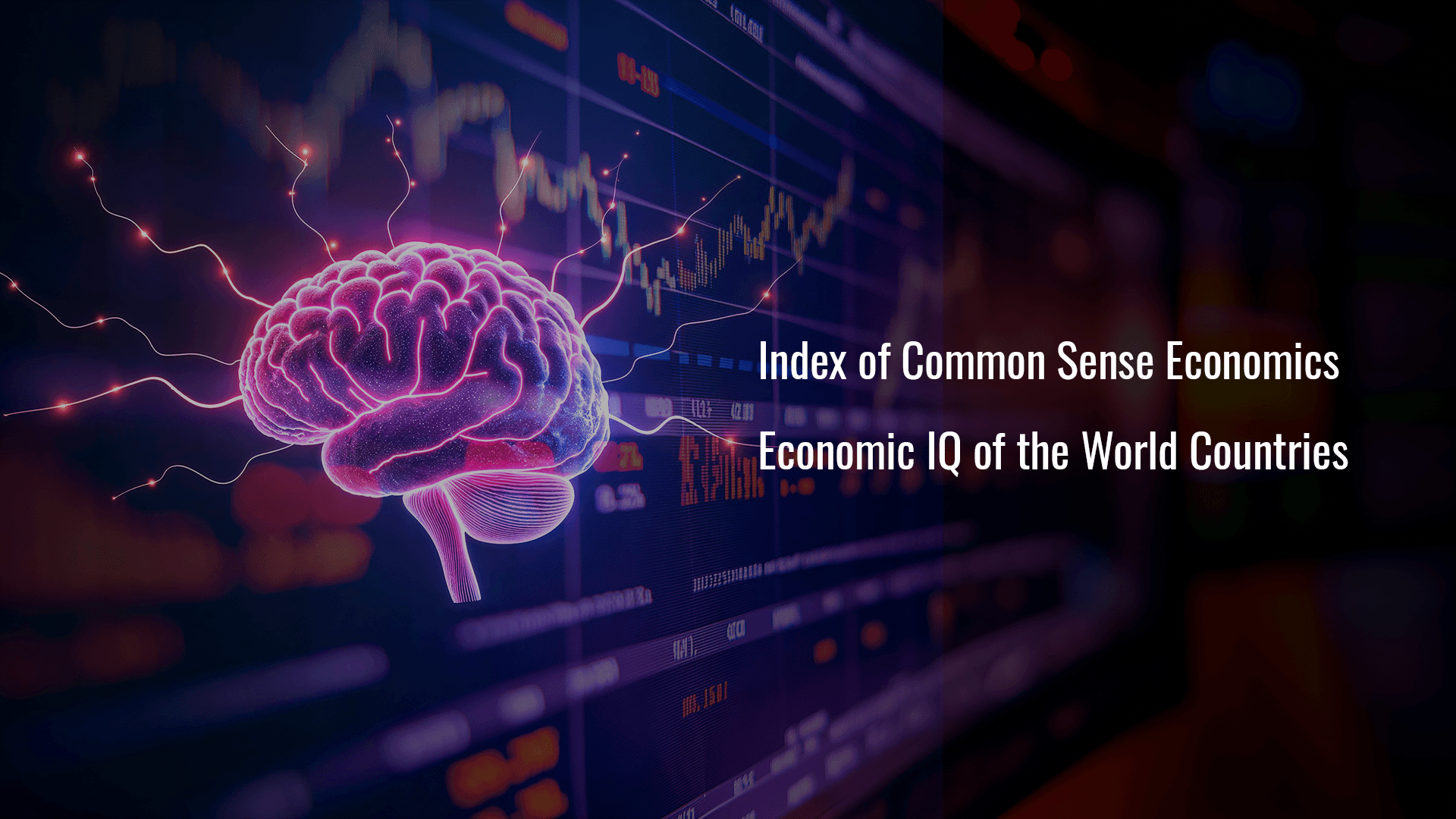
The brain economy, or the knowledge economy, is the most powerful driver of competitiveness in today's world. The idea for developing the Common Sense Economy Index arose from the widely used method of quantitatively assessing a person’s IQ (intelligence quotient). The Common Sense Economy Index (CSEI) is a measure of a country’s government’s economic intelligence. And when we talk about a country's economic IQ, we mean the Government’s views in a broad sense.
In other words, a country’s economic IQ reflects the quality of economic education in the country, as well as the political, business, and civic elites’ understanding of economic science. It also reflects the government’s commitment to applying global best practices in key areas of economic and institutional policy.
Accordingly, the Common Sense Economy Index (CSEI) from the International Liberty Institute, as a quantitative indicator of a country’s economic IQ, is an innovative tool for assessing the competence and professionalism of a country’s government.
The Common Sense Economy Index is a measure of a country’s government’s economic intelligence, its economic IQ.
An aggregate indicator from ILI assesses the extent to which common-sense principles are applied in the formulation and implementation of economic policy. It is based on the results of the six most important indices for developing an economic strategy: The Cato Institute’s Index of Human Freedom, the Fraser Institute’s Index of Economic Freedom, the Property Rights Alliance’s Index of Property Rights Protection, the World Justice Project’s Rule of Law Index, the Atlantic Council’s Prosperity Index, and WIPO’s Global Innovation Index. The aggregate index of the country's rankings in these six international indices serves as a measure of its government's economic IQ. This is an assessment of various economic parameters from the perspective of common-sense principles.
We selected these globally recognized rankings because they encompass thousands of indicators that serve as benchmarks for the governments of developed countries: levels of personal freedom and legal frameworks, property rights, the business climate, trade and competition, the quality of public administration and the environment, social protection measures, and the development and accessibility of infrastructure.
The axioms of common sense are known to everyone; they form the basis of normal human life and activity:
- it is better to be free than not free;
- it is better to be safe than to risk losing your life and health;
- it is better to have rights than to be without rights;
- it is preferable for the Government to be accountable, responsible, and transparent to the people, rather than being controlled by oligarchs, VIP administrators;
- it is better to be rich than poor;
- it is better to be advanced than backward;
- it is better to be with profit than with losses;
- it is better to be healthy than sick;
- it is better to live in a clean natural environment than in a polluted one, etc.
No one in their right mind would dispute these statements. These statements, which at first glance seem self-evident, serve as an effective mechanism for shaping a common-sense economy. If they are not only proclaimed but also used to shape one’s actual life according to these principles.
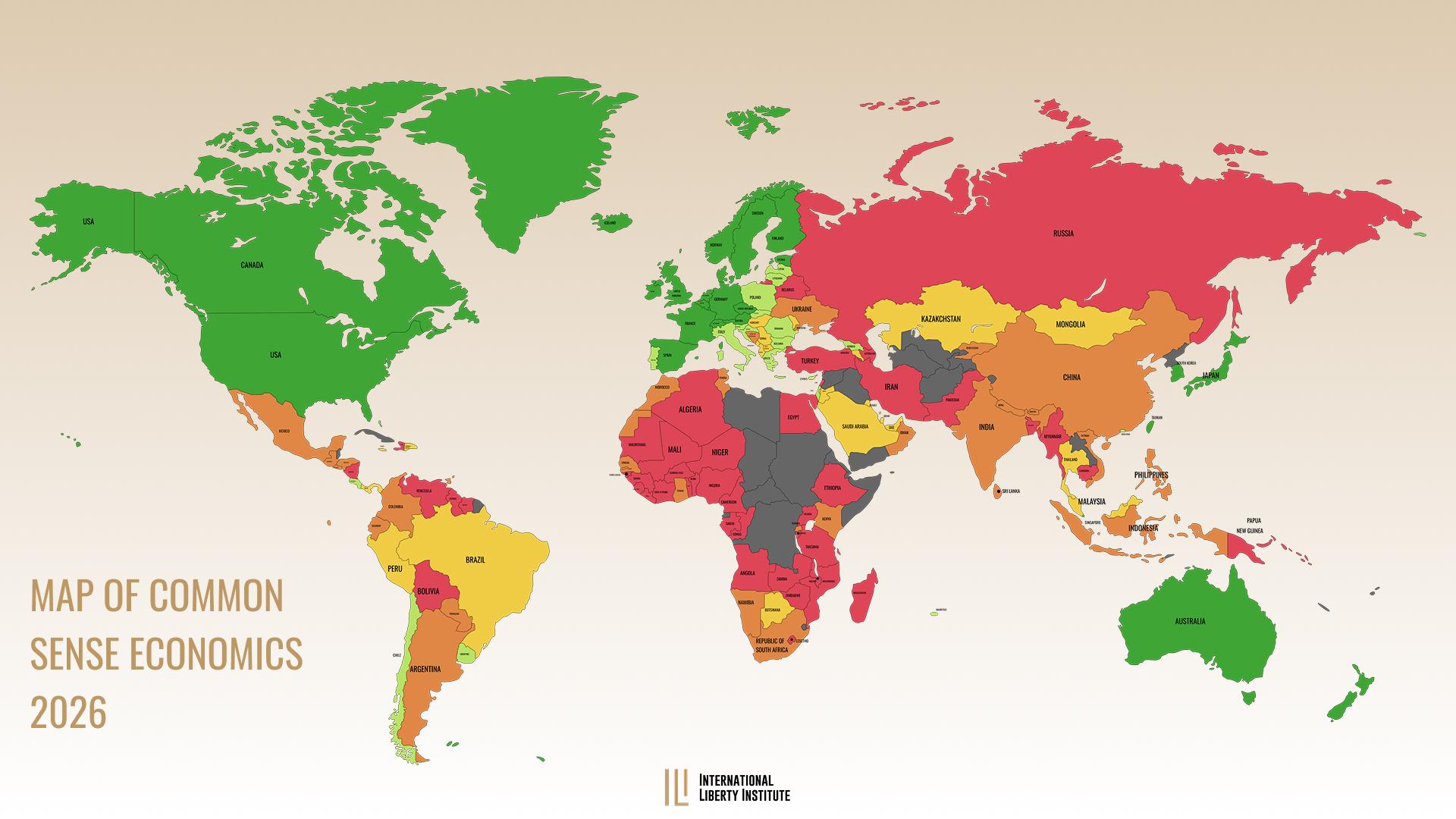
The 144 countries surveyed in the 2026 Index were divided into five groups, each of which clearly illustrates the "Common Sense Index" of these countries' governments:
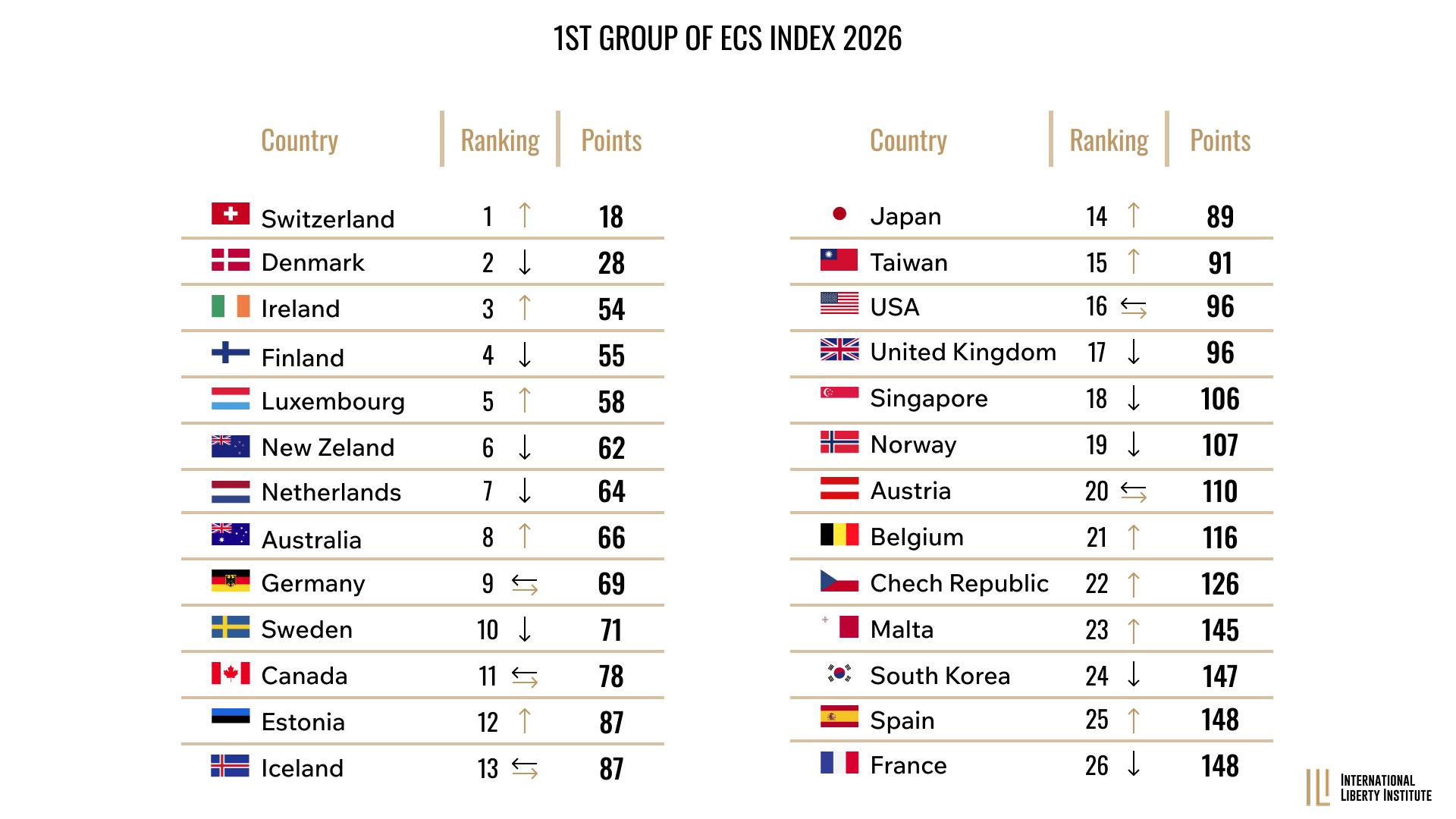
- Government of smart decisions — 26 countries—a government that studies and adheres to the laws of economics and common sense.
- Government of mental contradictions — 19 countries, the government is often unable to ensure the long-term, consistent, and systematic application of economic principles, and sometimes resorts to manual capital controls.
- Government of mental swing — 23 countries — this is a government that lacks a systematic understanding of economics and the political economy of reform.
- Government only with few glimpses of reason — 31 countries — this is a government dominated by Marxism and basic notions of economic policy.
- Government of economic ignorance — 45 countries — this is a government that has replaced economic science with ideological clichés and a contradictory set of projects promoted by various lobbying groups.
For more analysis and a complete list of countries in the Index groups, see the full research report.
INDEX OF COMMON SENSE ECONOMICS 2026
How a Government’s Common Sense Leads a Country to Prosperity — Lessons for Ukraine
At the top of the 2026 rankings is Switzerland, which has a total of 18 points based on the sum of rankings across all indices. This means that its government accepts and implements all of these principles in every aspect as the foundation of its economic policy, the basis for the country’s economic development, and the security of its citizens. This is what we must demand from the state and the government. If we look at the quality-of-life indicators in this country and other countries in the top tier of the Index—per capita income, social protection, investment, assets, economic growth rates, levels of public safety and protection of private property, and levels of taxation and regulation—it becomes clear that this is the true and rather simple recipe for an economic miracle.
All of this is based on the principles of the Austrian School of Economics and the theories of entrepreneurial growth developed by Mises, Hayek, and Schumpeter. All of this is the science of common sense. And this is precisely what Ukraine and other countries in Groups 4 and 5 of the Index should focus on.
Why the Top 30 Are Countries with High Economic Freedom, and What This Means for Ukraine?
Finland, Sweden, and Canada—these countries have operated under free trade and capitalism for decades, if not centuries. Of course, when we talk about role models for Ukraine, we need to look at them specifically during the period when they had a level of development, quality of legal institutions, and economic freedoms similar to ours. At that time, their institutions were not yet “Scandinavian” or “Canadian” in the modern sense—but they were all founded precisely on the principles of freedom.
The top 30 countries in the Common Sense Economy Index do not include poor countries, totalitarian countries, or countries with systemic problems regarding access to capital, capital preservation, or competitiveness.
Yes, every country experiences sectoral crises, but overall, these are highly successful countries that attract capital and immigrants. Common sense in economic policy is the foundation of national development and national defense capabilities. For Ukraine, this is a matter of national survival. That is why we will take a closer look at country-specific cases.
The overall index map shows distinct color-coded zones: the top represents freedom, while the bottom represents state control and intervention. France, Spain, Italy, and Germany accumulated capital and resources through market economies, but gradually gave way to state interventionism. Now, facing crises, they must undergo a radical reset, or they risk losing their competitiveness. The European Union is losing ground, and simply copying the current European model is not a viable option for us. This will lead to a reset of the oligarchy, not the country. But Ukraine has never had a true market-based capital structure. That is why we must time and again rely on freedom as the key factor in the formation of capital and the assurance of long-term economic growth.
In addition, the top tier of this index includes two post-socialist countries — Estonia and the Czech Republic, whose reforms began in the early 1990s. What is the secret to their success?
Estonia, under the leadership of Mart Laar (one of the world’s best reformers over the past 35 years), made a radical choice in favor of the free market. Laar wasn't a theoretical economist—he was simply a fan of Milton Friedman and the ideas of economic freedom, and he used to say, "We're doing this—and that's that." Flat tax rates, privatization, deregulation, and the elimination of tariffs and subsidies—these measures had a rapid impact.
Estonia's government spending amounts to about 42% of GDP, but this is a decentralized, transparent Scandinavian model, not Soviet-style centralism. If Ukraine had taken a similar path in 1991–1992, we would have a completely different economy today.
The Czech Republic has followed a similar path: widespread privatization, liberalization, and the creation of competitive institutions. It has integrated into the European division of labor and become an industrial hub that attracts both human and entrepreneurial capital. Today, its GDP per capita exceeds $30,000, and it has a well-developed industrial sector.
And most importantly, the tax burden in Estonia and the Czech Republic is currently lower than it is in Ukraine during the war. That is the key conclusion.
That is precisely why we must understand that even in times of war, we cannot violate the basic principles of common sense—otherwise, the consequences will be catastrophic. Yes, it is possible to try to raise an additional $50 billion for the budget by increasing the VAT rate or the tax burden on sole proprietors. But this is a flawed, misguided approach—it will have the opposite effect. It contradicts theory, empirical evidence, and common sense.
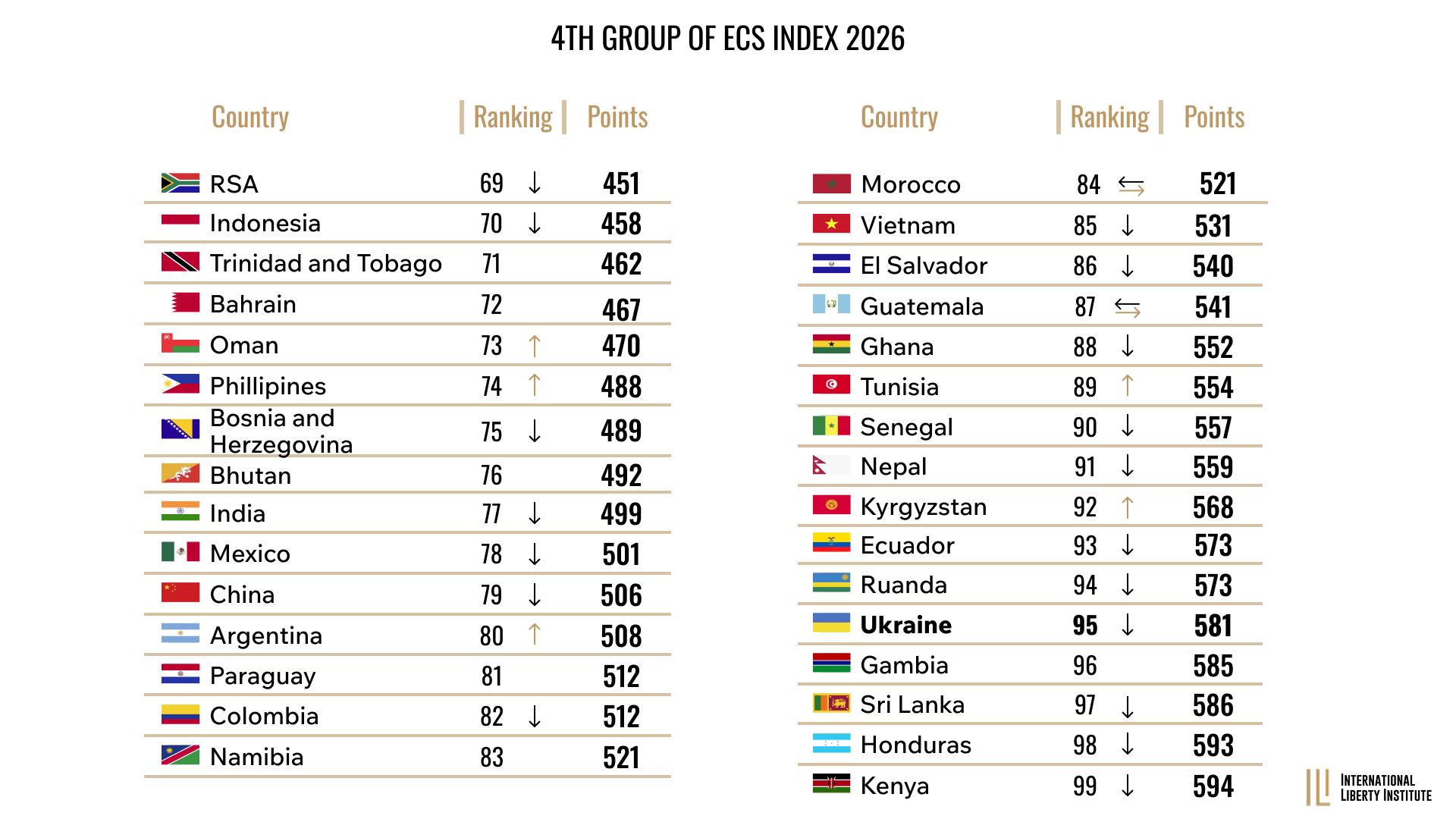
In the Common Sense Economics Index 2026, Ukraine ranks 95th out of 144 countries (581 points, fourth group), having dropped six places over the past year. This is our clear diagnosis. With this knowledge, we can move forward and draw the right conclusions for economic policy.
This index shows how to ensure that common sense is not confined to universities, think tanks, or intellectual communities, but is also present in the government, parliament, and all branches of government. So that think tanks, professors, and experts could reach decision-makers, and these decisions were better for the economy.
In today's world, the economy of common sense is rapidly spreading across the South American continent, where reform-minded governments are in power in Argentina and Chile (Group 2), and, we hope, soon in Peru (Group 3). They will provide examples of rapid progress toward the top 30 countries in the Index. Therefore, Ukraine should already be following Argentina’s example, where President Javier Milei has launched radical reforms, including labor market reform.
L"
This is very good news that could serve as a guide for us on how to carry out economic reforms after decades of socialism. Hernando de Soto, who is the author of one of the six Indices — Property Rights Protection Index from the Property Rights Alliance, became Prime Minister of Peru. (...) And now, in addition to Javier Milei, the president of Argentina, we have Hernando de Soto, a man with market-oriented views who understands why property rights, economic freedom, and human freedom must be the forms of capital that ensure long-term economic growth. It takes a lot of hard work to improve a country's ranking in the Index. Argentina is currently ranked 80th. In the two years since Milei took office, he has implemented a vast number of reforms, and the country is slowly improving its standing. But this is a task that will take many years of hard work."
L
Source: Yaroslav Romanchuk, presentation of the Common Sense Economics Index, Interfax Agency, 25.02.2026.
Китай (79 місце, 4 група) втратив позиції порівняно з минулим роком, але зростав він не завдяки стандартній податковій чи регуляторній політиці, а завдяки сотням спеціальних економічних зон, де діяли принципи, наближені до вільного ринку та здорового глузду. Саме ці зони дали стрибок наприкінці 1990-х — початку 2000-х. Але останні 10–15 років Китай робив помилки: зростання боргів, посилення контролю, суперечність між тоталітарною марксистською природою (гальмування свободи) та цими зонами. Тепер Китай змушений перезавантажувати модель — це нагадує азійську кризу 1997–1998 років, коли Південна Корея, Тайвань, Таїланд були змушені радикально скоригувати курс, а багато чеболів (великі сімейні компанії) збанкрутували.
China, the world's second-largest economy (79th place, Group 4), has fallen in the rankings compared to last year. But it grew not because of standard tax or regulatory policies, but thanks to hundreds of special economic zones where principles close to those of a free market and common sense were applied. These very zones drove the surge in the late 1990s to early 2000s. But over the past 10 to 15 years, China has made mistakes: rising debt, tighter controls, and a contradiction between its totalitarian Marxist nature (which stifles freedom) and these zones. Now China is forced to reset its model — this resembles the Asian crisis of 1997–1998, when South Korea, Taiwan, and Thailand were forced to radically adjust their course, and many chaebols (large family-owned conglomerates) went bankrupt.
Japan remains in the top group. But while it was competing with the United States in 1989–1990, its GDP reached $5.5 trillion. Then, a loss of 1.5 trillion, followed by stagnation. Conclusion: Success does not give you the right to implement just any policy—otherwise, you will lose everything.
For its part, India is also promoting economic zones (such as the IT hub in Bangalore), but a powerful bureaucracy, clannishness, and regulatory barriers are holding things back. If India undergoes radical deregulation and protects property rights, its economy could jump from $4 trillion to $8–10 trillion. But that depends on how much common sense the Indian government has.
Therefore, it would be advisable for Ukraine to focus on countries with a high level of economic freedom that were once at our level (such as Estonia and the Czech Republic in the 1990s. And even during the war, we must not violate the principles of common sense. Reducing the tax burden, deregulating, and protecting property rights—this is the only way to leap forward. Otherwise, we'll end up in the lower divisions instead of the top 30.
Specific recommendations for the Ukrainian government
First and foremost, Ukrainian society and the country’s economic and intellectual elite must establish clear, measurable KPIs—key performance indicators—for any government. Specific, rather than vague, goals—such as “4% growth”—after which the government proudly reports a 1.6% figure and blames everything on the war, shelling, or energy shortages, while in reality nothing changes.
Which indicators should be mandatory?
- Economic growth rates that are at least 30% higher than the global average. Today, the global average GDP per capita is about $13,000–$14,000, while in Ukraine it is approximately $6,500. We are lagging behind the global average by nearly half, and to catch up with and surpass the European average (we currently stand at only ~13% of it), we need to accelerate our growth significantly.
- Growth of Ukraine’s share in the regional/global economy. Currently — 0.18%. The goal is at least 1%. This is not just a matter of growth, but also of economic security.
- A ceiling on public debt and the budget deficit—strict fiscal discipline benchmarks for any government.
That is precisely why we need a professional government that relies on scientifically proven theories and empirical research, including the Common Sense Economics Index from the International Liberty Institute.
Empirical studies of dozens of countries show that the highest growth rates were observed when the public sector accounted for about 19% of GDP. In Ukraine, the figure is currently around 75%, whereas before the war it had remained at 43–45% for 20 years. This slows down the economy, enriches the oligarchy and clan-based structures, rather than contributing to the country's development.
Another set of issues concerns employment in the non-market sector: civil servants, inspectors, auditors, etc. They do not create added value or stimulate entrepreneurship; on the contrary, they hinder it.
Reducing the size of the state, radically improving the business climate, and removing the “straitjacket” from the economy—that is Ukraine’s leap forward across all key indicators. This is the recipe for an “economic miracle”.
The main reason for our consistently low results is the systemic neglect of economic freedom as a key factor for entrepreneurial growth. Unfortunately, a significant portion of the Ukrainian government, parliament, and politicians remain advocates of interventionism, the philosophy of the “Leviathan-like superstate,” and the utopian belief that “the state will take care of it”.
Economic theory and empirical evidence clearly demonstrate that without true capitalism — small state, economic freedom, strong protection of property rights, and open competition—sustainable growth is impossible.
Even if we receive $100–200 billion in aid after our victory, it will temporarily boost GDP figures, but it won’t be a success for all Ukrainians. This will mark a fresh reboot of the oligarchy and the syndicate of “managers of other people’s money”—and only for 3% of the population.
Our government's economic IQ is lower than that of 66% of the world's countries. Therefore, we must work not only with donors, but first and foremost with our own human capital, which is currently leading the country. This is no longer a political issue, but an existential one.
Without improving these indicators, no president or prime minister will be able to change anything. Veterans returning from the front lines and the young people who come back will see that nothing has changed in the country, and they will leave to seek a better life in countries ranked in the first and second tiers of the Index. Because we are once again ignoring the basic principles of common sense.
The long-term development strategy must be clearly focused on entering the top 30 of the Common Sense Economics Index. Specific KPIs for every government—regardless of its name: “government of public trust,” technocratic, professional, etc.
When we’re promised “growth through forums, investments, donor aid, and reparations”—that’s not about development. This is about the redistribution of other people’s money through the budget. True Ukraine will become a powerful “lion of Europe” not when 200,000 officials and businessmen together siphon off foreign funds, but when 8–10 million Ukrainians start working in the regions, across various sectors, creating economic freedom and prosperity.
Therefore, the country’s chances of economic success will increase significantly when the government implements swift, systematic reforms aimed at aligning with the top 30 countries in terms of personal economic freedom, the rule of law, and property rights protection.
The Economic Security Index from the International Liberty Institute, the Common Sense Economics Index, and the six indices on which it is based should now become mandatory KPIs for the Ukrainian government to evaluate its performance; only then will the Ukrainian government have a chance to become one of the best in the world.
The International Liberty Institute is Ukraine’s first and only think tank to publish a global index assessing economic and social development and growth policies. In today's world, global indices are developed by think tanks in the United States, Canada, the United Kingdom, Switzerland, Germany, and Australia. Now, Ukraine can join the ranks of these countries.