The new industrial policy for artificial intelligence in this new era is leading to tighter government regulations and the emergence of new, powerful corporations at the expense of smaller companies. It runs counter to the principles of the free market and fair competition.
The need to transition to superintelligence has become a central theme of the 13-page document published by OpenAI on April 6, 2026, titled «Industrial Policy for the Intelligence Age: Ideas to Keep People First». The paper proposes the creation of new federal institutions, a sovereign wealth fund, expanded social safety nets, higher taxation, mandatory worker consultation on AI deployment, partial nationalization of energy infrastructure, and the establishment of supranational AI governance bodies.
The document was released on the same day that “The New Yorker” published the results of a lengthy investigation that calls into question OpenAI CEO Sam Altman’s credibility on AI safety issues. Coincidence or not, the timing of the publication illustrates that a company valued at $852 billion — which has just raised $122 billion and is preparing for an IPO with a target valuation of $1 trillion — is proposing that the government reorganize the economy around a product on which its market capitalization depends.
The EU's Artificial Intelligence Act follows the same logic as the General Data Protection Regulation: horizontal regulation, a disproportionate burden on small businesses, and market consolidation around major players.
The OpenAI document goes further and proposes not merely regulatory policies, but a full-scale industrial revolution: state planning, state ownership, and state redistribution of property.
The industrial policy suggested by OpenAI — federal funding for energy infrastructure, subsidized access to AI, and a sovereign wealth fund that will invest in AI companies — channels public resources into this very same closed loop.
The AI Economy: Billions Circulating in a Closed Loop
First, it is worth analyzing the highly attractive AI sector, where, according to many forecasts, there are signs of a bubble that could lead to a future economic crisis.
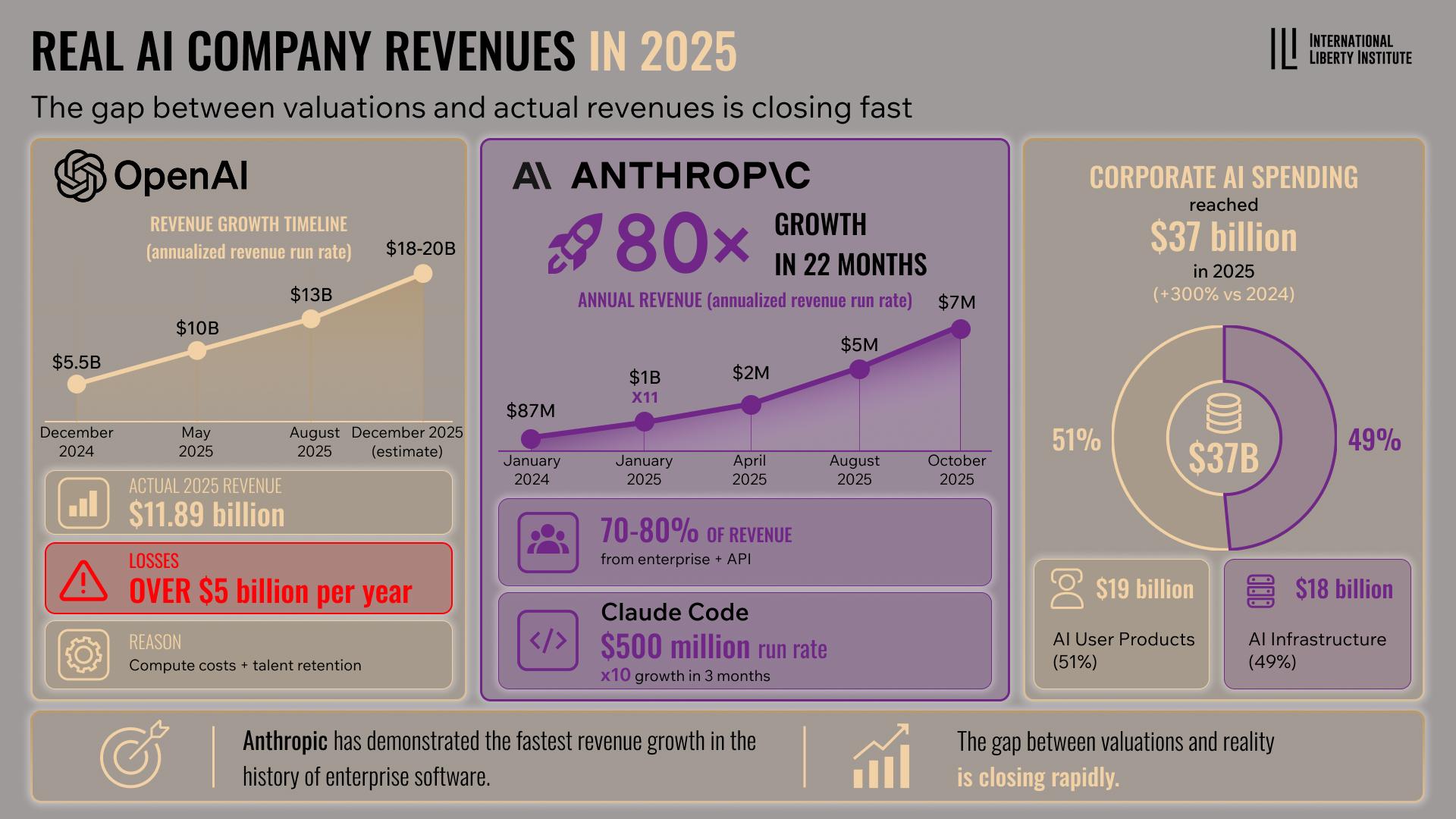
In 2025, global investment in AI totaled $202.3 billion — half of all venture capital invested worldwide. OpenAI and Anthropic together received 14% of all global venture capital investments across all sectors.
Interestingly, these funds are circulating in a closed loop — Microsoft has invested over $13 billion in OpenAI and secured a commitment to purchase $250 billion worth of Azure services over six years. Amazon invested $8 billion in Anthropic, which runs on AWS. Google — $3 billion for Anthropic, plus access to a million specialized TPUs. All of these investments ultimately translate into chip purchases: in fiscal year 2026, Nvidia generated $197.3 billion in revenue from data centers.
The chain is clearly visible to anyone who cares to look. In February 2026, Anthropic announced the purchase of $30 billion worth of Microsoft Azure computing power based on Nvidia chips. At the same time, Nvidia invested $10 billion in Anthropic, while Microsoft invested $5 billion.
L"Nvidia is investing $100 billion in OpenAI shares, and OpenAI says it will purchase $100 billion or more worth of Nvidia chips"L
— this is how Michael Cuzumano, a professor at MIT Sloan, described this dynamic.
For the fourth quarter of 2025, Microsoft spent $37.5 billion on AI infrastructure and recorded a profit of $7.6 billion from its 27% stake in OpenAI.
SoftBank has completed a $41 billion investment in OpenAI, acquiring approximately 11 percent of the company. The Stargate project, announced in January 2025 as a $500 billion joint venture between OpenAI, SoftBank, Oracle, and MGX to build AI infrastructure in the U.S., had not hired a single employee or begun construction on a single data center a year later: the partners were arguing over the division of responsibilities.
The gap between the valuations of artificial intelligence companies and their current revenues remains significant, although it is narrowing at a faster pace than in previous technology cycles.
The New (Old) Deal 2.0 — or Back to the Same Old Trap?
OpenAI explicitly cites the Progressive Era and the New Deal as models to emulate. The document states that these programs “have helped modernize the social contract” and calls for “an even more ambitious form of industrial policy”.
We are familiar with the history of these programs.
The Progressive Era (1890s–1920s) gave rise to three institutions that shaped the 20th century.
First — the Federal Reserve System (1913): centralized control of the money supply instead of competition among private banks.
Second—the federal income tax (16th Amendment, 1913): enacted as a moderate measure with rates ranging from 1 to 7 percent.
Third — Prohibition (18th Amendment, 1919): an attempt to regulate personal behavior through federal enforcement powers.
The New Deal (1933–1939) went even further. The National Recovery Administration (NRA) cartelized industry by setting prices, production quotas, and wages for entire sectors. The Social Security Act (1935) established a pension insurance program for a limited group of workers. In addition, the New Deal gave rise to dozens of new federal agencies — the SEC, FDIC, FHA, and TVA — each with a narrow initial mandate.
Result: The Supreme Court ruled that the NRA was unconstitutional in the case of Schechter Poultry Corp. v. United States. Prohibition was repealed 14 years later. The rest remained.
The Federal Reserve System has evolved from a technical clearing mechanism into a full-fledged central bank that sets interest rates for the entire economy. The social security system for industrial workers has evolved into a program that covers pensions, disability benefits, and healthcare and costs $1.4 trillion annually. The SEC, FDIC, and FHA — none of these agencies has been dissolved, and each has expanded its mandate.
The only notable exception was the wave of deregulation under Carter and Reagan in the aviation, rail, and telecommunications sectors. At that time, some regulatory agencies established under the New Deal were abolished, but this did not affect social programs.
When OpenAI cites these precedents as models to emulate, it is drawing on a tradition in which the creation of institutions is the rule, and their dissolution is a rare exception.
Japan's MITI, often cited as a successful example of industrial policy, directed resources toward industries that would have grown even without government intervention (electronics, automobiles), while subsidizing declining sectors (coal, shipbuilding). South Korean chaebols, built on preferential lending, left the economy dangerously overleveraged, as the 1997 crisis demonstrated.
In every case, the government chose not the best companies, but the companies with the best lobbyists.
The OpenAI document acknowledges that “in normal times, markets function on their own” and that “competition, entrepreneurship, and open economic participation have raised living standards”. At the same time, each of their specific proposals runs counter to this assertion.
A Sovereign Public Wealth Fund, Because The ‘State’ Is Supposedly Wiser Than Its Citizens?
OpenAI proposes establishing a Public Wealth Fund that “will ensure every citizen shares in the growth driven by AI”. The fund will invest in “long-term, diversified assets that reflect the growth of companies developing and implementing AI” and the proceeds will be distributed directly to citizens.
Such a mechanism is commonly referred to as a sovereign wealth fund, in which the state becomes one of the largest investors in the private sector, using tax revenues to acquire stakes in private companies.
A government that owns shares in AI companies has a financial incentive not to regulate them too strictly or, conversely, to regulate their competitors more strictly. The Norwegian experience shows how this works in practice. Norway's Government Pension Fund (worth $1.9 trillion) has excluded more than 180 companies on “ethical” grounds. Israeli companies have the highest exclusion rate: 32 percent in a portfolio of 63 countries. In November 2025, the Parliament suspended the exclusion of companies on ethical grounds following the decision to divest from Caterpillar, acknowledging that the criteria were being applied inconsistently. The fund, which was supposed to be a neutral investment vehicle, has become a battleground for political campaigns.
The proposal also assumes that citizens are unable to invest on their own, even though private pension accounts, index funds, and direct stock ownership already allow anyone to participate in economic growth. The difference is that these instruments are voluntary, whereas the sovereign wealth fund is mandatory, both in fund collection and in investment strategy.
The Automation Tax Is Equivalent To A “Productivity Tax”
Such a mechanism is commonly referred to as a sovereign wealth fund, in which the state becomes one of the largest investors in the private sector, using tax revenues to acquire stakes in private companies.
A tax on automation is a tax on productivity; in other words, if a firm can perform the same work at a lower cost, it benefits the entire economy: costs fall, prices fall, and real purchasing power rises. Therefore, taxing this process is economically equivalent to taxing efficiency.
In October 2025, Senator Bernie Sanders proposed a federal “robot tax”. An analysis by the Brookings Institution found that firms that adopt robots experience greater employment growth than those that do not and are more productive. The authors noted that it is practically impossible to define a “robot” for tax purposes: any definition is either too narrow (and does not cover AI in its current form as large language models) or too broad (and covers programs such as Microsoft Excel). An excise tax on automation would have a ripple effect on the competitiveness of American companies, increasing the risk that innovative firms would relocate overseas.
Mandatory Allocation of Productivity Gains
OpenAI suggests that the government should “encourage” (and in some cases require) companies to convert profits from AI into “sustainable improvements for employees”: a 32-hour workweek, paid time off, and “performance bonuses tied to measurable productivity gains”.
How a company distributes its profits is a matter between the company and its employees, mediated by the labor market. Employees have different preferences: some want higher pay, others want more free time, and still others want a stake in the company. A mandate that says, “You must convert productivity gains into X” replaces these individual preferences with a single one—a political one.
In political documents, the word "stimulate" usually means “we will use tax penalties or subsidies to encourage you to achieve the desired result”. This is a form of soft coercion. And once a precedent is set whereby the state dictates how AI profits are distributed within companies, the scope of this power will only grow.
“The Right to AI” – The Right to Free Competition or Total Control?
Overall, the document proposes treating access to AI as “the foundation for participation in the modern economy, much like the widespread efforts to promote global literacy,” and creating “free or low-cost access points”.
The right to free speech means that the government cannot stop you from speaking. “The right to AI” means that someone else must provide you with a product.
First, negative law: limits on government power.
Second—positive law: a claim to resources created by others.
If access to AI is declared a right, the state must fund it and therefore tax productive activities to subsidize consumption. It must also determine which AI systems qualify, which providers are eligible, and what constitutes a “basic level of capability". Each of these decisions becomes political, subject to lobbying and influence by the regulator.
The Internet has achieved nearly universal access in developed countries, even without being declared a right. This was due to private investment, competition, and cost reductions driven by technological progress. Businesses are competing for customer segments they haven't yet captured, so they're offering their services to as wide an audience as possible. The same forces are already at work in the field of AI, which is why ChatGPT has reached 100 million users in two months.
ACCESS EXPANDS WHEN COMPANIES COMPETE FOR USERS, AND STATE-RIGGED TENDERS REPLACE COMPETITION WITH BUREAUCRATIC ALLOCATION.
Automatic Safety Nets
The document proposes “a package of temporary expanded safety nets” that “activates automatically when metrics exceed predefined thresholds.” As disruption intensifies, support scales up; when conditions stabilize, that support is gradually rolled back when metrics exceed predefined thresholds".
In practice, government programs that expand automatically are almost never scaled back. Robert Higgs documented this pattern in Crisis and Leviathan: programs created as temporary measures during a crisis become permanent and gain political defenders.
Sourse: Higgs, R. (1987). Crisis and Leviathan. Oxford University Press.
The U.S. federal income tax was introduced as a temporary measure in 1913, with rates ranging from 1 to 7 percent. During World War I, the top rate rose to 77 percent. In the 1920s, the rate dropped to 25 percent. During World War II, it rose again to 94 percent. Since 1986, the income tax rate has fluctuated between 28% and 39.6%; it currently stands at 37%. The tax, which was introduced as a temporary wartime measure, has been in place for 113 years and has never been reduced to its original level.
Social Security Disability Insurance (SSDI) was established in 1956 for a narrow category of beneficiaries, specifically workers aged 50–64 with severe long-term illnesses. In 1960, dependents were added to this list, and the age limit was lowered. The program now covers more than 7.5 million people and costs about $150 billion a year.
This “ratchet” mechanism applies to most such programs. After a crisis, the budget reverts to its baseline level, and the next crisis expands it again; therefore, OpenAI’s proposal for “temporary” safety nets with “automatic” activation has no historical precedent in which automatic expansion was accompanied by automatic rollback.
The proposal is also based on the assumption that government transfers are the appropriate response to economic changes. Technological disruption creates winners and losers in the short term, but the mechanism that resolves this is the price system: wages adjust, workers retrain, and new industries absorb the displaced workforce.
Safety nets that are too generous or automatic slow down this adaptation by reducing the incentive to adapt.
New Regulatory Bodies аnd Expanded Regulations
The document proposes strengthening institutions such as the Center for AI Standards and Innovation (CAISI) and building “a competitive market of auditors and evaluators” through “government procurement, advance-purchase commitments, insurance frameworks, and standards-setting.”
Every new regulatory body creates compliance costs. These costs disproportionately fall on small firms and startups, which cannot afford dedicated compliance departments. The document acknowledges this, stating that standards should “avoid creating an unnecessary regulatory burden for small companies.” Every regulatory proposal makes this claim, but in practice, compliance costs always favor the big players.
Sourse: ACT | The App Association & TechnoMetrica. (2025). Survey of 1,000+ tech MSMEs across EU, UK, US.
The GDPR costs small and medium-sized technology companies between $109,000 and $375,000 per year. The market for compliance with the EU AI Act is estimated to be worth 17 billion euros by 2030—it is a distinct industry with a vested interest in maintaining and expanding regulatory requirements.
“Pre-purchase commitments” to create a market for AI auditors mean guaranteed government revenue for a new class of compliance firms. This creates a lobbying group advocating for increased regulation, since auditors' business model depends directly on the complexity of the rules that their clients' businesses must follow.
Federal control over energy infrastructure
The document proposes “granting limited federal authority to expedite the construction of interregional power lines” and using “targeted investment loans, flexible subsidies, or equity stakes” to expand the power grid to serve AI data centers.
Federal stakes in energy infrastructure capital are a form of partial nationalization. The government, which owns the power transmission infrastructure, has an incentive to direct power to politically favored regions and to use its position to exert pressure on private energy companies.
Delays in obtaining permits are a real problem, but the government itself created this problem. The average time required to complete an environmental review under NEPA is 4 years; for wind power plants, 45 months; for solar plants, 27 months. State-level regulation adds additional delays on top of the existing ones. If the government recognizes that barriers to market entry are slow and burdensome, then the correct solution would be to remove those barriers rather than create a new federal agency that selectively bypasses them whenever it is politically convenient.
Mandating employee participation—an attempt to control the internal affairs of private businesses
“An interesting aspect of the document is the proposal to give workers ‘a formal pathway to collaborate with management so that AI improves job quality’ and to establish ‘clear limits on harmful uses of AI that can undermine job quality by increasing workloads, reducing autonomy, or undermining fair scheduling and pay.’
Formal mandates granting workers a role in decisions about technology adoption give labor unions the right to veto productivity increases. A similar situation brought the British printing industry to a standstill from the 1970s until 1986, when the NGA union blocked the introduction of computer typesetting on Fleet Street, protecting linotype operators’ jobs at the cost of higher expenses and lower output.
The proposal to “set clear limits” on the use of AI that “increases the workload” or “restricts autonomy” invites regulators to determine what constitutes acceptable and unacceptable work arrangements. If an AI system allows a company to allocate tasks more efficiently, and employees are consequently busier during their shifts, is this an “increased workload”? If AI takes over planning and reduces a manager’s discretion, is this a “restricting of autonomy”? Such decisions are the responsibility of companies and employees as part of contract negotiations, not that of a regulatory body.
Model Restraint Protocols — The State’s Right to Regulate AI
The document also proposes developing ‘coordinated protocols for containing and mitigating dangerous AI systems once they have been released into the world’ for ‘scenarios where dangerous systems cannot be easily recalled’.
What does it mean to ‘contain’ a deployed AI model? The proposal refers to ‘limiting the spread of dangerous capabilities, reducing harm, and coordinating response efforts.’ In practice, this means granting the state the authority to determine which AI systems are allowed to operate, compelling companies to shut down products, and coordinating enforcement actions across jurisdictions.”
By analogy with the doctrine of prior restraint, this grants the state the authority to prohibit the distribution of software even before any harm has been proven. If the government can declare an AI model “dangerous” and coordinate efforts to curb it, it has the authority to ban any AI system on safety grounds.
The definition of “dangerous” will inevitably expand. Export controls on encryption, initially justified on national security grounds, have hindered the spread of secure communications for decades. The Crypto Wars of the 1990s left U.S. companies subject to key length restrictions (40 bits for exports) while the government determined which encryption was “secure”. The scope of content moderation, which was originally aimed at illegal material, has expanded to cover political speech: In 2020–2021, Twitter, Facebook, and YouTube removed posts claiming that COVID-19 originated in a laboratory, which their platforms subsequently stopped blocking. Any authority to contain will follow the same trajectory.
The document states that ‘leading AI companies should adopt governance structures that include public-interest accountability, such as Public Benefit Corporations with mission-oriented governance.’
“Should” in a policy document authored by a company that lobbies for regulation means “we want the government to require this”. OpenAI recently attempted to transition from a nonprofit organization to a for-profit entity, which led to lawsuits. A company that has failed to get its own governance structure right is now proposing that the state dictate governance structures to its competitors.
The status of a Public Benefit Corporation requires directors to consider the interests of stakeholders, not only shareholders. This approach undermines accountability. When a board of directors is expected to serve shareholders, employees, the community, the environment, and the “public interest” all at once, it effectively serves no one. Any decision can be justified by citing the interests of one of these groups. PBC status gives management an excuse to ignore market discipline and further incentivizes them to ask the government for a “bailout”—that is, taxpayer-funded assistance used by governments to rescue companies classified as systemically important or “too big to fail”.
Global Regulation—the Path to a Global State
The document proposes building ‘a global network of AI institutes that collaborate through shared information-sharing protocols, joint evaluations, and coordinated mitigation measures’, which would over time evolve ‘into an international framework similar to other multilateral institutions.
In essence, the proposal is to establish a global AI regulator. The model is expected to be similar to the IAEA for nuclear technology and the Basel Committee for banking. Despite their tangible achievements, both institutions have been significantly influenced by major government actors and established industry players. The International Atomic Energy Agency inspection regime did not prevent nuclear proliferation — North Korea withdrew from the Treaty on the Non-Proliferation of Nuclear Weapons in 2003 and tested its first nuclear weapon in 2006.
The Basel Accords established capital requirements that favored large banks at the expense of small ones. The number of banks in the United States fell from 18,000 in 1984 to 4,135 at the end of 2022 — a 77 percent decline. The Basel Accords were one of the factors behind this consolidation: while a large bank can cover compliance costs with a team of five people, a small bank either struggles to do so or goes out of business.
A global AI governance framework would allow major powers to impose their regulatory preferences on weaker nations. It would slow down innovation by requiring international consensus before new capabilities are deployed, and create a single point of regulatory control: a company or government that influences the standards of an international body and sets the rules for everyone.
Countries that reject such a framework and allow for freer development will gain a competitive advantage. As a result, we will either see a “race to the bottom” in regulation (which proponents of the framework will use to justify its necessity) or a divide between regulated and unregulated jurisdictions.
Conclusion: The Fox Guarding the Henhouse
In each case, OpenAI identifies a real problem (job displacement, wealth concentration, security risks) and proposes a solution that expands the power of the state while portraying major existing players—including OpenAI—as indispensable partners in the governance system.
Several proposals in the document are consistent with market logic; for example, portable social benefits tied to the individual rather than the employer and the removal of barriers to permitting procedures in the energy infrastructure. However, these proposals are moderately indirect and are not the main focus of the document.
Overall it is important to understand that OpenAI advocates for higher taxes, more government mandates, more state ownership, more regulatory bodies, and greater international coordination.
Share
OpenAI Inc., founded by Sam Altman and Elon Musk in 2015 and the developer of ChatGPT, is valued at $852 billion and has massive capital needs. What benefits does the company gain from implementing the Manifesto?
The company benefits from a regulatory environment that raises barriers to entry.
The company directs government funding toward the infrastructure it uses.
This manifesto positions it as a reliable partner in governance, rather than as a subject of regulation.
In other words, the proposals in this document achieve all three objectives.
The companies that stand to lose from these proposals don’t even exist yet. They are startups, independent developers, and small firms that can’t afford compliance departments or lobbying offices in Washington. These companies foster competition and innovation, but industrial policy, as currently conceived, puts them at a disadvantage.
A horizontal industrial policy ex ante approach has alternatives.
For example, an ex post liability regime argues that companies are free to deploy technologies but bear legal responsibility for actual harm. The EU had an AI Liability Directive (COM(2022) 496 final) proposal, which embodied this approach, and it was withdrawn in October 2025 in favour of a stricter horizontal regime.
Voluntary standards with market-based accountability will also be more effective. Anthropic, despite its shortcomings (the weakening of the training pause requirement in version 3.0), has demonstrated a level of public accountability that government regulation rarely achieves.
These issues are of direct importance to Ukraine.
A country that built the Diia digital government platform under missile strikes, scaled drone production from 7 to 500 manufacturers in three years, and deployed the world’s first national AI assistant, has, for now, adopted a two-year moratorium on mandatory AI regulation. The Ministry of Digital Transformation’s White Paper explicitly states the goal of “not overregulating the AI market” at the early stage.
At the same time, as a candidate for EU membership, Ukraine will ultimately have to adopt the regulatory regime of the Artificial Intelligence Act (Regulation (EU) 2024/1689).
If we add an OpenAI-style industrial policy to this framework, the result would not be “human primacy,” but rather the preservation of large corporations at the expense of those who could compete with them.
Adil Abduramanov is a young researcher at the Educational and Scientific Institute of International Relations of Taras Shevchenko National University of Kyiv, and a PhD student (aspirant) at the Department of Private International Law.
The path to an "all against all" regime in the global economy is open. Consequences of the New US Foreign Trade Policy for the Countries of the World and Ukraine
A sober analysis of events, probable positive and negative developments in the new year for the world, the US, the EU, and Ukraine, and the conditions for their realization, without all-encompassing scientific “futurology” and illusions.
The case of outwardly prosperous Norway as an example of state economic policy that forces big business and wealthy individuals to emigrate from the "socialist Scandinavian paradise" along with their capital due to excessive taxes and overregulation to more financially favorable jurisdictions.