Humanity is always seeking simple answers to complex questions, and economics is no exception: if a country is rich, then, in economic terms, it means that everything is being done correctly. For years, Norway looked exactly like this. High rankings in the Human Development Index, a generous welfare state, free education, and healthcare. Financial strength backed by oil and gas revenues and the world's largest sovereign wealth fund, the Government Pension Fund Global, with assets of over $1.6 trillion. This translates to approximately $300,000 per citizen.
It seemed that this model had already passed all tests and finally became an example of a country of so-called "flourishing effective socialism." But if we analyze the situation more closely, we can see some alarming trends.
Is Norway really a comfortable welfare state?
People who start new companies and launch products, risking their own money, are increasingly choosing other countries, fleeing Norway. This is not a panic-stricken escape, but a conscious choice, a conscious rejection of "comfort" in favor of other countries. And these are not isolated incidents. This is a growing trend: mass migration of wealthy people from Norway, caused mainly by changes in the country's tax policy.
During the period 2022–2023, which became a real catalyst for this movement, 82 wealthy Norwegians officially changed their tax residence, moving it abroad, with more than a third of them doing so in 2023. At first glance, this seems like a small percentage of the five million population. But the total capital they took with them is enormous, amounting to around 46 billion Norwegian kroner (US$4.5 billion).
In recent years, the trend has accelerated dramatically, slowing down at the end of 2025, along with the IMF's positive forecasts for the country's GDP growth to $504 billion.
Source: Alstadheim, K. B., & Kibar, E. (2024, January 15). Bloomberg, with reference to data from the Norwegian Ministry of Finance.
For comparison: this is more than the total number of wealthy individuals who left the country during the previous thirteen years combined. Such rapid growth in the rate of "wealth flight" indicates that a critical point has been reached where Norwegian tax conditions have become unacceptable to large asset owners.
Where wealthy Norwegians are fleeing to
The geography of this capital movement is extremely revealing and clearly reflects the main motivation behind these decisions. Wealthy Norwegians do not simply choose other countries to live in; they deliberately choose jurisdictions that offer the most favorable fiscal conditions.
Switzerland dominates among countries of new deployment. It remains a classic haven for private capital. According to Dagens Næringsliv, more than 70 of the 82 wealthy Norwegians who left chose Switzerland.
Source: Fortune (2024, April 19). According to Dagens Næringsliv.
It attracts not only with its political stability and reliable banking system, but also with a relatively low wealth tax, which in the cantons can range from 0.10% to 0.88% of the total value of net assets. In addition, there is a system of contractual (lump sum) taxation for wealthy foreigners, which is based not on actual income, but on the individual's expenses.
Source: Swiss Federal Tax Administration. (2024). HSBC Expat Tax Guide
The UK has historically been a magnet for the global elite thanks to its special tax regime for non-domiciled residents (people who live in the country but consider another jurisdiction to be their permanent home). This regime allows you to avoid paying tax on income and capital gains earned outside the UK until these funds are brought into or used within the country (known as the remittance basis). This, combined with the complete absence of capital gains tax on real estate located outside the UK and inheritance tax exemptions, makes it attractive for temporary or permanent residence for global millionaires.
Singapore positions itself as Asia's leading financial center. Its appeal lies in its flexible and low-tax system. In particular, the country offers a zero capital gains tax rate (profits from the sale of shares, bonds, or other assets), which is a key factor for investors. Corporate tax is competitive and amounts to approximately 17%, which is significantly lower than in many Western countries. Singapore is also actively promoting the creation of family offices through special tax incentives.
The United Arab Emirates, especially Dubai and Abu Dhabi, are experiencing a real boom in wealth migration. The UAE tax system is one of the most liberal in the world. In the UAE, there is no personal income tax or capital gains tax for individuals (although a corporate income tax will be introduced in 2023). The absence of inheritance and gift taxes, along with a high quality of life, security, and status as a global hub, makes the UAE one of the top destinations for global capital.
Why is a country with almost unlimited financial resources beginning to lose those who create value for the future?
The reasons for this choice are not limited to "searching for low taxes." It is about changing the very logic of the Norwegian model, which is considered one of the most successful commodity economies in the world. In 2021-23, the total rent from natural resources in Norway amounted to 8.5% of GDP.
Norway's tax system was formed during the oil era, when about 40% of exports and a significant portion of budget revenues were provided by the oil and gas sector. In this reality, the high tax burden worked.
Tax revenues reached about 40% of GDP — significantly higher than the OECD average — and financed a large-scale social security system. The Norwegian welfare state grew out of the oil reality. When money from the sale of natural resources comes in steadily and predictably, the state can afford a complex and expensive redistribution system.
Source: OECD. (2024). Tax Policy Reforms 2024: OECD and Selected Partner Economies. OECD Publishing.
Problems arise when people with ideas, rather than natural resources, become the main resource. The turning point came after a series of tax reforms between 2015 and 2024. The central element was the reform of the wealth tax.
The maximum wealth tax rate has increased from 0.85% to 1.1% per annum and applies to the net value of assets, including businesses, shares, and real estate.
This is a tax on capital, not on income. It must be paid regardless of whether the asset generates cash flow.
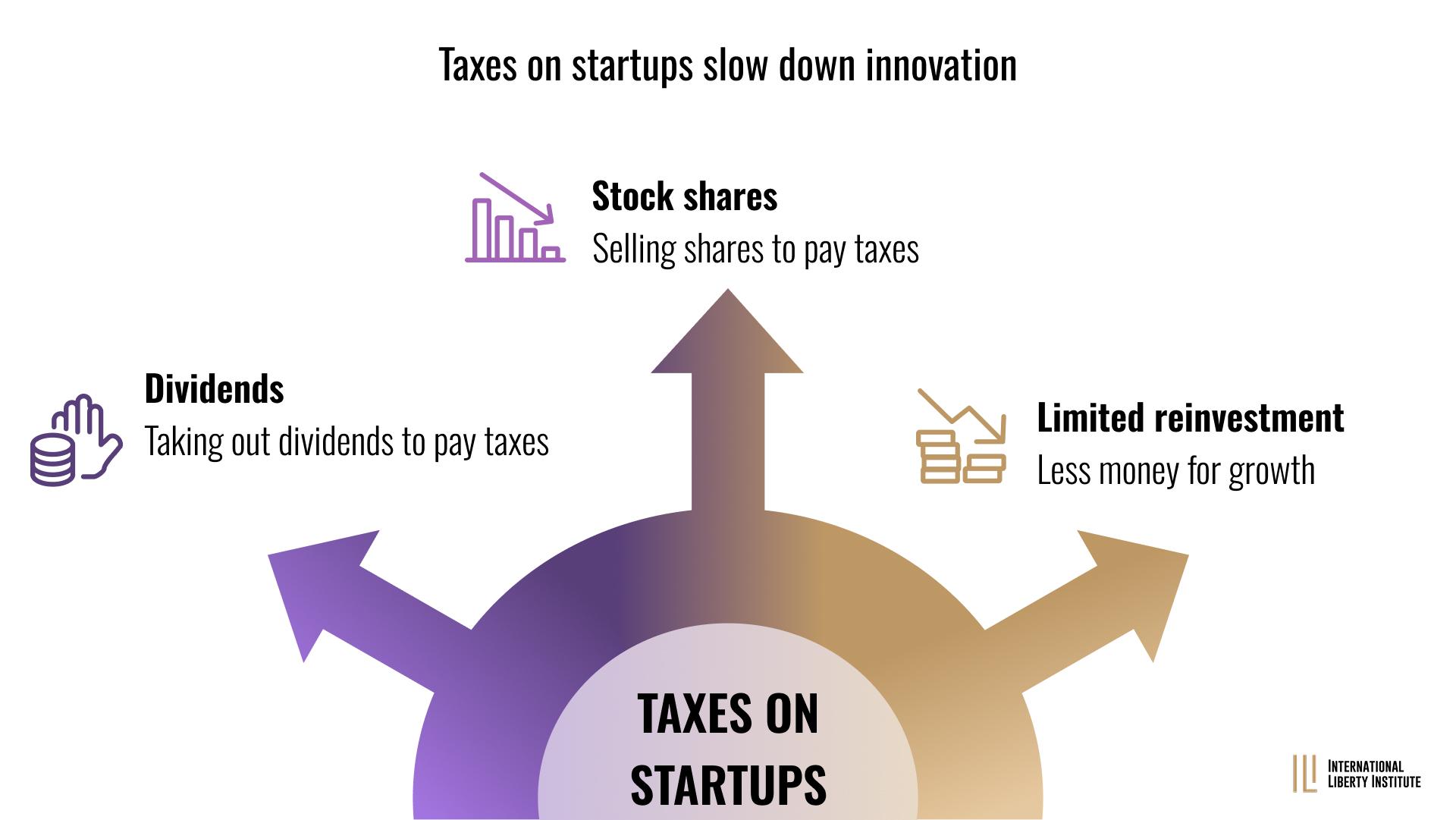
In this logic, wealth tax looks attractive—until you encounter its side effects. A startup may not make a profit for years, but it already has to pay tax based on estimates, expectations, and things that do not even exist in real money yet.
This creates a tough dilemma for innovative businesses: an entrepreneur who owns a startup valued at 100 million kroner must find 1.1 million kroner each year to pay taxes, even if the company does not generate a profit for years.
Options are limited: either to pay out dividends or sell part of the business precisely when it needs reinvestment. And the faster the company grows, the sharper this dilemma becomes. A rate of 1.1% is applied to net assets exceeding 20.7 million NOK.
Source: Norwegian Ministry of Finance. (2023). National Budget 2024: Tax proposals.
The situation was exacerbated by an increase in taxes on dividends and capital gains. From 2023, the effective rate increased from 35.2% to 37.84%. Combined with a 22% corporate tax and an annual wealth tax, the total tax burden for a successful entrepreneur easily exceeds 60–70%.
Source: OECD (2024); Chambers Corporate Tax Guide 2025.
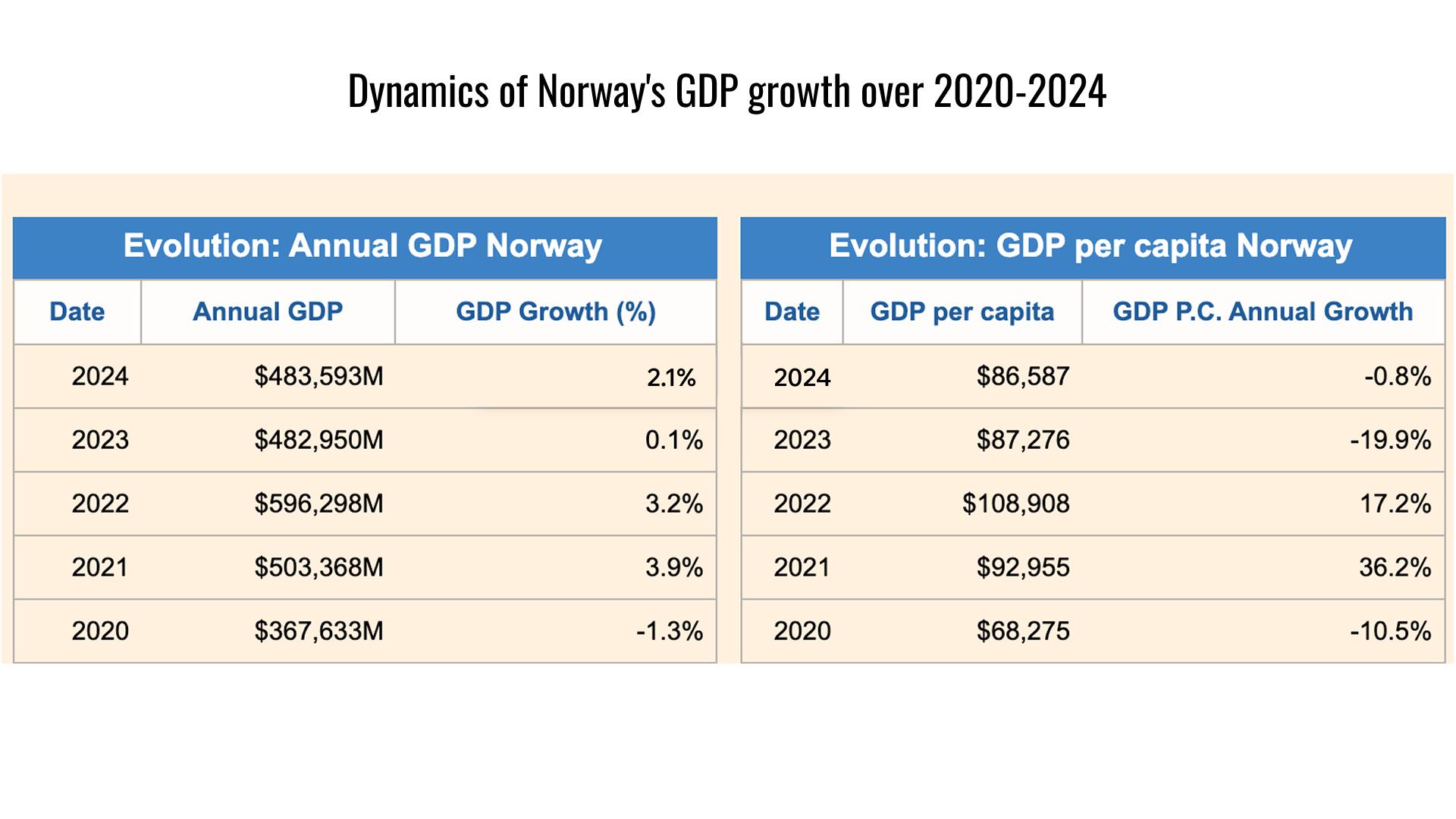
When the total tax burden on businesses exceeds half of their profits, entrepreneurs find it harder to believe in the redistribution system and easier to believe in blatant robbery. Taxes in Norway do not exist separately from regulatory arbitrariness. At the same time, the state has tightened administrative control. Stricter reporting requirements, new transfer pricing rules, and expanded powers of the tax service. All this also costs time, money, and nerves. Let's look at the dynamics of Norway's GDP growth over the years; the figures speak for themselves:
Why Norway has become a "tax nightmare" for startups
Large corporations can withstand such pressure one way or another. Startups do so much less often, as they lack the reserves and administrative capacity. They do not have internal legal departments and armies of accountants. It would seem that if the state declares its support for innovation, then here is an area for improvement, but it continues to ignore its own contradiction.
The government's response to capital flight added another signal. In 2024, plans were announced to increase the exit tax — taxation of unrealized capital gains upon leaving the country at a rate of 37.8% for amounts over 3 million kroner, as well as maintaining tax obligations after changing residence. This does not change the logic of the system, but it does change the perception of risk at the very start of the business.
Source: BDO Norway (2024). Rules tightened in 2024 to prevent deferral of tax liabilities
The empirical consequences are already visible. The loss of one entrepreneur with capital of around $100 million means a loss of $1.1 million in annual revenue from wealth tax alone, not including dividends, investments, and the multiplier effect on the local economy.
Capital is followed by angel investments, mentoring networks, and role models for young founders. The tech sector has proven to be the most vulnerable. Startups often do not make a profit for 5–7 years, but their value grows rapidly. It is this dynamic that makes them the main target of the wealth tax.
Shipbuilding, financial services, and development are also experiencing significant outflows, but the innovation ecosystem is responding the fastest. According to Dealroom, venture capital investment in Europe fell by 37% compared to 2022, and in Norway, the number of funding rounds fell by about a quarter.
Source: Dealroom.co. (2024). European Tech in 2023
Which countries have already managed to rectify the situation?
In recent years, dozens of large Norwegian business owners and investors have moved their assets to jurisdictions with lower taxes and clearer rules — Switzerland, the UK, Singapore, and the UAE. Without crises or disasters. Simply because it makes more sense.
The contrast with neighbors only highlights the problem. Sweden abolished its wealth tax back in 2007 after a similar capital outflow. Today, Stockholm is one of Europe's strongest startup capitals. But Norway has not learned this lesson.
Source: Henrekson, M., & Du Rietz, G. (2014). Nordic Tax Journal. Tax Foundation (2024)
Denmark retains its wealth tax, but at a level of around 0.5–0.6%, and supplements it with tax incentives for innovation. The number of "unicorns" speaks for itself: about 46 in Sweden, 16 in Denmark, and only 5–8 in Norway.
Source: Atomico. (2024). The State of European Tech 2024. Vestbee (2025)
For comparison, it is worth mentioning other approaches. In Estonia, corporate profits are not taxed as long as they are reinvested. The tax is only levied when dividends are distributed. The system has been in place since 2000 and deliberately sacrifices part of short-term budget revenues for the sake of business liquidity and growth.
The UAE will introduce a 9% corporate tax in 2023, but only for profits over AED 375,000 (approximately $102,000), leaving small businesses and startups free from tax pressure in the early stages.
Source: UAE Ministry of Finance. Federal Decree-Law No. 47 of 2022.
Along with taxpayers, the country loses access to investment decisions, entrepreneurial networks, and scaling experience. This is not visible in annual reports, but it is what constitutes long-term growth.
Comparisons with Estonia often seem inappropriate. Estonia has no oil revenues or large reserves. There is another simple rule: corporate profits are not taxed as long as they remain in the business. Tax is only paid when the owner takes the money for themselves. Until that moment, the state is not interested in the cash flows of the business at all. It does not promise much support or incentives — it simply does not interfere.
This approach does not guarantee automatic success for every business. But it removes one of the key obstacles that also hinders entrepreneurs in Ukraine: fear of growing faster than the tax system allows.
Conclusions
In the global economy, countries can no longer hold entrepreneurs back with administrative force. People and capital move to places where the rules are simpler and more stable. This is normal behavior.
Norway is currently facing a systemic problem caused by an outdated paradigm. The rules remain those of the economy of the past, while reality has long since changed.
In such conditions, economic freedom ceases to be a rosy ideal for fanatics and becomes a real criterion for economic survival. Norway will either allow risk-taking or lose everyone willing to take risks.
For Ukraine, this case is not theoretical. The standard income tax rate is 18%, and 25% for banks. There is a repatriation tax of 15% on dividends, royalties, and other passive income, with the possibility of reduction under double taxation avoidance agreements. Formally, the rules are clear, but practical business experience is shaped by administration, the presumption of guilt of the taxpayer, and judicial predictability.
We compete for capital and talent under significantly worse starting conditions, given the military risks. We have no margin for error and no oil-backed safety cushion.
When Denmark allows Ukrainian businesses to disregard some of the regulations for launching production on its territory, Ukraine must send a clear signal that it is much more interested in its entrepreneurs than any other country. And it must demonstrate this interest exclusively by easing restrictions, not tightening the screws.
The case of Norway shows that one may have any attitude toward the ideas of the Austrian School of Economics, but it is impossible to deny their effectiveness. Financial strength does not protect against false incentives. The model that worked in the resource economy is beginning to fail in the knowledge economy. If the tax and regulatory system creates additional pressure on those who invest and create jobs, the result will be predictable, no matter how much money the state has.
Freedom works where rules do not create incentives to escape. And that is the main lesson of the Norwegian paradox.