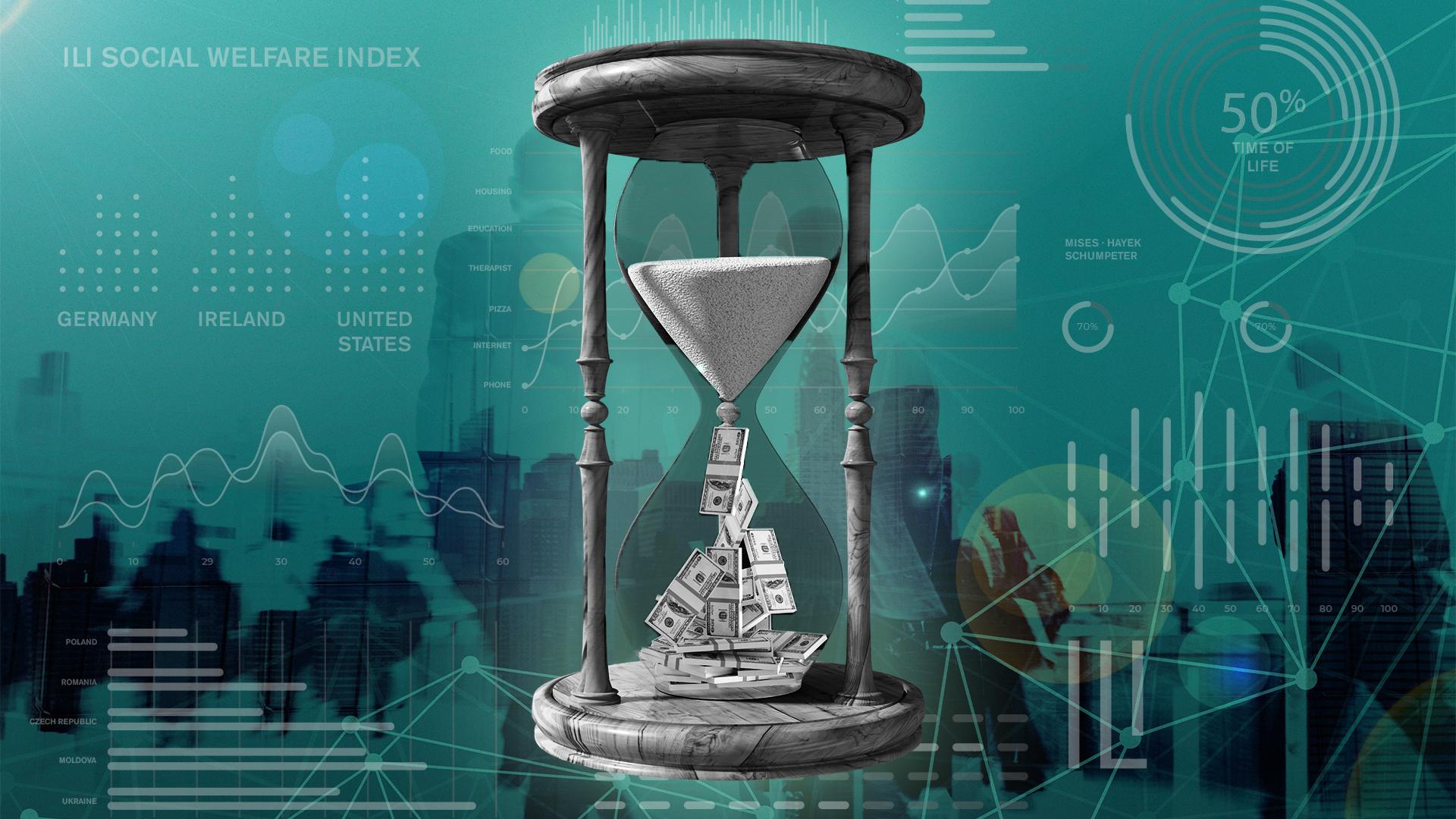
How do Ukrainians perceive their country? The main objective of the study "Social Attitudes of Ukrainians: Individualism, Collectivism, and Ideology", which was conducted in September 2025 based on a sociological survey of Ukrainians by New Image and Marketing Group on behalf of the International Liberty Institute (ILI).
The study provides a comprehensive understanding of the extent to which Ukraine can be considered capitalist in the minds of its citizens and how perceptions of free market ideas have evolved over 34 years of independence, and whether there are signs of awareness of the need for a full transition from the Soviet "state plan" to a genuine market economy with minimal state interference in economic activity and citizens’ lives.
Renowned economist and expert on transition economies Yaroslav Romanchuk usually describes the current structure of Ukraine's economy as a system of "Schematism + Oligarchy" — where large business groups have close ties to the government and political forces, reaping huge profits from this, meanwhile, state institutions display traits of the Soviet legacy, functioning not according to the principles of classical market capitalism, but rather serving the aforementioned system of discretionary distortions and the interests of high-ranking officials. Delays in privatization processes and excessive regulation are hampering the country's economic development, keeping it mired in stagnation and under the yoke of debt.
The state remains the main owner and administrator of most sectors of the Ukrainian economy. The development of institutions responsible for ensuring transparent rules of the game and upholding rights and freedoms remains significantly lower than in European countries, including those from the post-socialist bloc.
These aspects are the source of many problems, including preventing Ukraine from being considered a fully-fledged "capitalist" state. The full-scale war has led to a growing influence of the state in the economic sphere, an increase in the share of GDP distributed through the budget (almost 72%), and the slow — or, in some cases, complete lack of — implementation of necessary reforms in the area of the rule of law, which would otherwise contribute to business development and the improvement of the country’s investment climate. In general, all EU countries neighboring Ukraine are significantly ahead of it in the
Economic Freedom Index ranking: Romania ranks 50th, Hungary 61st, Poland 76th, Moldova 85th, while Ukraine continues to belong to the group of countries classified as "economically unfree states," It was able to improve its score by only a few points, moving from 150th to 143rd place in 2025, ahead of Russia (148th place out of a possible 165). The question arises: do Ukrainians understand that their well-being depends on how successful their country is on the path to capitalism? The study provided answers to this and other important questions:
- What is the attitude of Ukrainians towards capitalist values — economic freedom, free personal development, entrepreneurship, etc.?
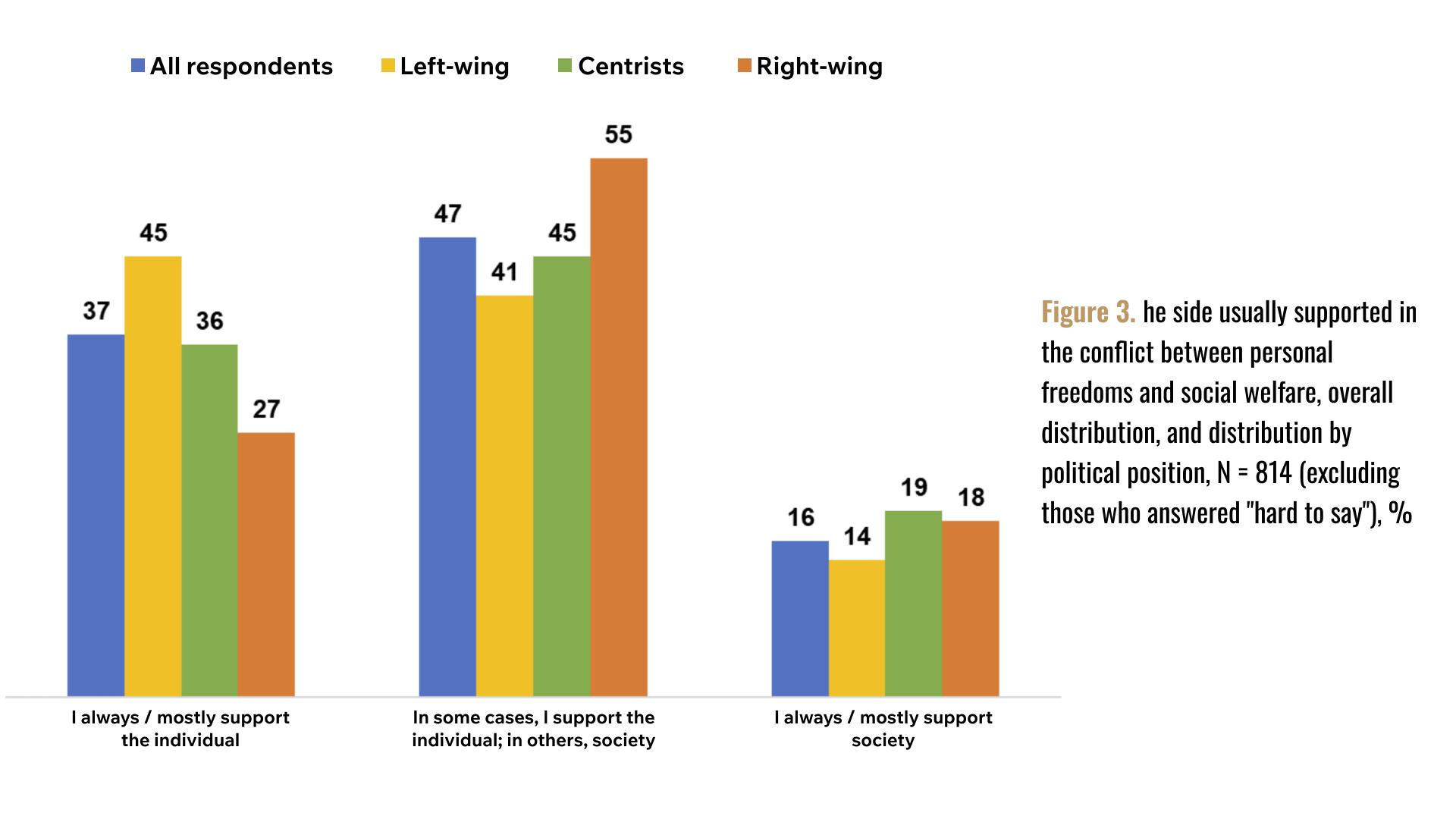
- What will most Ukrainians choose in a difficult situation — personal or social?
- What negative and positive characteristics do people associate with the term "capitalism"?
- How do people in Ukraine with different incomes and education levels, ages, and genders perceive capitalism?
- Do Ukrainians understand the political coordinate system, and how do representatives of different political views feel about the ideas of economic freedom and state intervention?
Other related aspects provide a complete picture of civilizational choices in the way of thinking and obtaining information for the formation of one's own worldview:
- Is there a connection between conspiracy theories, education, and anti-capitalism?
- What do Ukrainians use as the main information channels?
The full research report is available above and below this post (значок pdf).
Ukrainians' values: individual or collective?
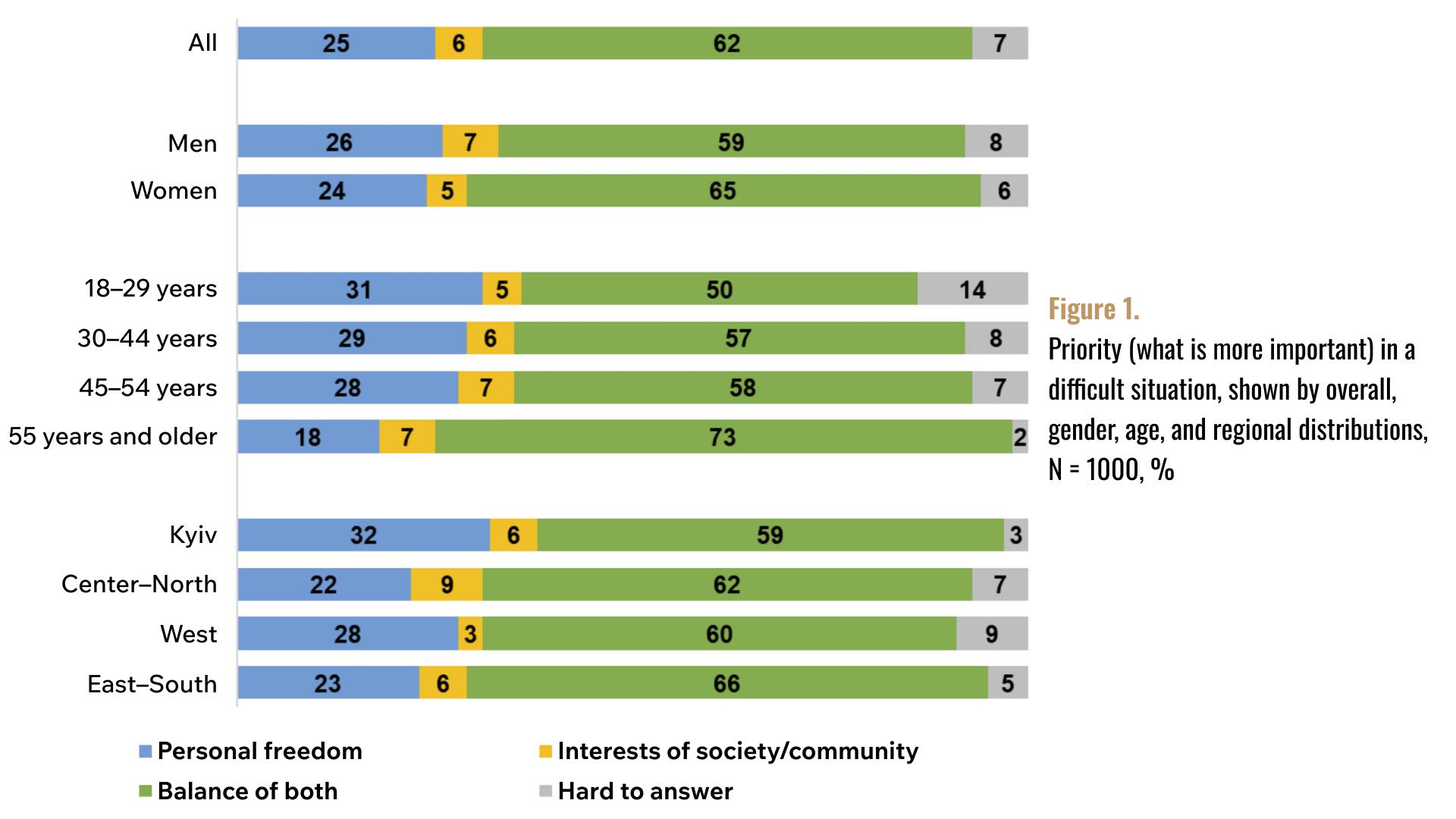
To measure Ukrainians' value orientations regarding their inclination toward individualism (prioritizing personal freedom, self-expression, autonomy) or collectivism (willingness to subordinate individual interests to the needs of society or the community), respondents were asked the question: "What is more important to you in a difficult situation?”
62% of respondents said that in difficult situations, it is important for them to strike a balance between personal freedom and the interests of society or the community. The importance of balance was most often chosen by respondents in the older age group, 73%.
At the same time, every fourth respondent (25%) noted that personal freedom is more important to them in difficult situations. The priority of personal freedom is more pronounced among young people: 31% (aged 18-29), as well as among Kyiv residents (32%) and respondents from the west of the country. Only 6% of all respondents said that the interests of society or the community were more important in a difficult situation.
As income levels rise, so does the percentage of those who choose personal freedom in difficult situations—29% among respondents with high incomes (average monthly family income ≥ UAH 40,000) and 26% among those with average incomes (UAH 10,000–20,000).) At the same time, respondents with "high" incomes were also slightly more likely than others to note the importance of society/community interests in a difficult situation. In contrast, respondents with "low" incomes were more likely than others to be unable to decide on an answer to this question.
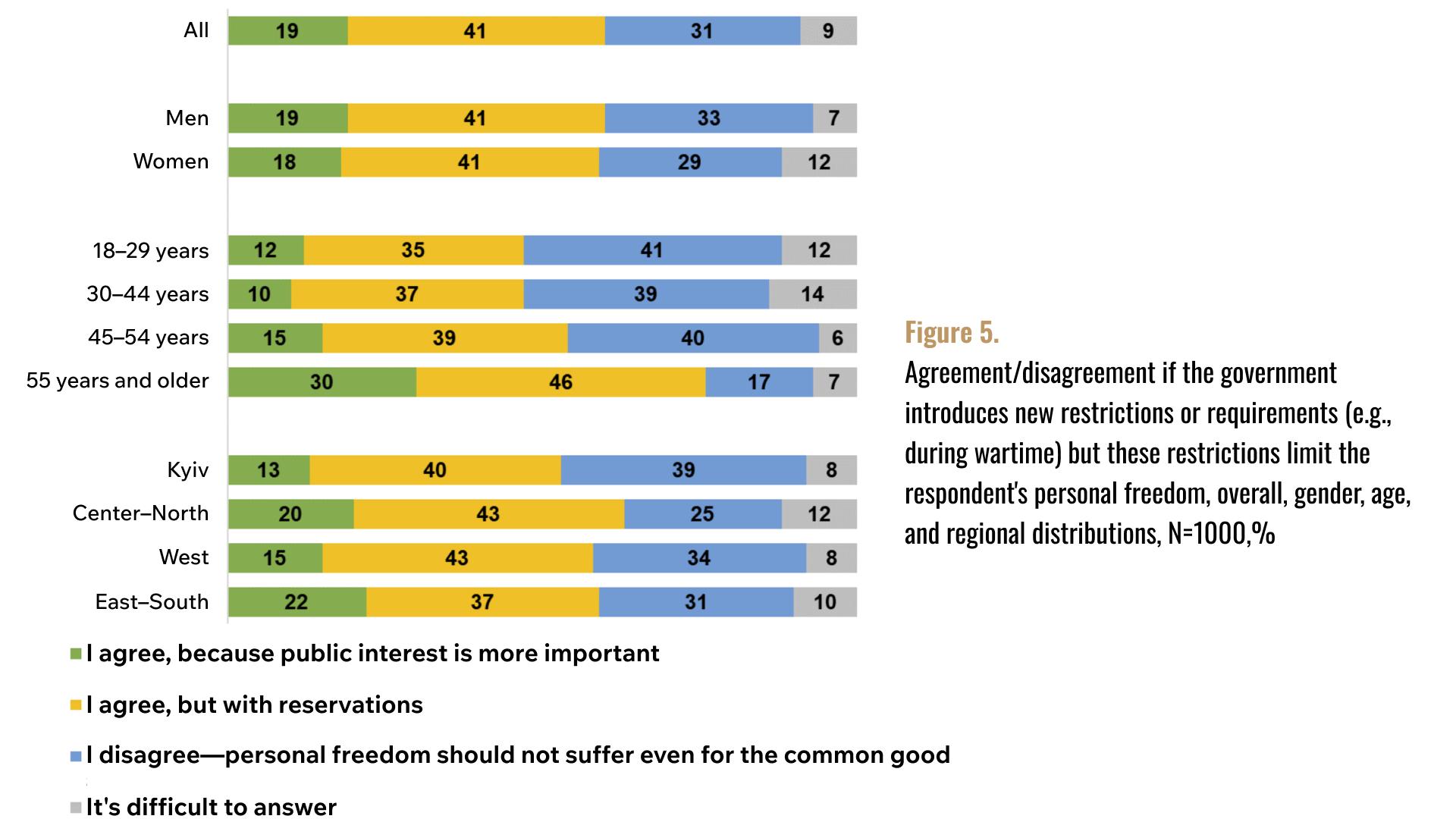
If the government introduces new restrictions or requirements (for example, during wartime) and these restrictions limit the respondent personally, 41% would agree to the new restrictions, but with reservations; 31% believe that personal freedom should not suffer even for the sake of the common good; 19% would agree because the public interest is more important, and 9% are undecided.
Only 17% of respondents aged 55 and older chose this answer, while in other age groups, between 39% and 41% of respondents chose this answer. That is, contrary to the "balanced" position on individualism and collectivism expressed by a significant proportion of respondents in the above questions, the existence of personal constraints increases the level of attraction to individualism among respondents aged 18-54.
Interestingly, 39% of Ukrainians agree with the statement that "People have the right to live as they wish, even if the majority does not approve", 21% somewhat agree with this, and 19% partially agree and partially disagree. 29% believe that "Success depends mainly on personal effort, not on support from the state," 24% tend to agree with this, and 26% partially agree and partially disagree. This indicates that society understands the pro-capitalist basis of personal success and freedom.
Ideological and political views of Ukrainians
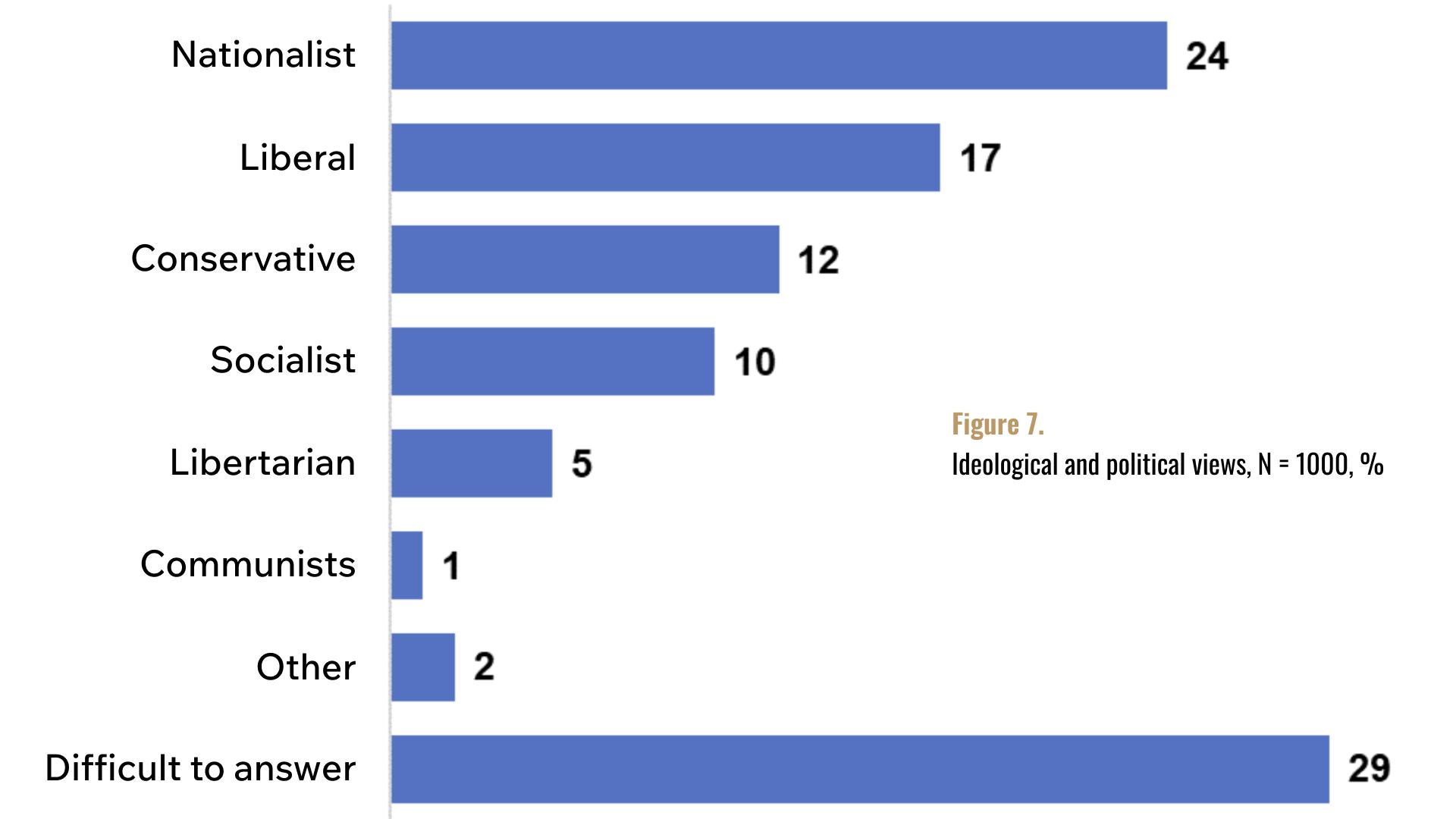
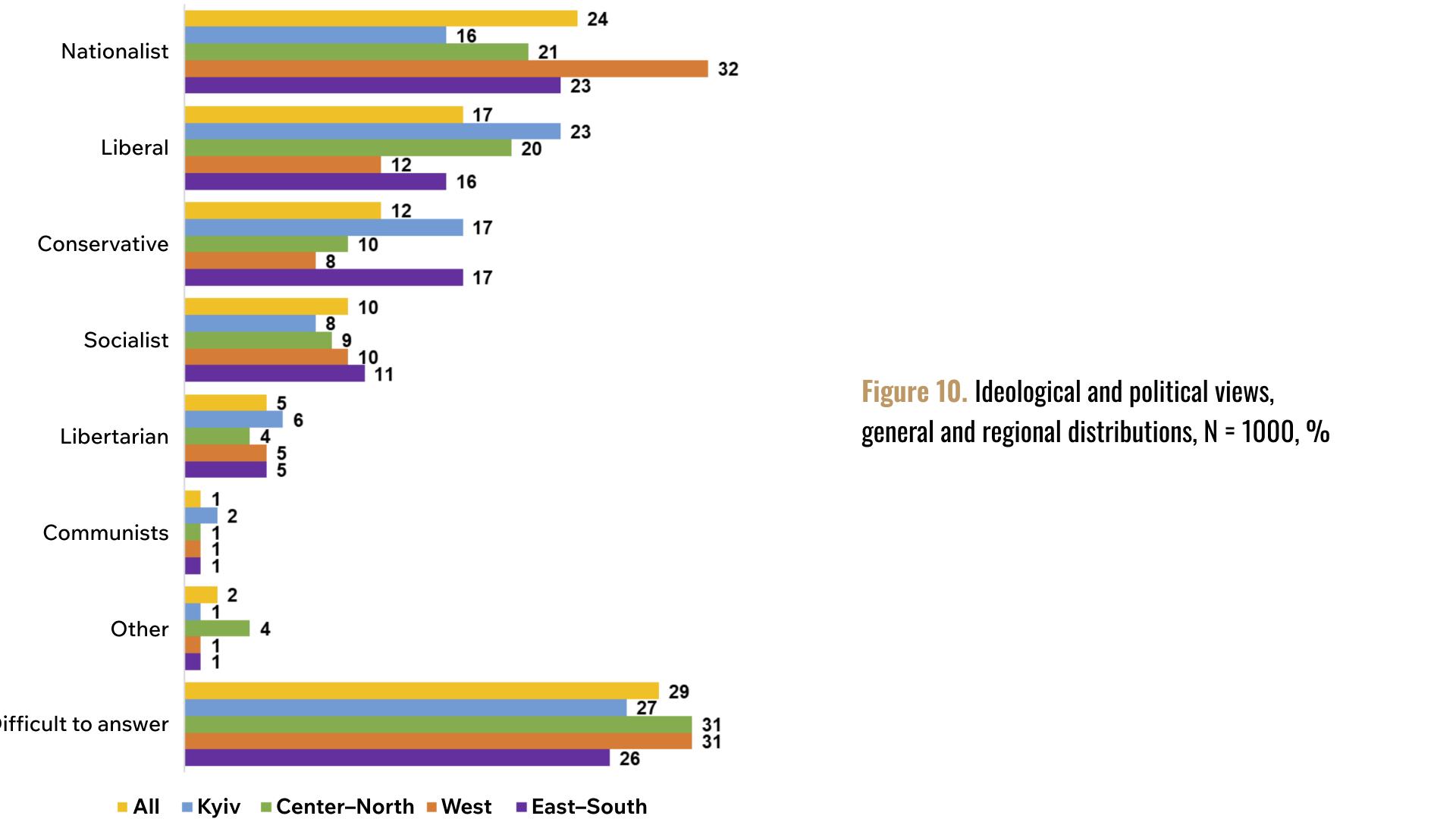
Screening ideological and political preferences is important for this type of research. Almost a third of respondents (29%) were unable to define their own ideological and political views, with this figure rising to 36% among women.
- Nationalist - 24% of respondents. Respondents aged 18-29 and Kyiv residents chose this answer less often than others, while respondents aged 45-54 and respondents from the west chose it more often.
- Liberal - 17% of participants; men, respondents aged 55 and older, respondents from Kyiv gave this answer more often than others, while women, respondents aged 30-54, and respondents from the west gave this answer less often than others.
- Conservative - 12% of respondents, with respondents from Kyiv and the east-south choosing this answer more often.
- Socialist - 10% of respondents, more often, respondents aged 45-54.
- Libertarian - 5% of respondents.
- Communists - 1%.
- Own answer - 2%.
Attitudes toward economic freedom in Ukraine
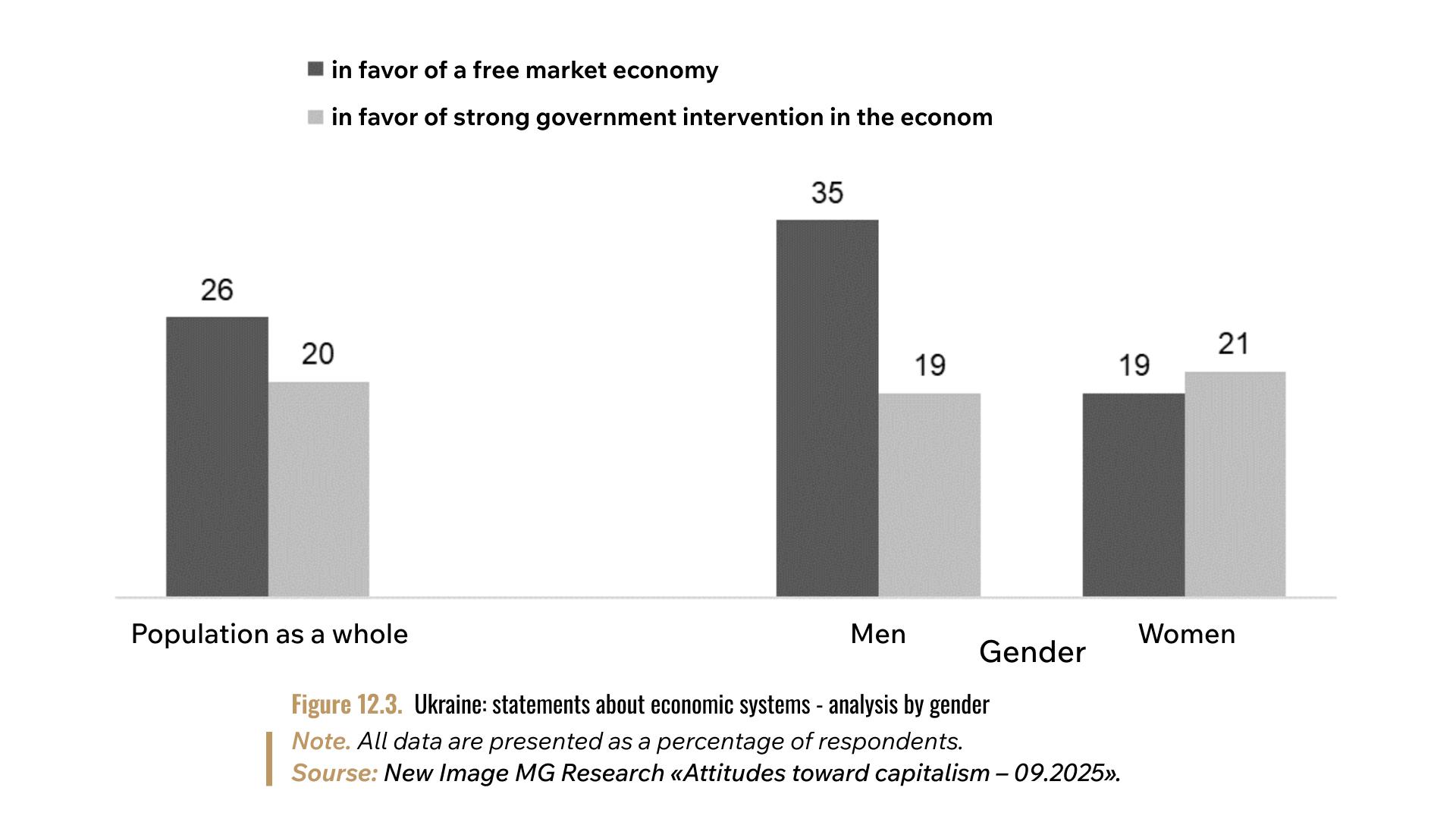
An analysis of responses to pro-state and pro-market statements shows that statements in favor of a free-market economy and reducing the role of the state are approved by 26% of respondents, compared to 20% who approve statements in favor of strengthening the state role. The approval rating for pro-market ideas among Ukrainians is 1.31.
Note: a coefficient above 1.0 means that views in favor of economic freedom prevail, while a coefficient below 1.0 means that views against economic freedom prevail.
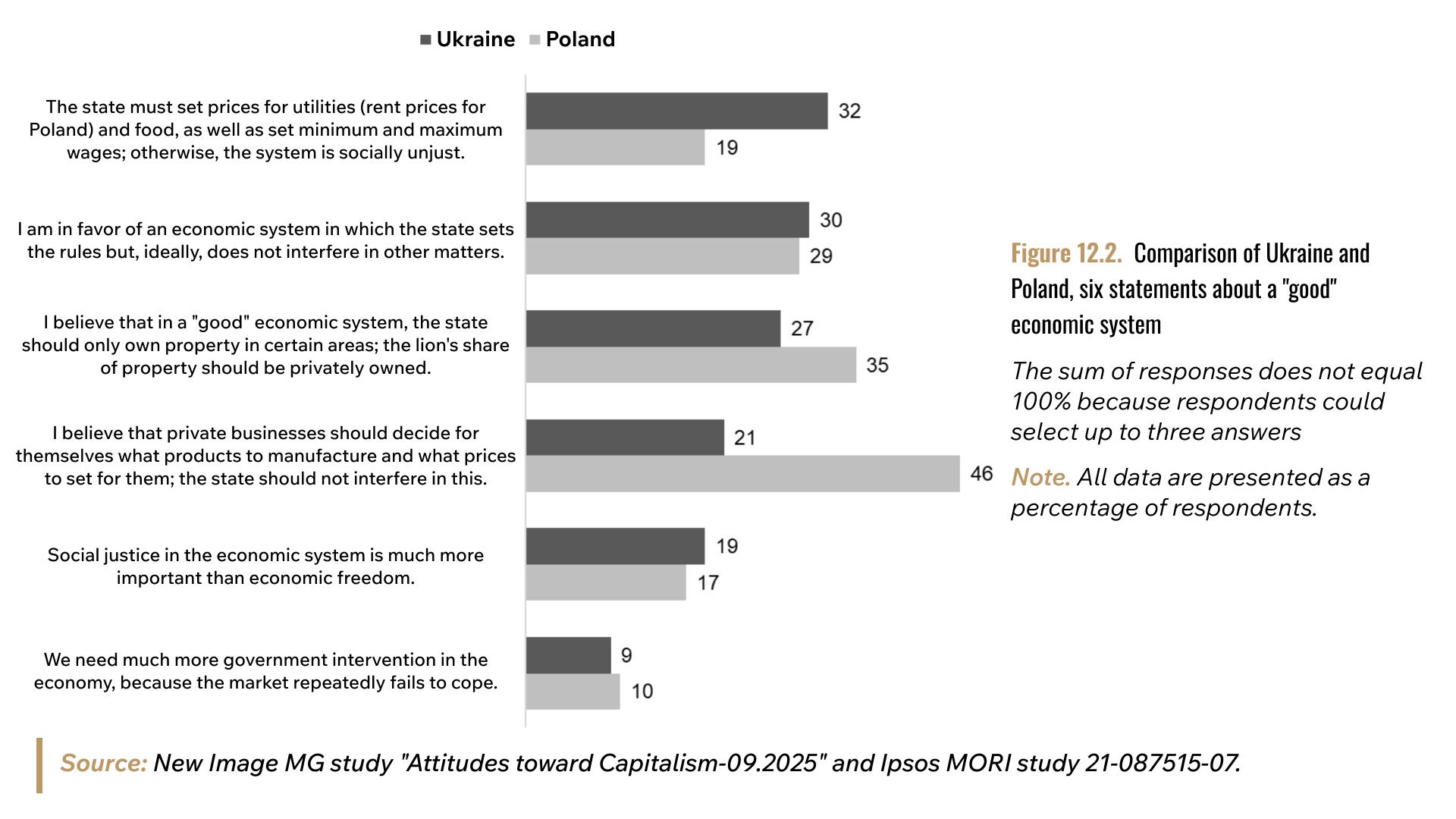
In a similar study, Russia, for example, has a coefficient of 0.42, which clearly indicates a skeptical attitude toward the market economy and opposition to economic freedom. Poland has a coefficient of 2.40, which indicates a significant dominance of views in favor of economic freedom.
At the same time, pro-state orientations in the economic sphere still enjoy significant approval, with 32% of all respondents considering a "good" economic system to be one in which "the state should set prices for utilities and food, as well as set minimum and maximum wages; otherwise, the system is socially unjust". In Poland, only 19% of respondents agreed with this statement; in Russia, 65% of respondents agreed with this statement, indicating a significant difference in opinion.
Significant differences were found in the approval of economic freedom depending on the respondents' gender in Ukraine. Women were more likely than men to support pro-state statements, while men were more likely to support pro-market statements. Although respondents of both genders generally hold pro-capitalist views, men were more likely than women to express their support for pro-capitalist views and individualism, as evidenced by the coefficients: 1.38 for men and 1.03 for women. Women also found it more difficult to define their political views (36% were undecided).
In most age groups in Ukraine, approval of the market economy and economic freedom prevails, especially among respondents in the younger age category – 18-29 years old (33% of respondents), with only 19% expressing support for pro-state statements. Among respondents aged 45-54, slightly more respondents supported pro-state views than pro-market views: 23% of respondents versus 20%.
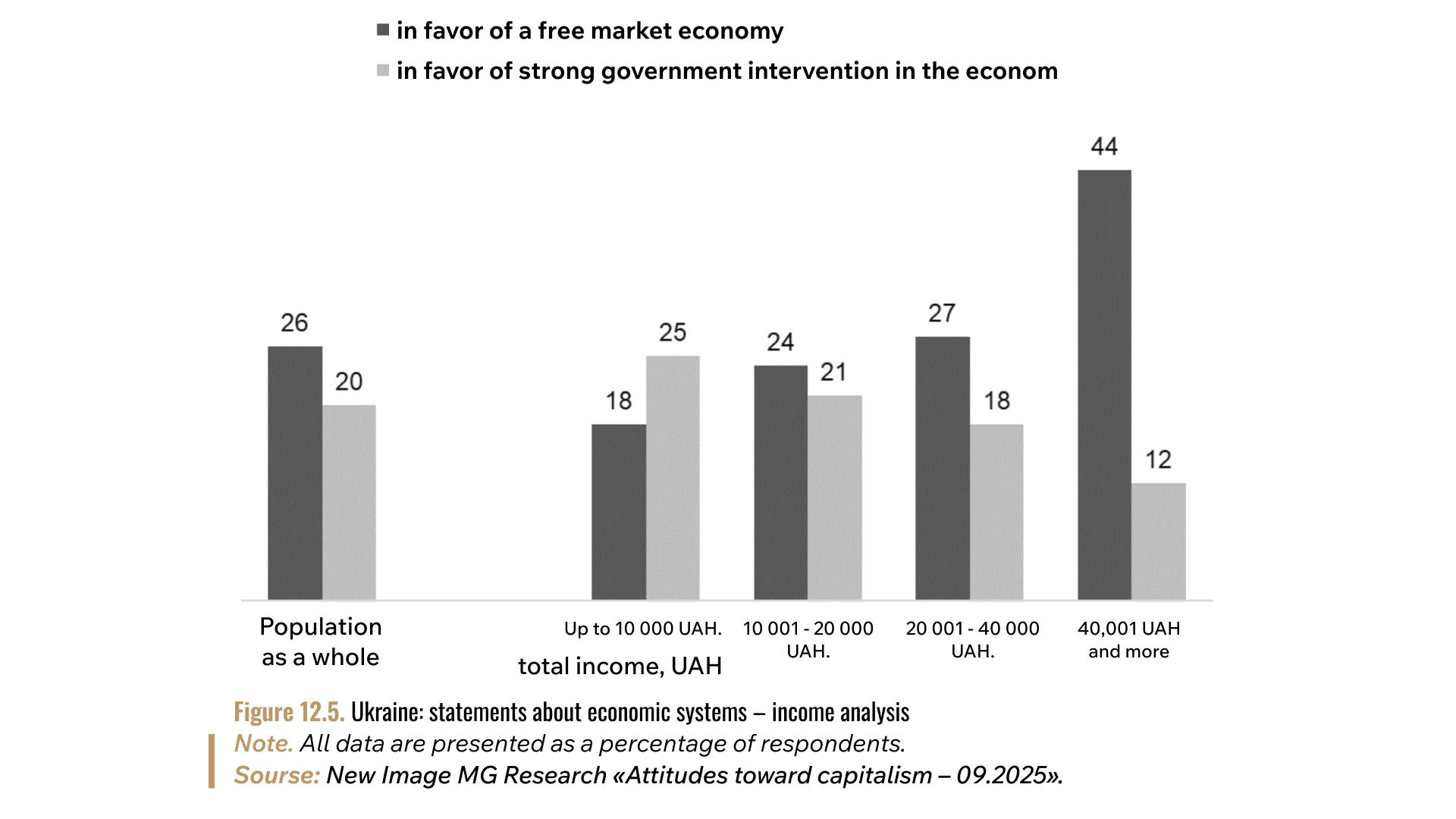
An important finding of the study is that as income and education levels rise, so does support for free market economics.
44% of respondents with a total family income of over UAH 40,000 supported statements in favor of a free market economy, while only 12% supported statements in favor of significant state intervention. Respondents with low incomes (not exceeding 10,000 hryvnia) are more skeptical about the market economy and express support for state regulation of the economy.
Respondents with incomplete higher education and complete higher education express pro-capitalist views, while respondents with lower levels of education have lower coefficients (0.98), and therefore, anti-capitalist views dominate among this group of respondents (coefficient 1.28).
Market economy and political views have the following relationship: rejection of free market ideas is most pronounced among representatives of extreme left-wing views, coefficient of 0.67., representatives of other groups across the political spectrum have coefficients above 1.0, meaning that pro-market views dominate among respondents of other political orientations, especially among the "moderate" right wing, with a coefficient of 2.51.
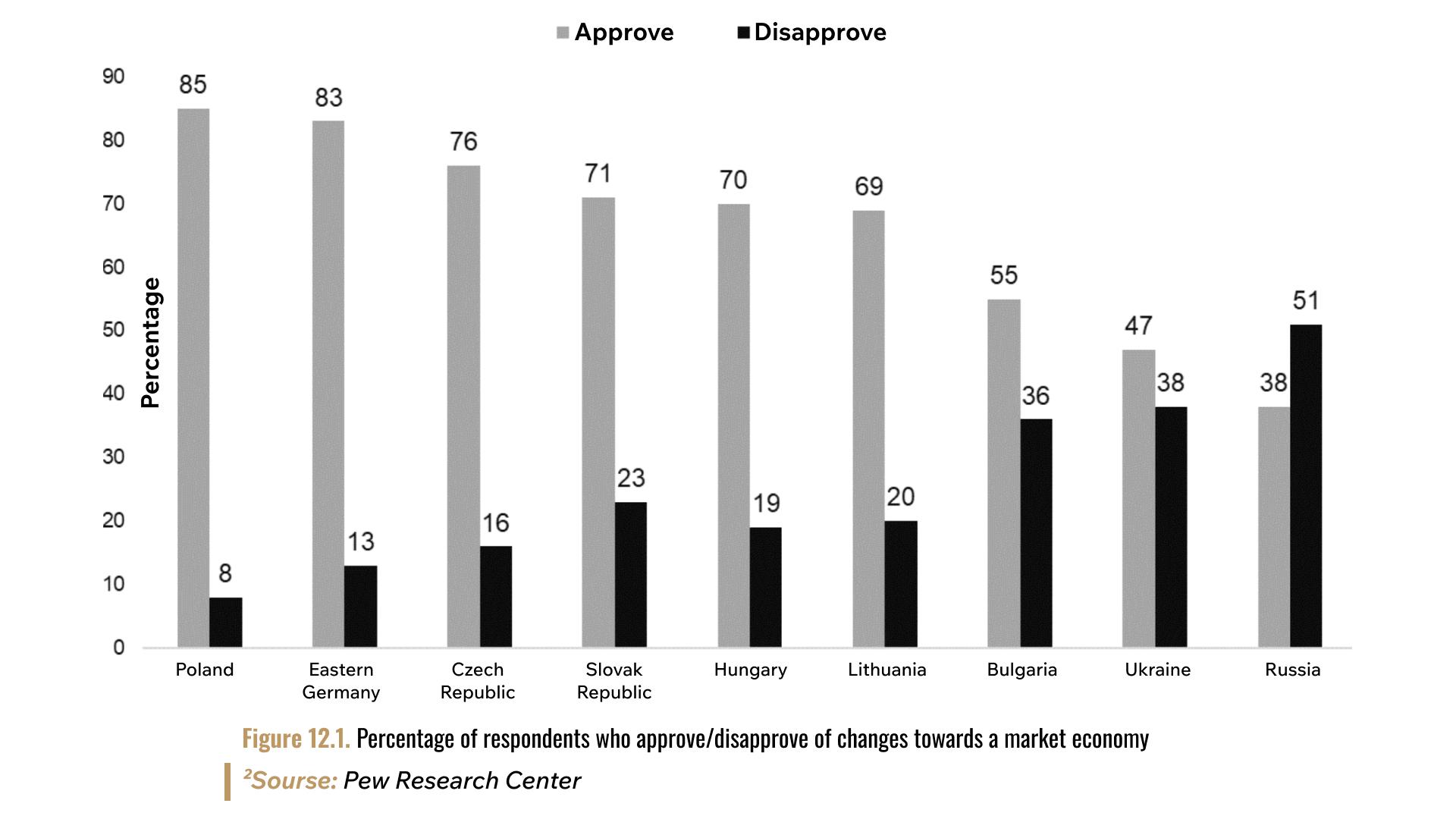
In 2019, the Pew Research Center conducted a survey in 17 countries, including Ukraine. During the study, respondents were asked questions about the transition of countries' economies from socialist to market economies. In this study, Ukrainians were asked the same question: "Do you approve of the transition to a market economy?”. 65% of survey respondents approve of this transition. We are seeing an increase in the proportion of those who approve of the transition to a market economy in 2025 compared to 2019.
What do Ukrainians associate with the concept of "capitalism»?
Among all Ukrainian respondents, regardless of income level and age, positive associations with the concept of "capitalism" prevail.
The most positive attitude toward capitalism prevails among respondents in the older age group (55 years and older), as well as among young people (18-29 years old). Respondents aged 30-44 and 45-54 demonstrate more negative associations.
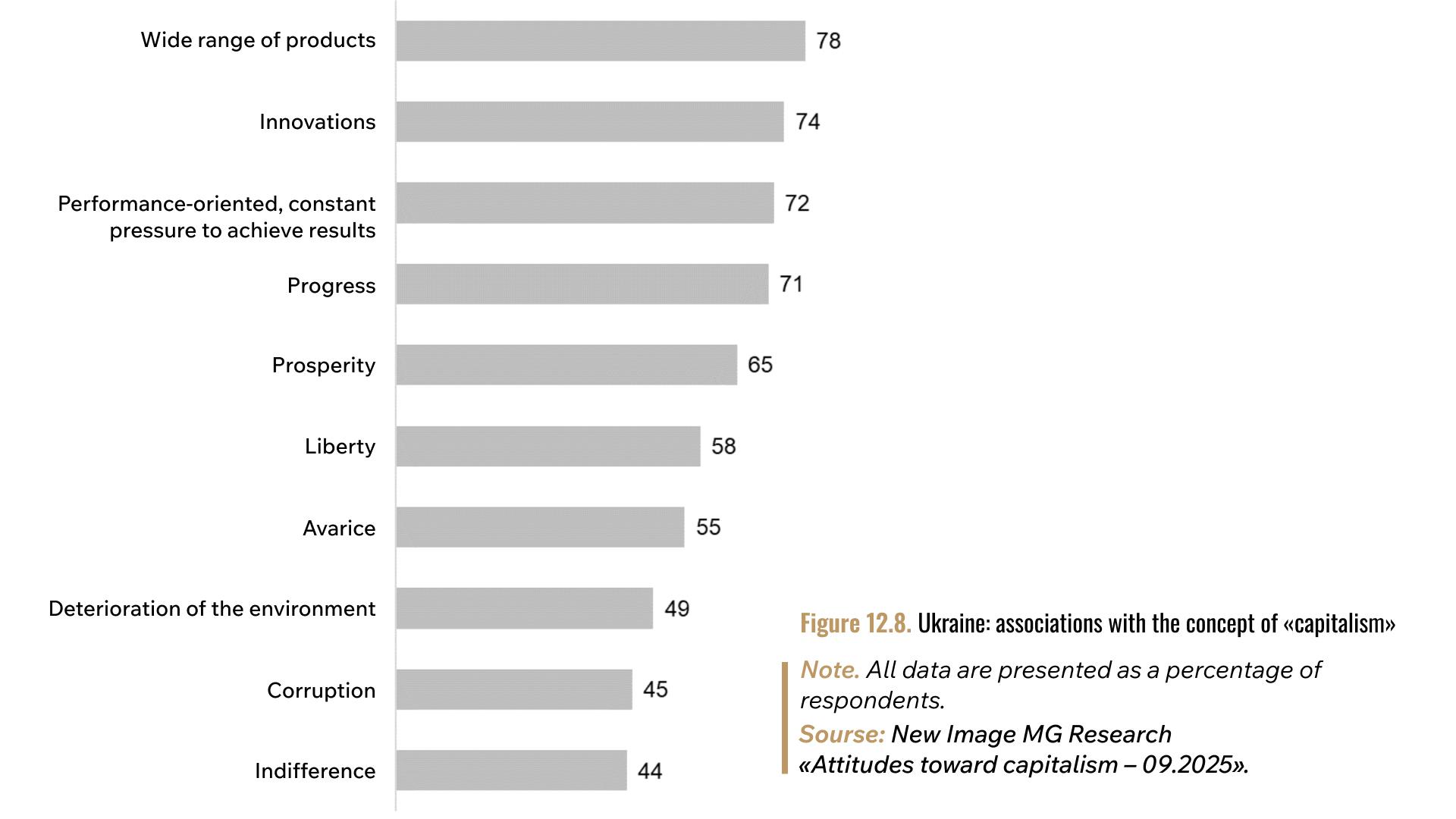
All respondents were presented with 10 terms – five positive and five negative – to determine their associations with "capitalism." Result: Respondents in Ukraine associate the term "capitalism" with positive phenomena.
The average share of positive terms mentioned alongside the concept of "capitalism," such as "wide range of goods," "innovation," "progress," "prosperity," "freedom," etc., is 69%. On the other hand, negative terms such as "greed," "corruption," "indifference," etc., were noted by 53% of respondents.
A clear trend shows that as respondents' income levels rise, so does the percentage of those who associate positive terms with the concept of "capitalism." This is particularly evident in the case of the term "freedom": among respondents with low incomes (≤ 10,000 hryvnia), 49% associate capitalism with the term "freedom," while among respondents with the highest incomes (≥ 40,001), this figure rises to 67%.
As expected, representatives of extreme left-wing views were slightly less likely to associate positive connotations with the concept of "capitalism" – 56% compared to an overall figure of 69% among all respondents. At the same time, it is interesting that even among respondents of this political orientation, positive associations outweigh negative ones.
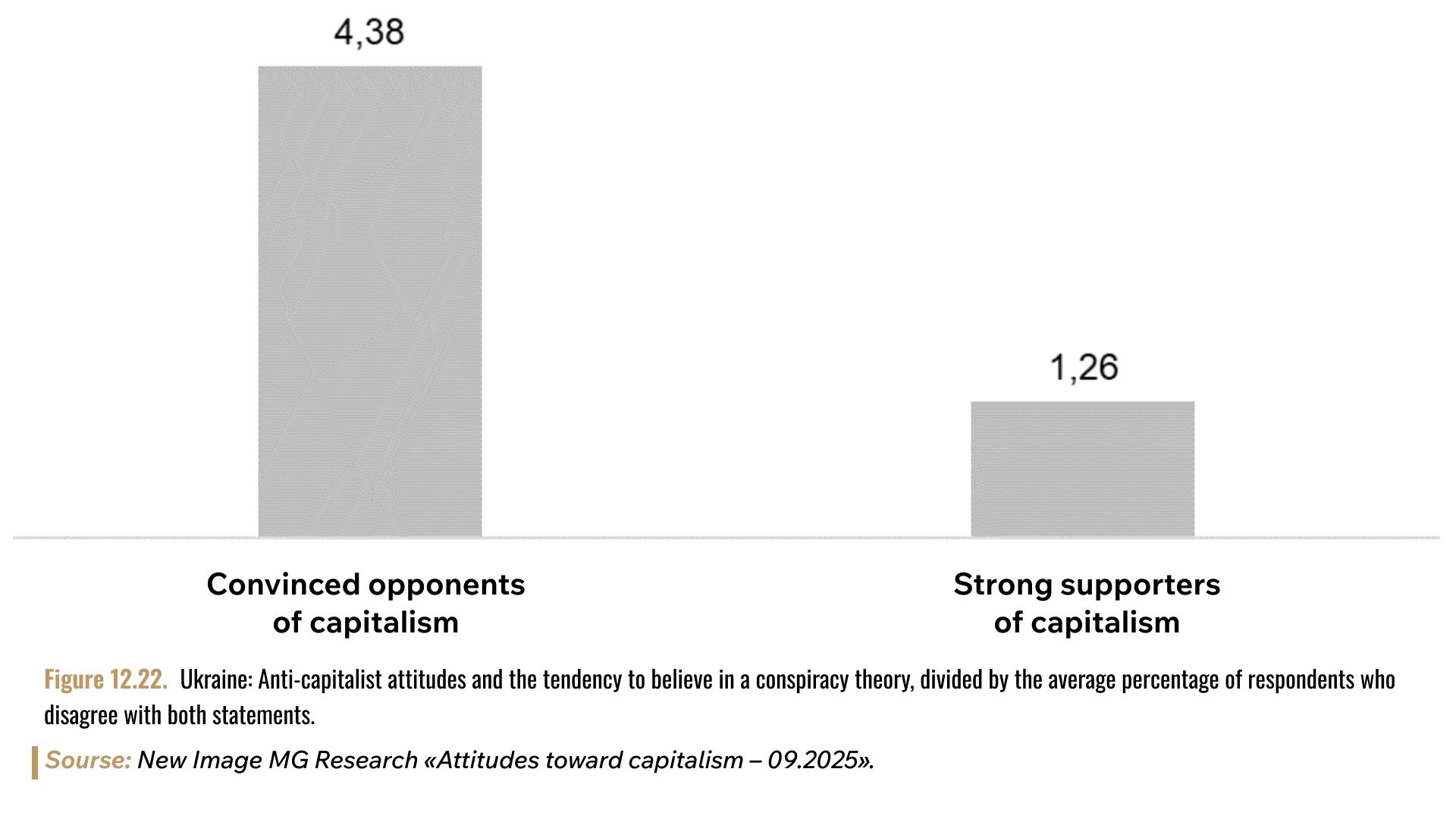
The study also showed that in Ukraine, staunch opponents of capitalism believe in conspiracy theories more strongly than staunch supporters of capitalism.
The link between conspiracy thinking and anti-capitalism is obvious. Similar trends prevail in all other countries where similar studies have been conducted.
Despite Ukrainians experiencing the collapse of the Soviet system and decades of socialist rule, their values demonstrate a pronounced pro-capitalist orientation. This is also reflected in a propensity for private initiative, entrepreneurship, and personal responsibility for the results of one's work. Unlike neighboring countries with more traditional authoritarian or centralized models, Ukrainians, in shaping their attitude toward the economy, show a willingness to rely on the market rather than exclusively on state regulation.
This orientation has several sources.
- Historical experience of attempts to transition from a planned economy to a market economy has shaped the population's clear understanding that efficiency and prosperity depend on personal effort and entrepreneurship.
- The process of privatization and development of small and medium-sized businesses has allowed Ukrainians to experience the benefits of private ownership and a competitive environment in practice.
- Modern globalization and the influence of European values reinforce the desire for economic freedom, encouraging people to view market mechanisms as a tool for personal development and well-being.
The results of this study also confirm the pro-capitalist views of Ukrainians, and this applies to both the younger generation and representatives of older age groups.
At the same time, despite their desire for market instruments, Ukrainians value the balance between personal freedom and social welfare, demonstrating a moderate but steadfast commitment to capitalist principles.
This phenomenon makes Ukraine unique in the post-Soviet space as a country with a marked orientation toward economic freedom, contrasting with neighboring Russia, where the preference for centralized, authoritarian economic models remains more pronounced.
The study showed that even during a full-scale war, Ukrainians continue to show a steady trend toward growing support for capitalist views and methods of transforming the country's economy from a planned (socialist) to a market economy, which, provided that the recommendations of the International Liberty Institute, based on the principles of the Austrian School of Economics, are followed, will help Ukraine achieve prosperity and well-being, ultimately joining the ranks of the world’s developed and wealthy nations.
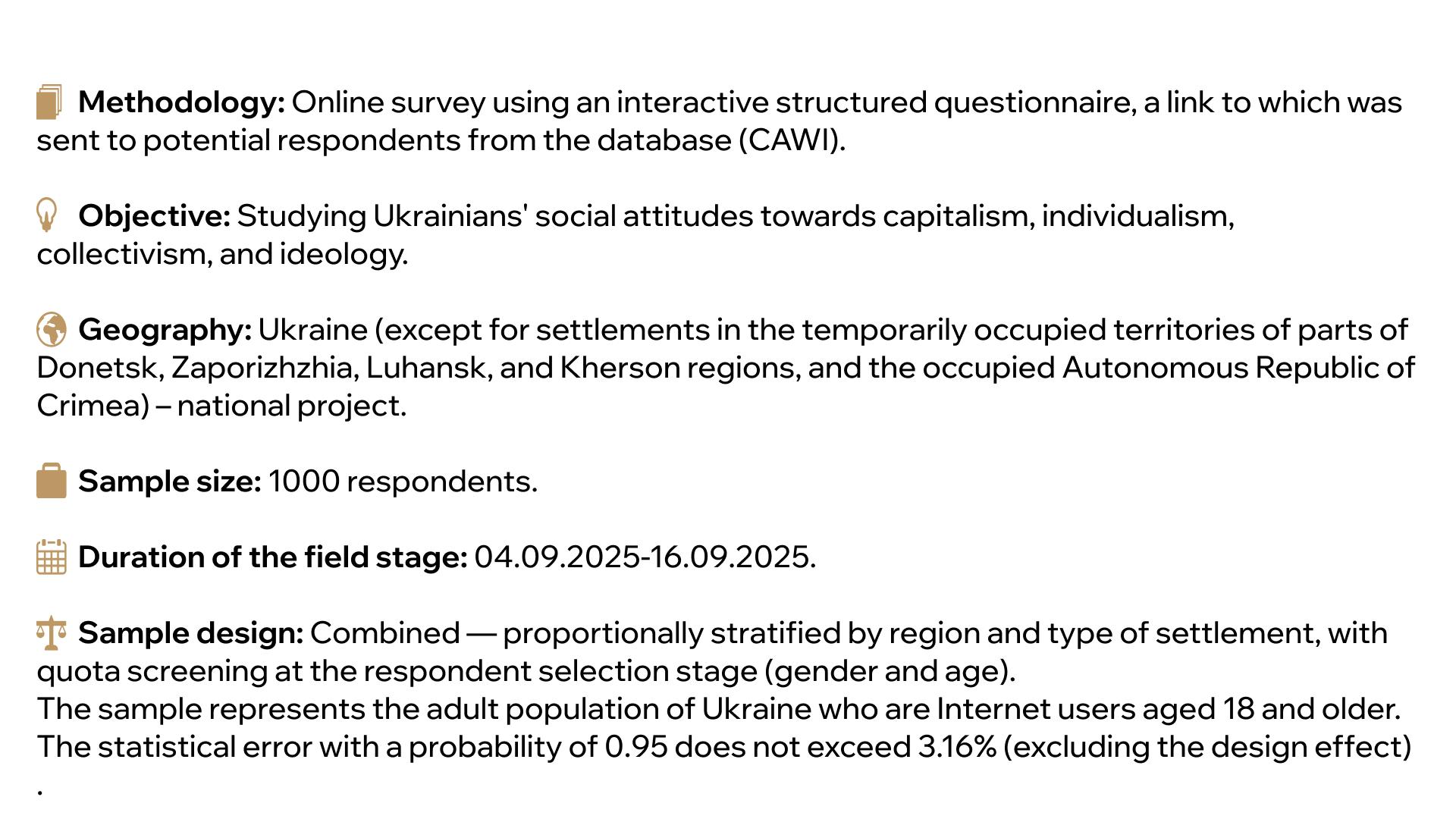
Survey parameters: