In 2025, the Ukrainian economy continued to operate amid radical uncertainty, external turbulence, and internal institutional contradictions. Russia's large-scale war against Ukraine remains the dominant factor influencing the economic decisions of the government, businesses, and households.
The annual reallocation of 30% of GDP to defense in the period 2023–2025 has affected the capital structure, investment, and production decisions of economic entities. The State has been and remains an equally significant factor influencing the behavior of goods and services producers.
The average annual non-military expenditure of state administration bodies in 2022-2025 amounted to 42% of GDP.
The dominance of the non-market sector in the economy, coupled with poor regulatory quality, weak government efficiency, pervasive conflicts of interest in government and business structures and organizations, and a fragile system of checks and balances, primarily on the part of parliament and law enforcement agencies, has exacerbated the problem of corruption and the associated costs for Ukrainian entrepreneurs.
In 2025, the total tax, regulatory, and transaction costs for legal and “gray” businesses increased. Widespread discretionary practices (subjective interpretation of legislative provisions) with a long list of legalized discriminatory norms list of “white businesses,” national cashback, “5-7-9” credit program, mobilization and reservation regime, opening of 112 technology parks with a special regulatory regime, preferences in access to public procurement have paralyzed the implementation of the principle of equal economic conditions. As a result, the most profitable business in the Ukrainian economy has become business between the state and the state, using state money and assets.
The government's intensified efforts to worsen working conditions for sole proprietors, including the introduction of VAT for them, are yet another measure aimed at undermining trust in the authorities and driving out small businesses.
Slowdown in Ukraine's GDP growth and disappointing forecasts
In 2025, there were varying rates of change in economic, investment, production, and financial processes and phenomena. On the one hand, we note a slowdown and a decrease in the intensity of certain trends. Contrary to official forecasts, GDP growth rates in 2025 have slowed significantly. Given the 28.8% decline in GDP in 2022, such rates of economic recovery in Ukraine are unsatisfactory at the current level of income.
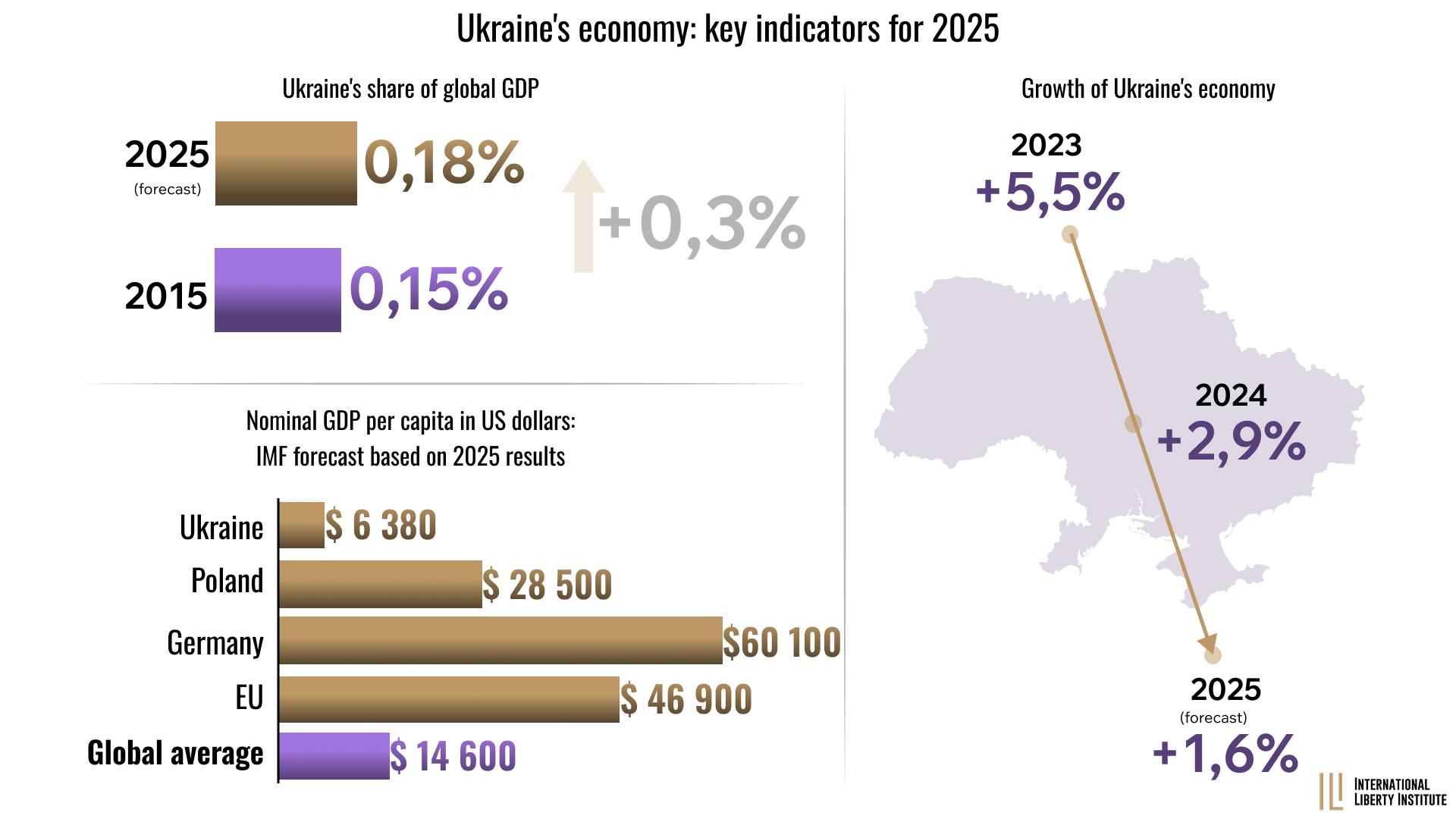
After growing by 5.5% of GDP in 2023 and 2.9% of GDP in 2024, the Ukrainian economy is expected to add only 1.6% of GDP in 2025. By the end of 2025, Ukraine's share of global GDP will be a meager 0.18%, compared to 0.15% 20 years ago.
According to forecasts for 2025, Ukraine's GDP per capita will be $6,382. This represents: 13.6% of the European Union level, 43.7% of the global average GDP per capita, 22.4% of Poland's level, and 10.6% of Germany's level.
Last year, in our
economic outlook for 2024, we considered two scenarios: a baseline scenario, which was more optimistic as it promised economic growth of 2.5-3%, and a pessimistic scenario (a decline of 2.5%). We must note that we are seeing at least minimal growth this year.
For comparison: according to IMF and OECD estimates, the global economy will grow by 3.2% of GDP in 2025, while developing Asian countries will grow by 5.2% of GDP.
Investments in Ukraine: no boom expected
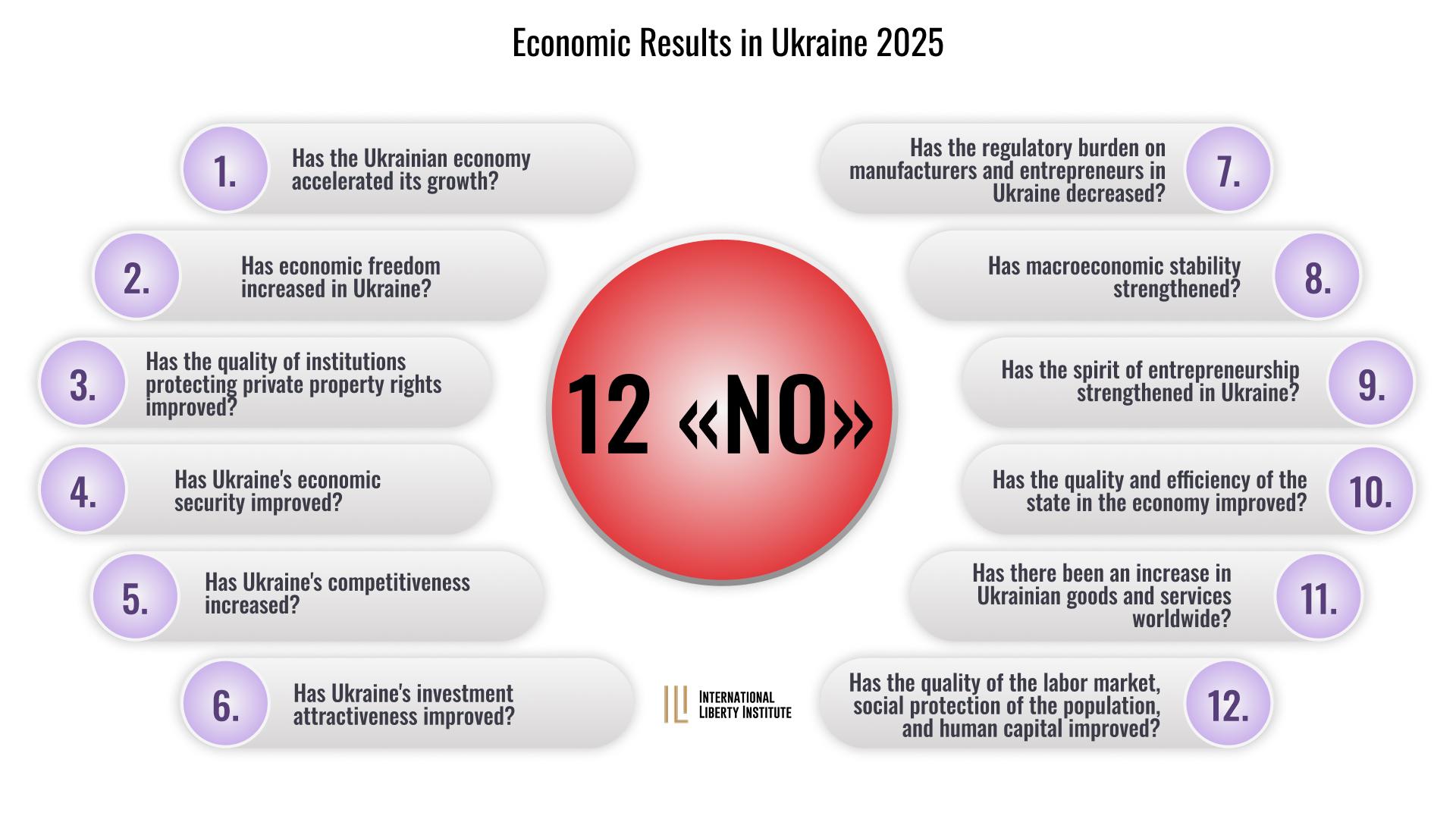
It is evident that by actively pushing private investors and producers out of the economy and expanding the non-market sector, the Ukrainian government has not achieved accelerated growth, an investment boom, or increased entrepreneurial activity, but rather the opposite result. Even minimal GDP growth rates in 2025 proved very difficult for the Ukrainian economy.
2025 is also characterized by a decline in private sector investment activity.
At the end of 2024, Ukraine's share in the world's accumulated foreign direct investment (FDI) was 0.1%, and its share in the European Union's accumulated FDI was 0.48%.
The volume of FDI accumulated by Ukraine per capita amounted to $1,516. However, this figure is only 17.7% of the Polish figure, 7.4% of the Czech figure, 22.7% of the Romanian figure, 24.2% of the global average, and 5.9% of the European Union figure.
According to the results of 2024, investments in fixed capital in Ukraine amounted to 18.6% of GDP, in 2023 – 18.1% of GDP. In 2025, their volume is expected to reach 20% of GDP.
The lion's share of investments in Ukraine is related to the military-industrial complex, energy, and the restoration of destroyed assets with the participation of the government and the public sector, it is not a new market structure of capital that is being formed, but rather the replacement of one nomenclature-oligarchic system with another.
Exports are falling, imports are rising
In 2025, we also see a decline in merchandise exports. In the first three quarters of this year, its volume was even less than $30 billion, which is 4.1% less than in the same period of 2024.
At the same time, imports of goods during this period exceeded $60 billion, which is 17.5% more than in the first nine months of 2024.
For comparison: merchandise exports per capita in Poland in 2024 amounted to $9,872, in Turkey — $3,080, on average for the global economy — $3,057, and in the EU — $15,890. In Ukraine, this indicator amounted to $1,170, which is 11.9% of the level in Poland, 38% of the level in Turkey, 38.3% of the global average, and 7.4% of the European Union average.
Ukraine remains overly dependent on exports of raw materials, and even in this area of economic activity, the potential of our economy has not been fully realized. According to UNCTAD data, raw materials account for 62.5% of Ukraine's total merchandise exports. The country's share in global exports of raw materials is only 0.43% overall, and 1.1% for agricultural raw materials.
Economic growth forecasts and reasons for the slowdown
In 2025, there was a simultaneous deterioration in three interrelated parameters of macroeconomic stability. The budget deficit of government agencies, the trade deficit, and the balance of payments deficit all exceeded 20% of GDP.
Obviously, the total state control of the economy, strict restrictions and barriers to capital movement, Ukrainian bureaucracy, and the widespread prevalence of discriminatory practices isolate Ukraine from the European and international system of labor division, complicating its integration into global and regional value chains. As a result, the national economic security system weakens, as demonstrated by this year’s Economic Security Index
With an acute shortage of financial resources, modern technologies, highly qualified personnel, high security risks, weak legal institutions for the protection of property rights, and an extremely low level of economic freedom, Ukraine is significantly reducing its chances of entering a trajectory of rapid (7–10% of GDP), long-term (15–20 years) economic growth.
Neither the Cabinet of Ministers' Priority Action Plan for 2025 (Prime Minister D. Shmyhal) nor the Action Program and Priority Action Plan of the new Cabinet of Ministers Y. Svyrydenko contain proposals whose implementation would eliminate the main obstacles to accelerating economic growth and neutralizing sources of macroeconomic, budgetary, financial, and social imbalances.
This year, public debt is highly likely to exceed 100% of GDP, while inflation remains firmly in double digits. The government is living beyond its means, operating without a scientific basis, ignoring common sense, and the recommendations of economists on economic security and the fundamentals of macroeconomic stabilization.
Negative consequences of tax increases during wartime
In 2025, tax revenues in Ukraine are projected to amount to 37.3% of GDP, which is more than in pre-war 2021 (33.5%). An 11.3% increase in the tax burden from 2021 to 2025 (as a share of GDP) amid sharply escalating risks and rising costs of access to capital and the labor market are signs of a deterioration in the quality of the economic security system.
For comparison, here are some data on tax pressure in other countries.
| Country | Taxes, % of GDP |
|---|
| Ukraine | 32.3% |
| Czech Republic | 35.0% |
| Bulgaria | 30.5% |
| Ireland | 22.4% |
| South Korea | 28.9% |
| Romania | 28.8% |
| Switzerland | 27.8% |
| Turkey | 23.5% |
In OECD countries, the average tax burden is 33.9%.
In Ukraine, the tax burden amounted to 34.5% of GDP in 2024 and will increase to 37.3% by the end of 2025.
Increasing the tax burden on Ukrainian businesses, which are suffering from the war, is a disregard for the theory of economic growth and development.
To assess the total amount of the state's claims on individuals, other types and forms of obligations should be added to the tax burden. Ukrainians work ~62% of the time per year to pay taxes (calculation methodology from the British Adam Smith Institute).
Ukrainians work only for taxes 164 days a year, with an average of 264 working days per year.
Add to this the costs of enforcing tax legislation and administering taxes, and we get Tax Freedom Day in Ukraine in 2025, falling on approximately August 30.
Taking into account the overall regulatory burden, inflation tax, the burden of public debt, and transaction costs, we get that the Day of Liberation of Ukrainians from the State in 2025 should be celebrated on approximately October 25.
This estimate is based on a regulatory burden of 16% of GDP, an inflation tax of 10% of GDP, and transaction costs of 6% of GDP.
During Russia's large-scale war against Ukraine, the total volume of state requirements for businesses increased significantly. This trend continued in 2025. There is no reason to believe that the situation will change in 2026.
One of the negative consequences of such economic policy is an acute crisis in the culture of saving.
Even before the large-scale Russian war, savings in Ukraine amounted to 12.5% of GDP. According to preliminary estimates, by the end of 2025, they will amount to 4.4% of GDP, which means we are seeing a catastrophic decline in household savings.
For comparison, here are some data on savings in other countries.
| Country | Household savings, % of GDP |
|---|
| Ukraine | 11.4% |
| China | 42.7% |
| South Korea | 35.7% |
| Ireland | 34.6% |
| Germany | 26.8% |
| Czech Republic | 28.0% |
| Turkey | 24.6% |
Ukrainians on the situation in the country: results of opinion polls
The year 2025 brought a series of high-profile corruption scandals, most notably,
Mindich-gate, while maintaining the low quality of dialogue between business and government, marginalizing the Verkhovna Rada in determining economic policy parameters and monitoring its implementation, and the domination of the VIP bureaucracy syndicate over significant resources and assets of the economy. All this deepened the crisis of mistrust in the country, including towards state authorities.
This is clearly demonstrated by the results of sociological surveys conducted by various agencies and research organizations.
In July 2025, according to a poll by the International Republican Institute (IRI Ukraine), 20% of the population approved of the parliament's activities, 27% approved of the Cabinet of Ministers, and 65% approved of President Zelenskyy.
The situation in the country and the main mistake of the authorities
According to the results of the SOCIS Center's survey, “The General Situation in Ukraine. Barometer. — October 2025,” 58.2% of Ukrainians said that the situation in the country is developing in the wrong direction. 34.4% responded that it is developing in the right direction. 61.3% of the population believed that the general situation in Ukraine has deteriorated over the past year. The economic situation in Ukraine has improved for only 5.2% of the population.
Three main factors negatively affecting the situation in the country, according to this survey:
- constant drone and missile attacks on energy, utility, and civilian infrastructure (48.6%);
- high level of corruption at the state level (48.2%);
- a decline in the population’s standard of living (rising prices, inflation, exchange rate depreciation, etc.) — 44.5%.
In October 2025, 60.5% of Ukrainians stated that the biggest mistake of the current government is «maintaining high levels of corruption and embezzlement of budget funds».
Trust in government institutions in Ukraine
According to a survey by the Institute of Sociology of the National Academy of Sciences of Ukraine (Ukrainian Society: Wave 2025), only 10.4% of Ukrainians said that central authorities were fulfilling almost all of their duties, while 31.6% said that they were hardly fulfilling their duties, and 54.9% said that they were fulfilling them partially. 65.4% of Ukrainians (September 2025) have a negative opinion of the functioning of the state, compared to 18.6% in May 2022 and 26.1% in December 2022.
According to a survey by the Kyiv International Institute of Sociology (KIIS) (September 2025), 71% of Ukrainians believe that the level of corruption in the country has increased during the period of full-scale invasion.
Source: Kyiv International Institute of Sociology (KIIS)
«The proportion of those who believe that events in Ukraine are developing in the right direction was 32.5%, while those who believe that they are developing in the wrong direction accounted for 48%».
It is important to emphasize the level of trust in the main central government bodies. Thus, 76% of Ukrainians do not trust the Verkhovna Rada, 75% do not trust the state apparatus (officials), and 73% do not trust the Government of Ukraine, 66% do not trust courts (the judicial system in general), 60% – the Prosecutor's Office, 59% – the political opposition, 57% – the Ukrainian authorities in general.
The main problems facing Ukrainian business
According to a survey conducted by Advanter Group in August 2025, the most pressing issues facing Ukrainian businesses are:
- «unpredictable actions by the state that could worsen the business climate» - 55.5% (according to a survey conducted in December 2024, the figure was 58.9%);
- «lack of sufficient number of solvent customers in the domestic market» - 53.5% (in December 2024, it was 51%);
- «unpredictability of developments in Ukraine and on the domestic market» – 52.7% (in December 2024, it was 60.8%);
- «lack of sufficient qualified workers» - 51.6% (in December 2024, it was 50.3%);
- «lack of sufficient capital» - 39.8% (in December 2024, it was — 33.8%);
- «high taxes and fees» - 36.3% (in December 2024, it was - 26.4%);
- «obstacles from regulatory and/or fiscal authorities» - 26% (in December 2024, it was 20.1%).
The crisis of confidence is a direct consequence of the current economic model and the state's dominance and control over all aspects of activity. In essence, the economy has been taken over and brought under the control of the Ukrainian deep state, which is a combination of nomenclature and power groups. This has led to poor-quality public administration and a crisis of confidence.
Ukraine in international ratings and indices 2025
| Rank | Index / Rating | Organization / Institute |
|---|
| 143 | Economic Freedom Index 2025 | Frazer Institute |
| 92 | Democracy Index 2024 | Economist Intelligence Unit |
| 118 | Freedom Index 2025 | Atlantic Council |
| 122 | Human Freedom Index 2024 | Cato Institute |
| 90 | Rule of Law Index 2025 | World Justice Project |
| 104 | International Property Rights Protection Index 2025 | Property Rights Alliance |
| 98-102 | Law and Order Index 2024 | Gallup International |
| 59 | Prosperity Index 2025 | Atlantic Council |
| 66 | Global Innovation Index 2025 | WIPO |
| 115 | quality of the institutional environment in the Innovation Index 2025 | WIPO |
| 106 | quality of the regulatory environment in the Innovation Index 2025 | WIPO |
| 63 | Social Progress Index 2025 | Social Progress Imperative |
| 105 | Corruption Perceptions Index 2024 | Transparency International |
| 111 | Happiness Index 2025 | Wellbeing Research Centre and UNO |
These are Ukraine's ratings in major international indices and rankings in 2025.
Ukraine's results in the International Liberty Institute's indices are also disappointing:
— Index of Common Sense Economics 2024 — 89th place out of 131 countries;
— Social Welfare Index (ILI) — 9th place out of 9 countries in the Index;
— Economic Security Index — 10th place out of 10 countries in the Index.
Conclusions: Economic results of 2025 in Ukraine in “blitz” mode
In 2025, the Ukrainian government was more concerned with legal and administrative procrastination than with concentrating resources and attention on solving the country's most pressing problems.
The approval by the Cabinet of Ministers of an operational plan for implementing the Strategy for the Promotion of Gender Equality in Education through 2030; the law on improving the public–private partnership mechanism; the restoration of mandatory statistical reporting; the establishment of yet another Entrepreneurship Council; the transformation of the State Enterprise “Forests of Ukraine” into a joint-stock company; the adoption of the Budget Declaration for 2026–2028, which entrenches an excessive size and scope of the State; the adoption at the national level of a national standard for eco-industrial parks; the approval of the Program and Action Plan of the Cabinet of Ministers under Prime Minister Y. Svyrydenko; and so on — all of these, along with thousands of other acts, are acts of process rather than results and are not aimed at improving the quality of the business climate or unleashing entrepreneurial freedom.
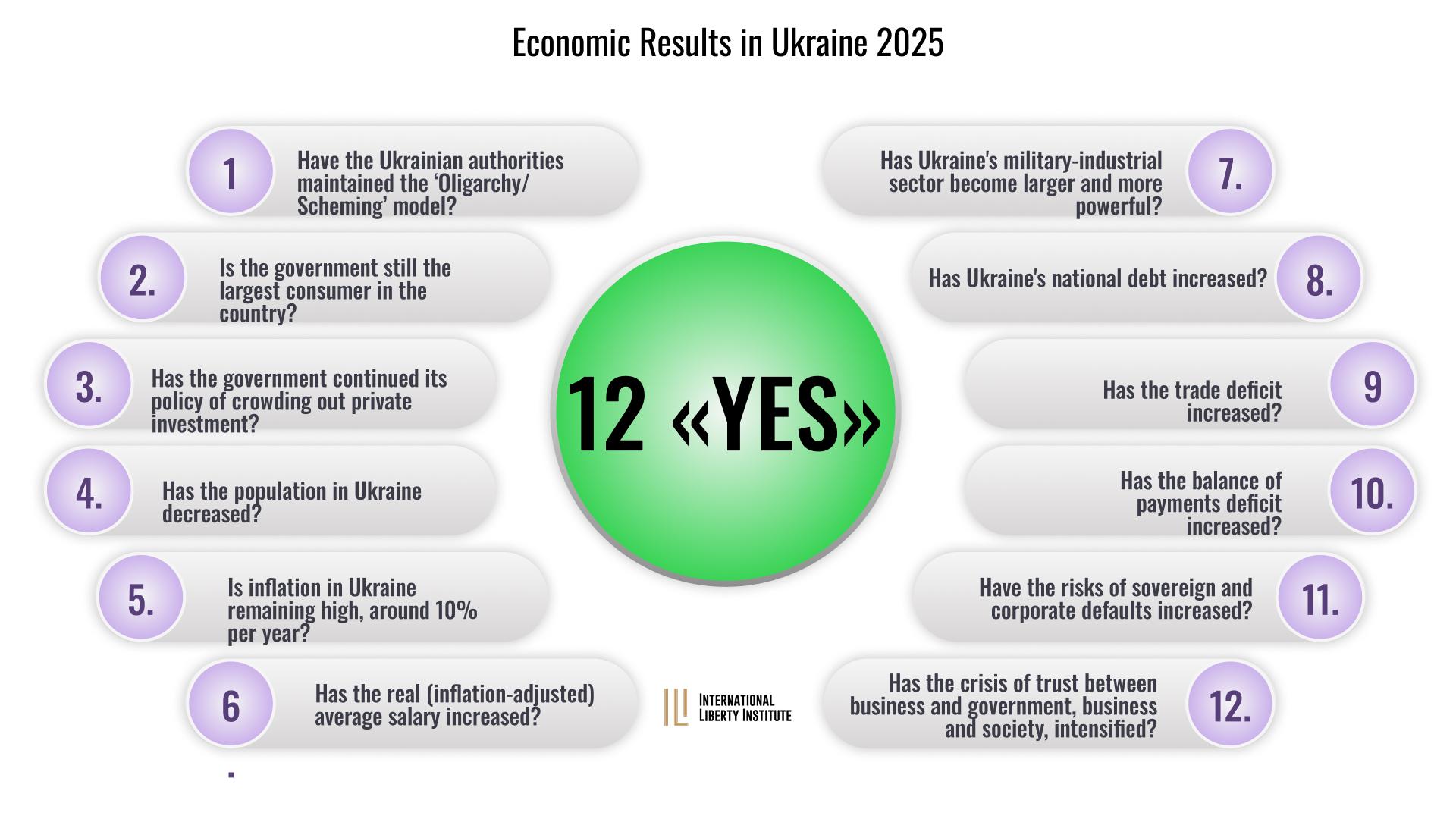
The year 2025 cemented the model of a militarized economy in which the state is the dominant economic agent, and entrepreneurs are merely subordinate executors of decisions. This is not a temporary deviation, but an established system with growing costs of inefficiency, corruption, and lost trust.
Therefore, Ukraine's macroeconomic indicators for 2025 are a natural result of excessive government spending, high tax pressure, discretionary regulation, and weak protection of property rights. Even an increase in investment to 20% of GDP does not mean a qualitative breakthrough: investment is concentrated in the military-industrial complex, energy, and reconstruction of destroyed infrastructure, rather than in the creation of a new market structure of capital. Therefore, Ukraine is not integrated into global value chains.
As a result, Ukraine ended 2025 with an economy focused on survival rather than development. Even in tough wartime conditions, there was still room for decisions that could have strengthened the private sector and laid the foundation for rapid post-war growth. This opportunity was not seized. At the same time, there is still potential for a turnaround: through the dismantling of discretionary regulation, reducing the role of the state in the economy, restoring trust, and truly, rather than merely declaratively, freeing entrepreneurs. It is difficult, but there is no other way to achieve 7–10% growth.
ANNUAL ECONOMIC RESULTS FOR THE YEAR IN 20 NOMINATIONS — BELOW IN THE PDF FILE