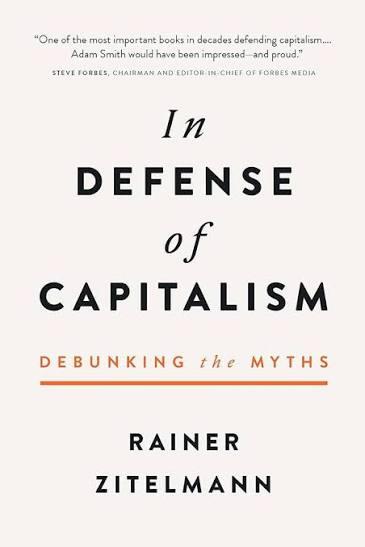
By examining economic and social developments across five continents, the author explores how different countries have experienced economic growth, poverty reduction, and improvements in living standards under different economic systems. The book challenges common misconceptions about capitalism and encourages readers to evaluate economic systems through historical evidence and real-world outcomes rather than ideological assumptions.
This approach helps readers understand that economic progress is influenced by the interaction between market institutions, private property rights, entrepreneurship, competition, and government policies. The author highlights the importance of economic freedom and the ability of individuals to pursue their own initiatives as significant drivers of prosperity.
Zitelmann, a German historian and sociologist, structures the book around illuminating case studies. He begins with China’s transformation after Deng Xiaoping’s reforms, showing how even partial moves away from Maoist central planning lifted hundreds of millions out of extreme poverty and turned a famine-stricken nation into a global economic powerhouse. He then contrasts West and East Germany, North and South Korea, Chile and Venezuela, and examines the effects of market-oriented reforms under Margaret Thatcher in Britain and Ronald Reagan in the United States.
Sweden, often held up as a model of successful socialism, is shown to have prospered most when it shifted back toward freer markets after earlier experiments with heavy state control. Africa receives attention as well, with Zitelmann arguing that market-oriented policies have proven far more effective against poverty than traditional development aid.
The central thesis is straightforward and powerful: the more an economy tilts toward private property, competition, and entrepreneurial freedom, the better the outcomes for ordinary people. Pure capitalism exists nowhere, Zitelmann acknowledges; every real system is a mixture. What matters is the balance. Add more market elements, as China did after 1978 or Chile after its reforms, and prosperity rises. Add more state direction, as Venezuela did under Chávez and Maduro or East Germany under communism, and stagnation or decline follows. The book closes with reflections on the 2008 financial crisis and an exploration of why so many intellectuals remain hostile to capitalism despite its record.
What makes The Power of Capitalism especially valuable is its accessibility. Free of dense economic jargon, it relies on historical narrative, clear comparisons, and data rather than models. Readers encounter not only statistics on poverty reduction and growth rates but also vivid details of everyday life under different systems—empty shelves in planned economies versus rising living standards where markets expand.
In a time when the lessons of the twentieth century risk being forgotten, Zitelmann’s journey across five continents provides a timely and persuasive case that capitalism, for all its imperfections, remains the most reliable engine of prosperity yet discovered.